Sunday, 17 November 2013

Flat field issues solved

I am still in the early stages of getting used to the new set up. With the old system I attatched the field flattener and DSLR and the correct ccd to lens distance was achieved instantly giving full flat frames. The same applied to the FLT110 and the DSLR good round stars to the edge of the field but with the Starlight express camera elongation of the edge of frame stars was noticable. I downloaded CCD inspector to examine the field.
As you can see a clear problem. I didnt have any m48 spacers, thankfully Andrew ( a fellow blogger and member of BAS) has lent me some. A few combinations later and 35mm worth of spacing has produced a much more pleasing result. Good focus and FWHM figures from centre to edge.


 This process was done late evening after returning from the observatory at Great Ellingham. I wanted to give it a test run on a subject until the rise of the comets. I ended with a nice result from 12 x 10 minute exposures on the enigmatic M42. A DDP stretch and saturation gave a good sharp result with lovely structure to the wisps of nebolosity. Guiding was sub pixel accurate.


Comet Fever

Comet fever is sweeping the globe, as we anticipate the arrival of comet Ison. I imaged Ison on the 13th at 05.00. I estimated the magnitude at approx 7.5 still just beyond visual limits. A few cloudy early mornings later it appears we have some excitement. As I write this there are posts on facebook claiming he is upto 5.5 and withing viusal limits. The dawn sky was lightening at pace as I tried 3 minute exposures with the Sxv M25. I also captured comet Lovejoy higher in the sky and captured earlier starting at 02.30. These images were produced by the comet stacking and star blurring in Deep Sky Stacker. A strange result with no elongated stars at all ??? I tried with the 3rd method of what would be double processing on the comet then the stars and recombining the to give a sharp core and stars image. This worked but I lost all the colour????. If you looka carefully there is some structure in the tail of Ison.
I wanted to post something from what was an all night session. I will have another go with them and also want to create an animation for them both too. Watch this space.

         Comet C/2012 S1) Ison                                                                                                                 Comet C/2013 R1) Lovejoy

Sunday, 3 November 2013

5 hours processed M81,M82

I am getting to grips with the Starlight Express camera from using the DSLR. This is the first time I have captured 5 hours worth of data. Registered in Maxim DL and processed in Images plus. (Pixinsight trial ended the other day). I know I will revit the processing workflow for this one but here it is at present.


B33 Dark Nebula. The Horsehead.


I have been using Maxim to calibrate the files as I was struggling with Pixinsight batch preprocessing. I am very pleased with the detail in the flame nebula.

 
2 hours worth of data here. still not happy with the gradient in the centre.

Sunday, 20 October 2013

Lunar Landscape

I have been clearing out a few old image sets from the now sold 90mm to find an unpublished moon image. Avi converted to an image via Registax6. Approx 1000 frames taken.
 

Saturday, 19 October 2013

Pixinsight Processing.

I don't mind admitting that Pixinsight is a difficult programme to get to grips with. I am currently running the 45 day trial. I am struggling with the preprocessing script. I have taken a series of 5 minute subs on M81,M82 over several nights. I made a small error and did not plate solve correctly and the 2nd night was not framed quite the same. As it happens that was the least of my worries. The first attempt was jus light frames only. Darks, Flats & Bias frames captured on night two. These images are from just those light frames processed by Andrew Luck at our Great Ellingham observatory. Andrew's skill in using Pixinsight is obvious to see, with the stunning wide field vistas he is producing. Please take a look at what his QHY9 is capturing at  http://blog.andrewluck.me.uk./ .
I had preprocessed with Image Calibration and Image Intergration to obtain a 3 hour exposure. I was amazed at how tight the stars were even when cropping. The new Ioptron IEQ 45 mount is astounding in it's guiding capabilities. I have a pic of a lovely even graph. (but I cannot find it)

Right so here we have a cropped image of the pair. There was a serious hot pixel problem which pixinsight gave a good attempt to remove despite no dark frame intergration. Andrew has followed a standard workflow to enhance the master frame. The real skill is knowing how much stretch, Tweaking, adjustment to make before thee next tool is used. I have tried with the same master. Not quite the same result. I also post on my facebook page and the Breckland AS page too https://www.facebook.com/?ref=home#!/groups/176906152365752/ like and join the page to follow all my frinds images.
The processing of the M82 Galaxy was a real treat to watch as it emerged from the hidden data.
I hope you agree a fantastic piece of processing to
get such detail from the core. Testament to the
SXVm25c too. I would like to test the Canon 40d on the same subject to do a comparison in the depth of detail captured. Please ignore the hot pixels. I am still struggling to remove them despite now having the darks. I mentioned earlier that I was trying to get to grips with the preprocessing script. It / I have an issue with my flat fields. It will not accept there is a signal there and refuses to combine them to a master. I have now managed to create a flat manually. Next issue I have come across occurs with the light frames in the preprocessing script it debayers ok and now cannot locate any stars in the frame. I have tested the whole process using Maxim and everything combines with no issues.
 I would consider myself a patient / tolerenat person god know I need to be in my line of work. But I am just so frustrated with it. I feel at the moment somewhat demoralised by the lack of consistent workflow guides and explanations given on various web pages. I seem to get problems in every step or script I try. Very pleased again with the detail in and around the core. Don't get me wrong it is an amazing piece of software. I am sure there are many who are in the same boat as me. I would like to hear from anyone who is? By now I was desperate to combine those new light frames giving me a total of 5 hours of light. I ran the whole set through Maxim and the flats really make a difference from the vignetting I could see on the 3 hour master. I have yet to play with it using the pixinsight processes but I will not be defeated and will post an update. Watch this space..........I have never using the old set up been capable of 5 hours worth of usable data. Even the smallest of stars are perfect. Sorry for banging on about it but this has really impressed me and I think given me a platform to produce some future stunning images. So in conclusion I am down, but certainly not out, the Jury is out and a verdict no yet reached. How many days of the trial left ?????


Thursday, 3 October 2013

New versus Old

I forgot I took these when setting up and testing the new scope and CCD. Approx 40 minutes exposure from each camera of the lovely M27

Canon to the left                                                                                                                           Starlight to the Right


Old favourites

The new set up is better than I would have hoped. Shame the skies have not been so cooperative. However last friday was beautifully clear. I wanted to capture and old favourite a target I was familiar with to put the scope & camera to the test. Guiding was absolutely flawless, sub pixel guiding for ever 3 hours. Captured in 5 minute subs these are the hugely cropped images of M81 & M82 processed in pixinsight by fellow blogger Andrew. It was amazing to see the workflow used by Andrew to pull out the detail in the pair of galaxies. I have also darkened the sky background.


I have a small issue with hot pixels which will be addressed, but I just wanted to get some photons on that CCD. I also have a William Optics 50 mm finder scope which other astrophotographers have used their guider. I think I will have a go and use the GT81 with the 40D Canon. I hope you liking the first results.

Wednesday, 11 September 2013

Iris Nebula

I have made a few modificationss to my motorfocus system that was on the 90mm. I have extended the plate and made a 90 degree turn so it can fit the 110. Well it works. The weather not so favourable though. A small patch of sky to the north was still clear. So I had my first go at the Iris nebula. Recently imaged by a few other Breckland society members. I managed an hours worth of data in 5 minute subs. This is a cropped image from the SXV-M25C. I am not happy with the colour though. The blue needs to be stronger.

Friday, 6 September 2013

M33 The Triangulum Galaxy.

 The weather recently has been quite good. Forecast was excellent and clear the whole night. No work either for me this week so I decided to go an all nighter. Happy that the mount was working fine, I decided that 10 minute exposures would be the order of play. My Eastern view is excellent and suffers no light pollution so should not be too detremental of the Canon 40D in noise. I managed to grab 220 minutes in total in 10 minute subs. As this is a test for the new set up I have yet to take 10 minute darks, so no darks subtraction. Stacked in DSS and processed in Imagesplus I am pleased with the result. Pic 2 is a reprocess by fellow Blogger Andrew via his pix insight software. Considerable difference in detail. I may just have to invest in. Just not sure if I have the time at present to learn a whole new processing pathway.


First test of the mount

Having completed the set up and install of cables etc. time has come to test the mount from it,s initial switch on. I aimed at a familiar target and let PHD do it's set up. My first test shot was a 10 minute exposure this would have been a personal record in itself. The second was 20 minutes and the third 30 minutes. to say the least I was very excited in seeing an image appear like these on the screen.


I am very pleased with the initial results and I want to look into recording the periodic error, using the data from that to guide more accurately.

I used the familiar Canon 40D as the imaging camera, I am of course used to it's set up and user friendliness. I would restrain myself and set up the starlight express when I am happy everthing works.

It appears everything is working well.

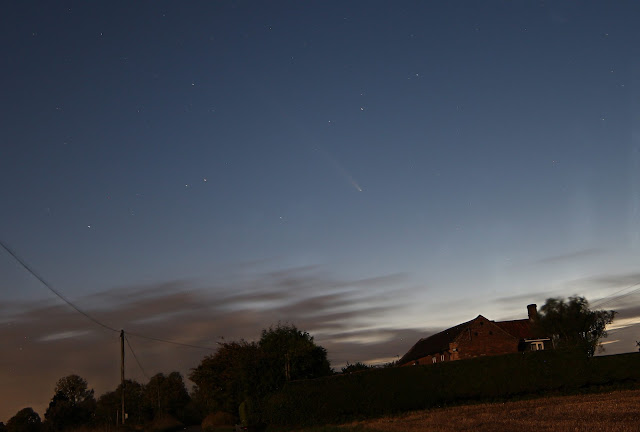
Comet Tsuchinshan-ATLAS, C/2023 A3 , Comet A3,

  A cosmic wanderer, Comet Tsuchinshan-Atlas or more commonly known as Comet A3 has traced its elliptical path through the solar system, a j...