Showing posts with label Leo. Show all posts

Wednesday, 31 May 2023

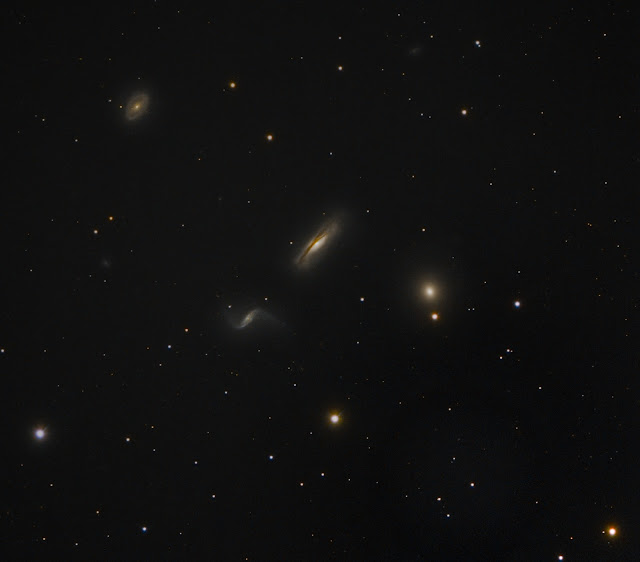
Hickson 44

I have long known about the ARP (The Atlas of peculiar Galaxies) but not known a great deal about the Hickson group of galaxies. 

I was playing with Stellarium looking for a new group of galaxies in Leo when I by chance found the Hickson 44 group. As always I do a google search and check out what the group looks like and found the group to be really interesting. 

The Hickson 44, after Canadian astronomer Paul Hickson, is a group of gravitational bound four galaxies about 100 million light-years away in constellation Leo. Other names include the Leo Quartet and the NGC 3190 Series. The two spiral galaxies in the center of the cropped image are edge-on NGC 3190 with its distinctive dust lanes, and S-shaped NGC 3187. The bright elliptical galaxy lower right is NGC 3193 the spiral in the center lower portion is NGC 3185.

Just 12 x 3 minutes per RGB filters used here, so a little over and hour and a half in total. Very pleased with the result and definitely worth a deeper view next spring.


Thursday, 1 April 2021

Leo Triplet

 I swear it is only ever clear the night of and after a full moon. Just my luck really, We have not had any decent nights for a while it seems, I wanted to get out and do something. I bought from                 U.K. Astronomy Buy & Sell (astrobuysell.com) a new Optolong  L Pro filter a light pollution filter that is more and more needed even in my rural location. Optolong LPS filter L-Pro for deep sky nebula consteallation photography-Optolong Optics Co.,Ltd

My only real unobstructed view is to the East and is the town of Watton is just 3 miles as the crow flies so the glow of the town radiates into view and the filter is needed. So my first test was the beautiful Leo triplet of galaxies. This image was taken over two nights using the filter and worked well I think. Only a very small gradient was noticed after some aggressive processing which was easily removed. I am quite happy with this image after some really poor seeing and the guiding on the first night never achieving better than 1.2 arc sec (usual average is 0.75.

59 x 5 minute sub exposures controlled with the ASIair pro2, stacked in Deep sky stacker and processed in Photoshop.


This trio is now accepted as part of the M96 group of galaxies and then part of an even larger group still.  I think to the accepted idea is also that M66 is a disturbed Barred Spiral. The front arm certainly looks like it has seen tidal interaction by a passer by whilst the rear arm looks somewhat undisturbed.


Wednesday, 10 March 2021

M96 & M105

 The universe never fails to amaze me of it's vast size and complexity. The 4 large galaxies seen here in the constellation of Virgo contain over a hundred trillion stars between them at an average distance of 30 million light years ish. When you look a little closer though you will see 360 small boxes. Hidden behind each one is another galaxy so distant it has taken the light of some over over 12 billion years to reach us. Every other point of light you see here are stars within our own galaxy.


Wednesday, 25 February 2015

A trio in Leo.

Unfortunately I have been ill and off work these past few months and my astronomy has taken a back seat. along with my cycling and my passion for just about everything that means the world to me.  I have been outside just 3 times since. I am now thankfully on the road to recovery with the support of my wonderful partner & family plus some great close friends. Mentioning no names Des & Phil oops, and once again my love for astronomy and everything else is returning. Also a big thanks also to all my colleagues that have asked after me at work. most of which have a gander as to what this astro geek gets up to at night. I enjoy talking to you guys & gals about my amazing hobby.
 -------------------------------------------------

Looking back over some old images. I found the ever popular Leo triplet of galaxies. Taken with the Canon 40D. I knew I could improve on it so that was the nights target. Taken through the Williams Optics GT81 and using 20 minute guided sub exposures. Calibrated with Dark frames in Maxim DL5. Processed in photoshop. This final cropped image is 3 hours of data. A very pleasing result Perfect focus and some lovely lane structure in all 3 galaxies.


Me being me I wasn't just satisfied with that. So I loaded Carte Du Ceil and had a closer look. I downloaded the PGC Principle Galaxies Catalogue and brought up my field of view.  The field lit up with large number of very little red dots. I loaded side by side Photoshop with my image. It soon became very clear that I had a deep image. The 15th- 18th magnitude galaxies were easily visible. After finding a few dozen I thought I should mark them and see how many I could find. There was a few places I must have missed as I seem to be adding more each time I    look. So far the total is 153 and counting.

The fainter galaxies were somewhat more of a challenge.


The image has been plate solved and I needed this to locate and verify the position of the objects that were barely visible even at 400 x  zoom in Photoshop. But I did find that an inverse of the frame gives greater contrast as some of the faintest smudges are just a couple of shades brighter than the background.

Incredibly small movements in the mouse movement moved the RA and DEC by arc seconds across the frame and CDC confirms the location of PGC 3542189. As I mentioned earlier the subtle difference in colour in the centre of the square with a contrast boost and inverted. reveals the presence of this Magnitude 20.31 Galaxy. Position confirmed as RA:11:18:17 and 
DEC :13:03:11. Unfortunately I am unable to find any information on the galaxy type or distance / redshift other than it has been catalogued.

 ------------------------------------------------

 I just picked up on my emails to learn  that our society http://www.brecklandastro.org.uk/ will again host the presenters of the Sky at night programme for a piece based on the HST. and it's deep field images. I think I will point the scopes next clear night and put in a contribution of my own deep field. They may be interested in what I have just done as well as a previous post on M97 & M108 with some very distant quasars. We will wait and see.
Monday, 2 April 2012

If it wasn't for bad luck

       I would have no luck at all. Is how the saying goes. Mystic Malc predicted a couple of weeks ago that we would indeed have a good week of clear skies last week. So we did, BUT I was not going to see any of them. Last monday to this Sunday inclusive was my first set of  nights on the night shift this year. Here continueth the run of bad luck.
      So if we skip back to last May I dismantled my observatory and packed everything away while we moved and of course missed Sn2011dh in M51 last June. Whilst I was building the new observatory last September I missed sn2011fe in M101.
      On the 23rd of Feb this year I imaged a wide field inc M95

and of course saw no Supernova See pic.Tonight is my first night at home again and guess what the clouds have rolled in. Am I destined to miss every Supernova.


To continue the run of misfortune. Last night 10/4/12 saw a reasonably clear. Google said the clear sky wouldn't last so I hastily set up and focussed on a set up star. Here in is where the problem lies M95 was a good 60 degrees across the sky and I completly forgot to refocus. Looks like a tenth of a mm out. But the good news is I have managed to get my first image of the sn2012aw.

Thursday, 23 February 2012

Galaxies here, there, everywhere

This is a lovely image of 2 hours 44 Minutes Iso 1600 in 2 minute subs, autoguided and  dark subtracted,  Near perfect focus on a myriad of M's, NGC's and IC's.  You will of course recognise M95 a beautiful barred spiral 38 million light years away. the Brighter M96 a mere 31 Million LY's. M105 the giant eleptical now known to have a super massive black hole in it's belly. A multitude of other Ngc's and a few IC's, all collectivly known as a member of the Virgo super cluster.

Sunday, 12 February 2012

80 Million Light years away.

My first night outside in nearly a month. Keeping an eye on the forecast, looked like Norwich would cloud over around midnight. I wanted a galaxy group in Virgo that were still low on the horizon unfortunatly they would be up too late to get a couple of hours worth of photons. So I spun the mouse over stellarium and it settled near a couple of little round hoops in Leo. A quick goto and I had settled upon a trio of fuzzies. Beyond reach optically on my 90mm refractor, but a minute test image at 3200 Iso revealed a mist in the centre of the frame. I set up a run of 2 minute guided exposures and returned inside. -10 in the garden was a little to harsh to want to stay outside.
This just over 1degree image shows you a galactic trio of NGC2964(Upper right), NGC2968(centre) and NGC 2970 (Lower Left) with an interval of 6 arc minutes at the northern part of Leo's head. A righthand spiral is NGC2964, has a long axis of about 3 arc minutes and 12th magnitude in brightness at a distance of 72 Million Light Years. And to its left is the irregular galaxy of NGC2968. You can just make out the eliptical galaxy to its left again Mag 14.5 NGC 2970 Both galaxies are about 80 millions light years away and have interacted in the distant past.

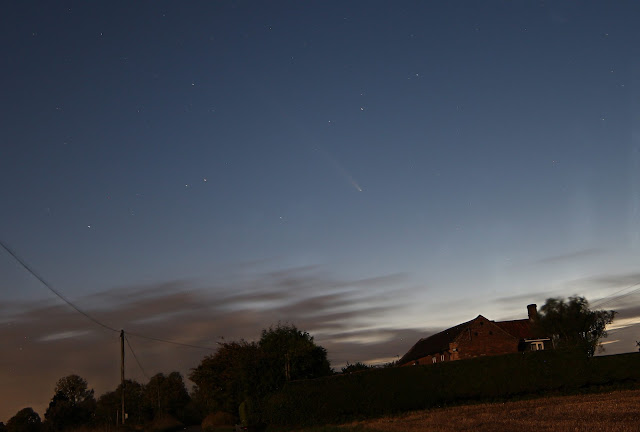
Comet Tsuchinshan-ATLAS, C/2023 A3 , Comet A3,

  A cosmic wanderer, Comet Tsuchinshan-Atlas or more commonly known as Comet A3 has traced its elliptical path through the solar system, a j...