Showing posts with label Deep Sky Stacker. Show all posts

Sunday, 17 October 2021

67P/Churyumov–Gerasimenko

5 years ago now I witnessed one the most incredible feats of engineering skill man has created thus far, not happy with just dropping into orbit around Comet 67P but sending a lander onto the surface too. With gravity at 1/10000 that of earth Philae didn't quite manage to stay put when the cold gas thrusters and harpoon failed to operate. So it bounced twice and settled, wedged into the side of a hill. 


Beautiful imagery was captured and returned by the Rosetta spacecraft detailing the shape and structure. Resembling a peanut shell (image above courtesy of Rosetta) this 2 lobed comet has tumbled through the solar system for billions of years. 

I have been keeping an eye of it's location each night in the hope of a capture worthy of posting. But in typical UK weather the clouds rolled in after less than ten minutes of imaging time against the lovely backdrop of Messier 35.  My intent was an RGB image through filters and using the comet stack in DSS to keep both stars are comet a pinpoint. However plans were scuppered after 7 minutes through the red filter.


Just had a look back at my comet images and this one will be my 16th Comet imaged to date.

In no particular order we have:


All of my previous comet images can be found in the previous pages of my blog.


Wednesday, 20 August 2014

Another Once in a lifetime Comet. C/2014 E2 Jacques

We have been treated to a few bright comets over the last year and once again treated to another dance across the heavens. A possible collision event somewhere deep in the Oort cloud has sent another cosmic interloper to grace our skies. Comet C/2014 E2 Jacques is a long period comet of approx 30,000 years, so last seen 1200 generations ago when the Neanderthals and modern man were developing stone tools and art whilst enduring what was earths last last ice age.....
I too have endurred a few recent problems with the DDG focusser on the FLT110 scope and will need to be replaced for sure. So I have for the purpose of this comet removed the Starlight express and replaced it with the Canon 40D. Better for short exposures on what was the guide scope William optics GT81. Offering a nice 2.6 x 1.7 degree fov. The GT 81 boast a flat field lens which performed well on it's first test with the Canon. No coma issues at all.

So my aim was to:
Capture enough frames to put together an animation showing its motion.
Use Deep sky stacker software to Comet stack, Star stack and merge the two together.
The final result is noisy for two reasons capture was @Iso 1600 and there were no calibration frames used. (no time to acquire them) It is also a shame that 4 minute exposures was never going to be long enough to capture the Heart & soul nebula that it lies between in my image.

So first up the animation. 14 frames of 4 minute exposures separated by 1 minute intervals.
Next the comet stack from Deep sky stacker. Sigma clipped to remove most of the stars.
 
 
Final processed image of star field & comet.


I think I will also try the same process in maxim as the stars are not right. But for now it is another comet bagged & tagged.
 
That reminds me I will have to dig out some of my comet Hale Bopp photos and scan them in and post. Them were the days when comets had 2 tails you could see naked eye. We need another Hale Bopp.
 

Thursday, 23 February 2012

Comet 2009 P1 Garradd

I had a great night Saturday night. Typical thought just had a week off for half term. and I have to return to work on Sunday so It's up at 6.00 ish. I finally rolled closed the roof at 02.30 and into bed by 02.45. I found it difficult to sleep as all I could see was the lovely comet Garradd. I swear I could almost see it moving in the eyepiece. It certainly did move over a period of an hour. I used Deep Sky Stacker to stack comet and stars. So there is a bit of noise present. None the less I just love the 2 tails. It was almost 3D looking at it through a 25mm 2" eyepiece on the 90mm refractor. So a stack of about 47 Minutes Iso1600. No dark calibration. Just a ddp stretch and a colour boost.

Sunday, 1 March 2009

Comet Lulin (C/2007 N3)

Object: Comet Lulin (C/2007 N3)
Type: Comet
Constellation: Leo
Date: 1st March 09
Equipment: William Optics Megrez 90 Canon EOS 40D Subframes: 11 x 30 second exposures unguided at ISO1600
Processed: No darks or flats were captured. Processed in Images Plus 3.75 with a small non linear stretch or DDP
Having just given our newborn her midnight bottle and tucked her safely in her crib. I looked out the window.

Guess What I Saw ??
Finally we have had a few hours of clear sky and this was my first view of comet Lulin. I spent 15 minutes or so looking at it through my 26mm 2" meade eyepiece through the 90mm refractor. I couldnt see any colour as in the west south west direction is our local town of Watton (only 3 miles away) and a significant amount of skyglow was creeping higher and higher as the clouds and moisture content increased. .

As Lulin is composed of frozen ice, dust and gases. Cyanogen gas and diatomic carbon present in it, when irradiated by sunlight, make it appear green.

I quickly connected up the camera and for the first time used Images plus 3.75 DSLR control for a series of exposures. This image was taken between 1.50 am and About 2.15 am Several frames removed from stacking as cloud passed by. I stacked them to keep the stars at pinpoint so the comets nucleus looks a little elongated. I also used the windows picture viewer and flicked through all the frames at high speed and it was amazing to see how fast the comet is now now moving across the fixed background stars. If I can find a simple animation programme I will will make an animation of its motion.

I am amazed there was a secondary point of interest here. The tail of the comet has passed across 4 NGC galaxies marked on the frame. The faintest of which is mag 15.00 and I can just confirm its there. Not bad for 5 and a half minutes of exposure.

Not the best pic I have taken by far simply because of the sky quality and all I kept was 11 subs from the 30 or so I had taken, A fraction on the heavy side of processing to see the tail and those 4 galaxies.
For fear of no more clear nights I reflect on another beautiful looking comet and the thought of its journey and possible return in 50 million years time.
God speed comet Lulin.

Thursday, 12 February 2009

Rosette Nebula

Object: Rosette Nebula NGC 2244, NGC 2237
Type: HII Emission Nebula
Constellation: Monoceros
Date: 3rd february 09
Equipment: William Optics Megrez 90 Canon EOS 40D
Subframes: 27 x 30 second exposures unguided at ISO800 & 10 x 30 second darks. No filters were used. Stacked by Deep Sky Stacker.
Processed: In Images Plus 2.0 with a DDP stretch.

Notes: Image taken under moonlit conditions.
NGC 2237 is generally the name given to the whole of the nebulous region & NGC 2244 is the cluster thats believed to be responsible for the stellar winds from a group of O and B stars are exerting pressure on interstellar clouds that cause compression, this initiate's star formation in the nebula. This star formation is currently still ongoing.

Back In Time: At a distance of 5200 light years. It was a time when Unification of the first ancient Egyptian states marked the beginning of the Ancient Egyptian civilization.


Wednesday, 4 February 2009

M42 The Great Orion Nebula


What an amazing night transparency excelent apart from the 62% moon in the way.

I thought I would have another go at M42. I wasnt happy with the previous posted image, well that was really just a test to get the PHD to work ( still no luck ). Apologies for slightly elongated stars.

Object: M42
Type: Reflection & Emission Nebula 1270 Light Years Distant.
Constellation: Orion
Date: 24th January 09
Equipment: William Optics Megrez 90 Canon EOS 40D
Subframes: 30 x 30 second exposures unguided at ISO800 and
Processed: 10 x 30 sec darks were captured & subtracted. Stacked using Deep Sky Stacker,
Processed in Images Plus 2.0 with a DDP stretch. 10 Iterations on a adaptive Richardson Lucy deconvolution filter.
Notes: This cropped Image was taken under a 62% illuminated moon.

Any exposure over 30 seconds was badly washed with moonlight so I kept it to that and the result is excellent. I also used Deep Sky Stacker programme for the calibration and stacking it was very easy to use and a great deal quicker than manual registration of each image. I used med fine quality JPEG as I have a small problem when I ask it to use RAW even with an empty card the camera says it is full and will not take an image.

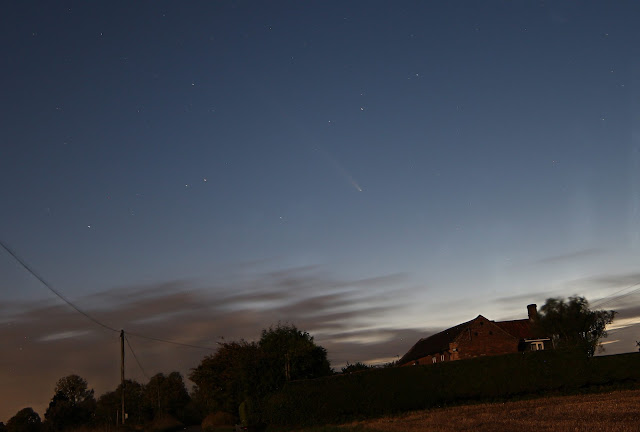
Comet Tsuchinshan-ATLAS, C/2023 A3 , Comet A3,

  A cosmic wanderer, Comet Tsuchinshan-Atlas or more commonly known as Comet A3 has traced its elliptical path through the solar system, a j...