Showing posts with label NGC 205. Show all posts

Thursday, 30 September 2021

M31

Almost a year ago was my M31 Globular clusters project. A fantastic project capturing a staggering 244 globular clusters associated with M31.

A year has passed and another M31 image is forthcoming. This time captured in HaRGB with my newish Mono camera, filter wheel and filters.

All of course captured with the ZWO ASI Air pro, a wonderful little device that has seen countless updated that include plan mode now. This allows an imaging run of multiple targets during a night. It allowed me on this occasion to run an imaging session on M31 swapping over filters and running the autofocus routine after each swap. It ran flawlessly.

So we have a basic stretch on each of the filters and a final combination giving a total of 4 hours, 1 hour on each filter.

Red


Green


Blue


Ha

4 hour Combination HaRGB

Crop


Overall I am very pleased with the image despite no calibration frames used at all here.


Friday, 18 September 2020

Andromeda Globular clusters.

 I stumbled across a great website by Steve Gottlieb https://www.astronomy-mall.com/Adventures.In.Deep.Space/gcextra.htm who has spend some time studying the globular clusters of M31. Several hundred were found categorised and published first by Edwin Hubble in 1932, As many as 509 globulars in M31 have been catalogued based on spectra plates taken at Mauna Kea with the 3.6 meter Canada-France-Hawaii telescope, (Crampton et al, 1985), although recent work indicates that some of these are faint background galaxies. In any case, the M31 globular cluster system does appear to be more numerous than our own galaxy by roughly a 2:1 ratio. This important article provides identifications, positions, magnitudes, colours and radii although no finder charts are given.

A few nights ago I was testing the ASIAIR Pro auto focus and aligned on The Andromeda Galaxy. An hour later I stacked an hours worth of data and stretched it. I was truly amazed I was able to resolve 2' clusters @>mag15. Resolving deeper & longer is a passion of mine and my project a few years ago labelled hundreds of PGC galaxies in the Coma Cluster, this intrigued me from the outset and I had to see how many I could find in M110 (NGC205)

It didn't take long to find them all.


My image is on the left. incredible detail for just 1 hour of exposure. Spectacular rounds stars with of .42 arc second guiding accuracy.


My next project during the new lockdown will be to catalogue the Globulars in M31. I have found quite a few already but it looks like it may take a while.

Monday, 1 October 2012

A billion Stars

Been a little busy recently, Going on holiday, Back to work, A set of nights, Sending eldest daughter to University, all plays havoc with the astronomy. I have been playing a bit with Maxim DL. I am trying to use the auto focus setup procedure and combine automation with exposure control. I still have a slight DEC drift and need to re centre the image by a few arc seconds every other exposure. So just trying to get everything sorted out. Andromeda was at a nice elevation so I thought I would have a little test.

This shot 2 Hour 13 Minute exposure in 3 & 5 minute subs. No dark frame subtraction, Flats or bias taken. Iso 1600. Canon 40D through my imaging set up. Comparing it to the others I have taken I think it is the best hands down. I would appreciate any feedback too!

My own criticism is that if I had taken a few short exposures I could tease out a little more detail in the core. Easily remedied as maxim has saved the camera rotation angel when I plate solved the image. So another visit sometime soon I hope. I might consider sending it to sky at night mag too.

Friday, 6 August 2010

In a galaxy far far away

I was saying the other night to a fellow member at our societies observatory that I shall spend the rest of the summer taking obscure faint fuzzies as most of the big and bright objects have been covered. Then Barry says well there is always room for improvement. True I said especially as I now have the field flattener so I think it may be the time to improve on a few of the objects previously imaged and cropped considerably because of coma. I was going to image the Cocoon nebula last night then realised that imaging at the near verticle will cause the camera to hit the mount. I could see the Andromeda galaxy naked eye well above the neighbours rooftop so I thought yeah lets have ago. Seven seconds later I was focused and set up a run of 90 pics. I didnt bother firing up the guider as I have no problems with 60 second exposures when facing east.

Comparing it to the previous image a bit further down the blog I am very pleased that there has been no cropping and a greater depth of focus has returned a very pleasing result.


Object: M31 The Andromeda Galaxy


Type: Galaxy

Constellation: Pegasus

Instrument: William Optics Megrez 90mm, William Optics MkIII field flattener.

F/stop: 5.52

Exposure: 1 hour 23 minutes

IS0: 1600

Date: 05/06/Aug/2010

Location: Saham Toney Norfolk.
Enhancement: Images Plus 3.82 DDP stretch and 3 Sharpening iterations.

Sunday, 27 September 2009

Andromeda Revisited

A revisit to the great Andromeda spiral galaxy on thursday took another 40 minutes worth of images including some 5 minute guided. About 60 minutes worth of darks subtracted aswell. Have had a play withe the processing to get a more pleasing colour. I dont think there was enough detail on shorter exposures on the previous image. Now i think it has become a great deal smoother. I do have a stock of flats and bias frames, so I may be back with another. I do have a few issues with coma however so I have cropped as best I can Let me know what you think.


Object: The Great Andromeda Galaxy
Type: Galaxy
Constellation: Andromeda
Date: 24th - 25th September 09 11.40 01.40am
Equipment: William Optics Megrez 90 Canon EOS 40D guided using 66mm William Optics refractor & Atik 16IC camera.
Subframes: 15 x 1 minute exposures at ISO1600, 4 x 5 minute ISO 1600 and 8 x 2 minute exposures approx 60 mins of darks subtracted
Stacked: by Deep Sky Stacker.
Processed: In Images Plus 3.75 with a DDP stretch.

Saturday, 29 August 2009

M31 Andromeda Galaxy


With the new job requiring many hours of my time. I finally had the opportunity go go outside last night. Things didnt go well. I went through the usual processes polar align scope, check balances, focus DSLR, connect guide camera (bugger) I think I have broken it. In connecting it up I power up first as required then tried to plug the USB into the ST4 port I heard an electrical crack sound and immediatly removed the plug connected to the USB socket and nothing. I powered down and reconnected several times but to no avail.

I continued the evening by just taking about 20 x 30 second exposues at ISO 1600. Deep sky stacker co added the images and Images plus has processed with a DDP stretch. Unfortunatly by now I had lost all interest it what I was doing but I this is my first shot of Andromeda so I wanted to post it anyway. I have emailed Atik and awaiting a reply as to what to do with my poorly camera.

Wednesday, 13 August 2008

Persied Meteor Through Andromeda


After a couple of hours at our Great Ellingham observatory. We saw 4 or 5 meteors.

Came home and set up the Canon EOS40d on a tripod and connected the remote shooting software. I cought this fine meteor at 00.43 13/8/08. You will notice it perfectly disects the Andromeda galaxy.


30 second image ISO1000 Delicatly processed by Barnfield Bob (thanks Bob)

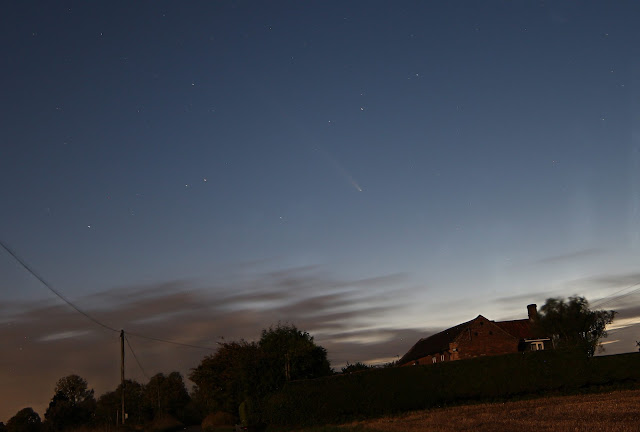
Comet Tsuchinshan-ATLAS, C/2023 A3 , Comet A3,

  A cosmic wanderer, Comet Tsuchinshan-Atlas or more commonly known as Comet A3 has traced its elliptical path through the solar system, a j...