Showing posts with label Reflection Nebula. Show all posts

Monday, 3 January 2022

M45 The Pleiades


Unchanged for eons. The Pleiades or the 7 sisters look the same today as they did for the first humans that walked the earth 1.9 million years ago. Without doubt the most beautiful and most recognisable of all the objects we can see in the night sky, this cluster of stars shine and reflects a hypnotic blue light onto dust that the stars are passing through. There is even a bronze age 1600bc artifact called the Nebra sky disk that is believed to depict the cluster. Located at a distance of around 400 light years. This means the light we see today left at the time Galileo Galilei made his first observations with the first telescope.


Nebra Sky Disk image first published Dec 2006 Copyright Dbachmann

Galileo's drawings of the Pleiades star cluster from Sidereus NunciusImage courtesy of the History of Science Collections, University of Oklahoma Libraries.

Saturday, 7 November 2020

Pleiades

A star cluster known to every civilisation and buried within the folklore across every culture on the planet, The Pleiades or the seven sisters is probably the most recognisable of all the 88 constellations. I think also the best example of a reflection nebula. Containing over a thousand members mostly of hot young stars. Slowly moving through space through an unrelated dust cloud, the dust is illuminated by light and the energy of the stars.


I love the way the dust is sculpted in front of the stars Maia & Merope.


Just under two hours of exposure time captured in 3 minute exposures using the ZWO ASI294MC pro, Calibrated with Flats, Darks and Dark Flats The first real test too using the new auto focus routine with the ZWO EAF focuser. All I can say is incredible, A quick and simple procedure that takes 2-3 minutes and can be incorporated into the autorun of a sequence. You can add a change to focus via temp difference or time. A Video to follow.


Thursday, 21 June 2012

Cocoon Nebula Wide Field

Having spent a night last week imaging some delight from the south. Upon processing the smallest stars appeared as donut shaped. My focus was off my 100th of a mm test images looked ok but it wasn't until they were stacked and processed you could see there was a problem. So last night was really just a test to try and put in place a good focussing technique. I started with π2cyg a 4.4 mag star less than 3° from my target. I use my bahtinov mask to achieve a near perfect focus. I then switch to Imagesplus and fine tune using the FWHM process. Overall I was pretty happy with what was done. Time was now gone 1.00am and work loomed for the next day. So I ran a 30 x 1 minute exposure at Iso1600. Deleted 2 subs and stacked a series of 28 frames to give me this shot. High in the North east under a very poor sky. I will endeavour to have another go later this year when positioned in the west and a good dark sky.

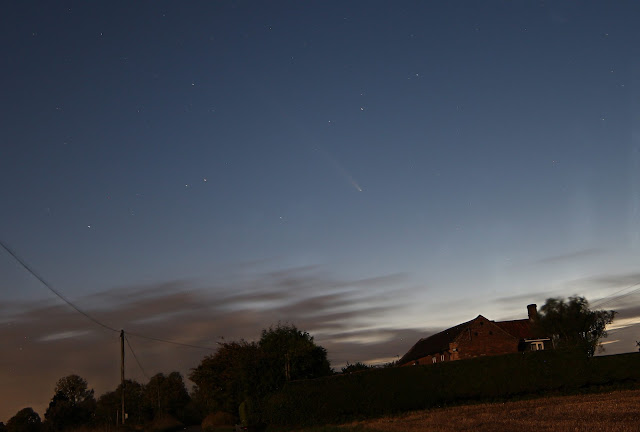
Comet Tsuchinshan-ATLAS, C/2023 A3 , Comet A3,

  A cosmic wanderer, Comet Tsuchinshan-Atlas or more commonly known as Comet A3 has traced its elliptical path through the solar system, a j...