Showing posts with label Asteroid. Show all posts

Sunday, 2 April 2023

A galaxy and an asteroid.

I don't think I have attempted to capture Ceres before but here we have it by chance as I put the new scope through it's paces on galaxy season. I was going to continue with my M95 project previously posted when I scrolled around Stellarium to see Ceres placed in the frame with M100. After a few lunar captures earlier I set an autorun for a few hours of data. Having a few calibration frame issues with the Flats not working properly, had a similar issue last year but a new set of flats with a higher ADU value solved the problem.

So here we have a massive crop of the original frame to show the beautiful M100 in all it's spiral glory. 


A few details on Ceres.

The largest of the catalogued asteroids at just under a 1000km in diameter, Ceres roams the solar system at an average distance of 400 million Km's. Ceres was discovered in 1801 after the prediction of another body between Mars & Jupiter.

Thursday, 3 June 2021

Juno

 The dark is a lonely place.

Since the formation of the solar system some 4 billion years ago, millions upon millions of rocks or asteroids are caught in an endless dance in orbit between Mars & Jupiter. 99.9% are no bigger than a London bus but some just some are a little larger.
Travelling at 18km per second I managed to capture movement of approx 32,000km during 30 minutes worth of exposure last night of the 320km asteroid 3 Juno. You can see from the cropped image the elongated shape due to the movement over that time. I have created a little repeating animation of the 15 frames to show the movement.


Juno was the 3rd asteroid discovered in 1804 and believed to be about the 10th largest in size.


Friday, 21 February 2014

Near Earth Asteroid 2014 CR


A near-Earth object (NEO) is a Solar System object whose orbit brings it into proximity with Earth. 2014CR pictured here in the little box was captured by me tonight It will pass the earth in the next 2 days approx 8.3 times further than the moon. Not considered a hazard to us, but if it were at
an estimate of 130 metres it could do a great deal of damage travelling at 27.000 MPH. When you consider that the meteor crater in Arizona was formed by an object
just 50 metres across. Food for thought hey...................

Cropped image from the original below.


Full Frame with no darks/ flats used. hence the dust donuts.


Stellarium screen print from 21.00 hrs tonight.


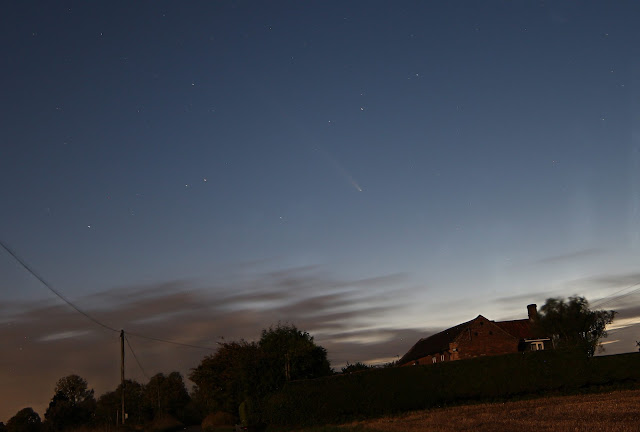
Comet Tsuchinshan-ATLAS, C/2023 A3 , Comet A3,

  A cosmic wanderer, Comet Tsuchinshan-Atlas or more commonly known as Comet A3 has traced its elliptical path through the solar system, a j...