Showing posts with label M13. Show all posts

Sunday, 13 August 2023

M13 The Great Cluster

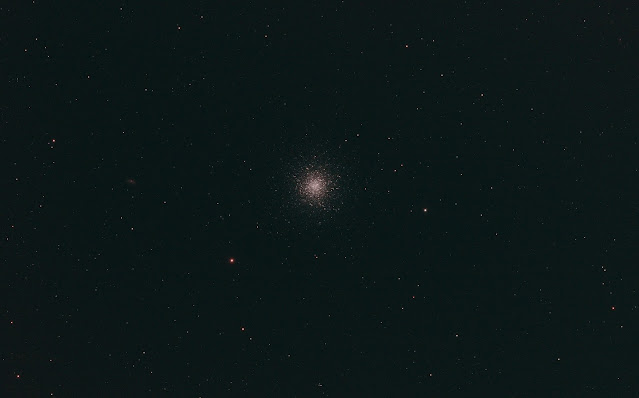
Without doubt the finest of globular clusters visible in the northern hemisphere. Located outside the plane of our galaxy and some 25,000 light years away.

An easy target to find.

M13 is located in the constellation Hercules, between summertime’s two brightest stars, Vega and Arcturus. About 1/3 of the way from Vega to Arcturus, locate the four modestly bright stars forming the Keystone of Hercules. On the Arcturus side of the Keystone, M13 lies between the stars Eta Herculis and Zeta Herculis.

A typical binocular field is about 5 to 7 degrees in diameter, and the Hercules cluster is found about 2.5 degrees south of Eta Herculis. The Hercules cluster’s position is Right Ascension: 16h 41.7m; Declination: 36 degrees 28′ north.

M13 was one of my first targets I captured many years ago. The cluster will not have changed since it's discovery over 300 years ago,  but my imaging and processing have. This Image is just 1.5 hours of data using the ZWO RGB filters, 30 minutes per filter.


Cropped image


Processed in Pixinsight.

Monday, 1 June 2020

M13

A beautifully clear night on Saturday in Saham.  M13, a globular cluster composed of several hundred thousand stars tightly bound by gravity and at a ripe old age of 11.66 billion years old some of the oldest stars in the galaxy. I am getting used to the new set up now, better balance and thus better guiding numbers. RMS 0.4 for 30 1 minute exposures.


Saturday, 25 April 2015

New Life in an old focuser

I tested a replacement focuser for the 110mm unfortunately it doesn't fit due to the 4" fitting on the 110. Having removed the existing I decided to have one more bash at trying to get the darn thing moving. I have the technical diagram for the focuser and decided to adjust the bolts that state should only be adjusted by an engineer. What the heck it's busted so what's the worst I can do. Fix it!!!!!

So 20 minutes later I have a reasonably smooth movement going, readjusted the tension to take the weight of the field flattener and camera. On it went and bingo it worked in both directions. I don't think I want to remove the camera ever again.......


A rebalance of the scopes was required to bring back the Starlight camera back into operation. 
A lovely flat field test has resulted in sharp round stars at the edges of the frame too. I took 40 sky flats and created a decent master. Dark frames also captured for a full calibration. I like to use a median setting in Maxim DL as this gives best removal of hot pixels. 5,10 & 20 minute guided exposures have given me a very smooth finish. Processed in Photoshop. The best image of M13 I have taken has resolved stars to the core. The somewhat forgotten Ngc6207 is showing structure and threre are a few more little galaxies easily visible. A PGC galaxy 3515221 can also just be seen at mag 19.64. This side by side inverted image and CDC chart confirms its location.


An inverted image of the core

Saturday, 24 May 2014

M13

A test of the set up was required. So I rebalanced and ran PHD of a target much lower in declination than M106. I wanted something bright and easy so M13 was an easy choice to make rising nicely in the North east. I ran the guide programme for 5 minutes with no issues. Fingers were crossed and I ran 5 x 20 minute exposures as a test run really. Calibrated in Maxim DL and processed in photoshop. All I done to process was levels and curves. No unsharp masks or colour correction. Very pleased the core of the structure was not overcooked. A close inspection of the image had shown a faint galaxy between M13 and NGC6207. Carte Du Ceil shows it to be a PGC (principle galaxy catalogue) designation PGC2085277 a mag16.15 galaxy some 2500 times further away than the galactic cluster M13. Delving deeper I found 31 in total as deep as 19.22. Some showing as a marginal brigtening of a pixel or 2 but still there. call up a 2 degree FOV in Carte du Ceil and see how many you can capture too. You may have to download a few extra catalogues though.

Thursday, 12 April 2012

An old favourite

After studying M13 through your telescope, imagine now the sky as from deep within the cluster. We would see uncountable numbers of blazing stars, many as bright or brighter than our naked eye planets. Inhabitants on a planet inside M13 would probably know nothing of the Galaxy and other galaxies, as their view would be completely blocked by the brilliance of their own skies. To them, the Great Cluster in Hercules would be "the Universe".

I wanted to try a few exposures at a low Iso and see how well the processing would keep noise to a minimum. The sky has remained very dark as the DDP stretch in Images Plus increased and teased out more detail. I wanted to capture more detail in the core, under saturating the chip at 400 ISO has worked well. Stacked in Deep Sky Stacker this is only 10 x 2 minute guided exposures. (This time I remembered to refocus after the alignment setup)

Wednesday, 4 May 2011

M13

We have been graced recently with some great clear nights. 5 in a row at last count but tonight was the 1st without the wind. So on goes the canon. I have said now a couple of times this may be the last pic for a while as I am moving, but the clear skies just keep on coming!!!

Anyway onto the good stuff. This is a slightly cropped and DDP processed image of 20 x 300 second exposures at ISO400.

It never fails to amaze me the sensitivity of the cameras just seems to get better. We can now image detail in the nearby 12th mag ngc6207. No longer just a fuzzy blob next to it.

About 124 light years in diameter M13 contains a few hundred thousand stars.

Monday, 12 May 2008

M13 The Great Hercules Cluster


Monday 5th May.


An historic day. My finished observatory has seen first light and to celebrate the event I pulled an all nighter ( well Very nearly).

The first target was M13 in the constelation in Hercules. I was initially happy to spend the evening just being able to achieve focus and get everything working. Having achieved this reasonably quickly I set about some imaging.

28 x 30 second unguided exposures using

Canon EOS300D / William Optics Megrez 90mm refractor / Processed Using Images Plus 2.0

I am very pleased with this first attempt.

Your comments are appreciated.


Thursday, 28 February 2008

Deep Sky M13

M13 The Great Hercules Globular Cluster.
This Image was Taken through The 10" Orion Optics reflector at principle focus with a Canon EOS300d DSLR. A stack of 6 x 30 Second exposures stacked in Images Plus V2
This as my first attempt a deep sky Imaging.

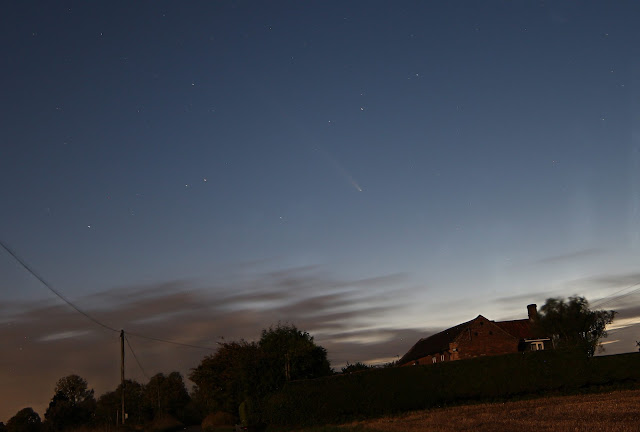
Comet Tsuchinshan-ATLAS, C/2023 A3 , Comet A3,

  A cosmic wanderer, Comet Tsuchinshan-Atlas or more commonly known as Comet A3 has traced its elliptical path through the solar system, a j...