Showing posts with label M12. Show all posts

Tuesday, 23 May 2023

M12


Not a great deal has changed in the 259 years since its discovery by French astronomer Charles Messier, M12 is a densely packed cluster of hundreds of thousands of the galaxies very oldest stars estimated to be over 13 billion years old, bound by gravity this cluster is 75 light years in diameter or about 435 trillion miles in length in comparison that would be approx. 74,000 yes seventy four thousand times the size of our own solar system of planets.

It took the new horizons probe 9.5 years to get to Pluto so that would mean it would take another seven hundred thousand years before it arrives at the majestic M12.

This image is an RGB combination of 20 x 120 second exposures using all 3 filters so a total of 2 hours combined data, processed in PI.

Considering this for me is very low down and just above the fence line I am very pleased with the result.


Thursday, 14 May 2015

M12 More than pleasing to the eye.

The globular clusters in the Milky Way are all estimated to be at least 10 billion years old and therefore contain some of the oldest stars in the galaxy. They contain an abundance of low-mass red stars and intermediate-mass yellow stars, but none greater than 0.8 solar masses. There are about 150 known globular clusters in the Milky Way. It is thought that globular clusters formed very early in the vast halo surrounding the nascent galaxy before it flattened to form the spiral disc. Star formation would have stopped in these clusters maybe 13 billion years ago, so only old stars are expected to be found there.

Described by Charles Messier as a nebula without stars, it's discovery almost 251 years ago this May 30th. M12 is fine example of a globular cluster, appearing to me visually in my 110mm as a compact dense core with a fainter outer shell. I have the luxury of shielding myself from extraneous light inside the observatory but I still like to cover my head with a dark towel and allow just the faint photons of light to touch the retinas. Somewhat smaller than M13 my eyes are drawn to the triangular shaped 3 stars to it's lower left resolving them to starlight points easily. I wanted to highlight that with this image taken Tuesday night with what was one of the best clear nights of the year. Just over 20 degrees above the horizon and tainted with the light from the nearby town of Watton. I limited exposures to 10 minutes and this was just about the limit as a gradient was becoming a problem. 2 Hours in total calibrated and stacked in Maxim and processed in Photoshop using several layers in an attempt to keep the core stellar like. My focus was a fraction off as 12th+ magnitude stars show a little blooming, noticable when stretched so I have sacrificed some of the background stars. Having never image M12 before I am pleased with the result.

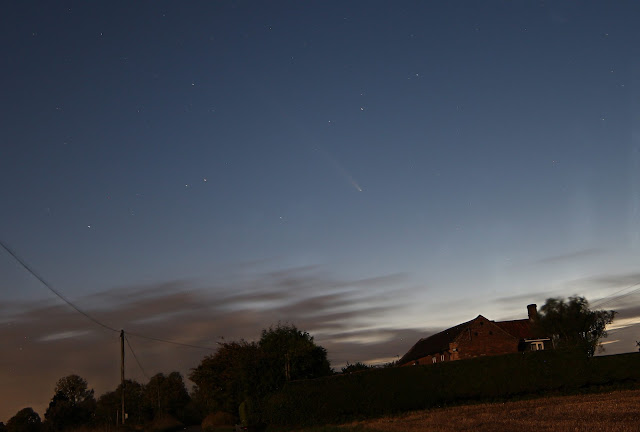
Comet Tsuchinshan-ATLAS, C/2023 A3 , Comet A3,

  A cosmic wanderer, Comet Tsuchinshan-Atlas or more commonly known as Comet A3 has traced its elliptical path through the solar system, a j...