Showing posts with label Emission Nebula. Show all posts

Saturday, 11 December 2021

IC410 The Tadpoles.


As I may have mentioned before on my facebook page and even on here too the last 5 plus weeks of weather have been truly awful. However, 2 nights from Friday last week have been cold and clear but somewhat spoilt by the approaching full moon. So the filter wheel has rotated to the HA filter and the start of 2 projects IC410 & IC405 are born.

IC410 is a dusty emission nebula located in the constellation of Auriga at about 12.000 light years from Earth. It is part of a larger star forming region that also contains the Flaming Star Nebula (IC405). The gas structures in this picture are lit by the radiation from the open star cluster Ngc1893 that lies in the center of the nebula. This star cluster is about 4 million years old, but in astronomical terms it is still very young, with hot, massive stars. Just right of the star cluster two more dense structures are visible. Affectionately known as The Tadpoles these two structures are approximately 10 light years long these are similar to the famous Pillars of Creation and they are composed of dust and gas leftover from the formation of the star cluster and are very likely to give birth to more stars in the future. As can be seen in the image, these structures point away from the center of the nebula. This is because of the stellar winds and radiation pressure from the stars in NGC 1893. The really do look like they are trying to get back to the centre.


    25x 5 minute Ha subframes.

    Tadpoles crop
    Looking a little closer they really do look like tadpoles.

Lets hope for a few more hours of data to complete a Hubble Palette image.
Watch this space:

Image Details

  • Total Exposure:  2 Hours, 5 Minutes ( 25 Frames) x 5 Mins Ha (10/12/21)
  • Image Acquisition: ZWO ASIair Pro
  • Camera Settings:  ZWO ASI2600mm pro Gain 100, 0°C
  • Accessories: ZWO 7 position Filter wheel
    •                Optolong narrowand filters 
    •                ZWO broadband filters
    •                ZWO EAF
  • Calibration Frames: No Calibration
  • Stacking and Calibration: DeepSkyStacker
  • Processing: Adobe Photoshop 2020, 
  • Size: 2.26 x 1.38 deg 
  • Pixel Scale: 1.41 arcsec/pixel

Friday, 2 July 2021

First Light as promised IC1396 The Elephants Trunk Nebula.

To the left is a 3 hour calibrated frames desaturated from the colour of the 294mc pro, to the right is 20 x 3 minutes frames calibrated from the new Mono camera. One error I made was setting the camera at gain 100 so stars are a little bloated. I am not interested in anything other than it's sensitivity and noise levels. Test 1 pretty incredible.


Friday, 14 May 2021

Rosette Nebula.


The long winter nights have gone but some of those iconic targets are not forgotten, had a reprocess on this winters attempt of the Rosette Nebula. I think over the years my processing style has changed and improved, I like a more natural colour palette. Saying that I am looking at a full mono set up with LRGB HSO filters. Just 45 minutes worth of data here captured using the Optolong L-enhance filter in my ZWO filter draw.


The Horsehead Nebula

The winter months were not great from my location, that and the bloody tree facing due south, I only managed just over an hour on this iconic target, it beats too the image I took when featured on the Sky At Night Programme when Pete Lawrence visited our Society Breckland Astronmoical Society to celebrate the 25th Anniversary of Hubble. New image at top.  I know heavily cropped but an amazing difference in camera technology and processing technique.


Tuesday, 26 May 2020

The Crescent Nebula.


The Crescent Nebula (also known as NGC 6888Caldwell 27Sharpless 105) is an emission nebula in the constellation Cygnus, about 5000 light-years away. It was discovered by Friedrich Wilhelm Herschel in 1792. It is formed by the fast stellar wind from the Wolf-Rayet star WR 136 (HD 192163) colliding with and energizing the slower moving wind ejected by the star when it became a red giant around 250,000 to 400,000 years ago. The result of the collision is a shell and two shock waves, one moving outward and one moving inward. The inward moving shock wave heats the stellar wind to X-ray-emitting temperatures.

Captured with the new ZWO ASI294MC Pro and Esprit ED100 and controlled via the ASI air pro. An amazing piece of kit, Those of you who are thinking about one to use with their ZWO cameras and many DSLR's I cannot put into words as well as a cut and paste. Coped from the website from Widescreen-Centre where Simon & Julian have been amazing with my questions and ultimate order from them, throughout their service, advice and professionalism has been superb.

ZWO ASIair PRO Smart WIFI Accessory for Portable Astro Photography with ZWO ASI Cameras and dSLRs

NEW FEATURES OF THE ASIAIR PRO


PRO SOFTWARE FEATURES

The new Asiair Pro comes with amazing new features such as Live Stacking, Automated Meridian Flip and more!
The Asiair app is compatible with iOS, iPadOS and Android, plus through emulator software you can run it on Apple laptops or computers as well.

IMPROVED STORAGE

A 32GB TF card provides 20GB free space for the user, plus the included 64GB U-Disk (USB memory) provides additional storage. If necessary, further storage can be added by user provided external storage.

POWER OUTPUTS / INPUTS

DC 12V@5A (Min voltage is 11.5V; Max supported current is 6A).
4 output ports; 12V input is recommended, but do not to exceed a total of 6A on all ports, as too high current will cause overheat problem.
The voltage and current of power outputs are 12V@3A.
The port type for the power outputs is 2.1*5.5mm center positive.

IMPROVED MOUNTING

ZWO redesigned the case for easier and more stable mounting by using the dovetail bar on your scope or a clamp.

NEW CNC-MACHINED ALU CASE

A beautifully designed and machined CNC case contains the new electronics. Aluminium is excellent for dissipating heat, whilst there is almost no effect on the WIFI signal.

So after that I am sure you have convinced yourself that is an amazing bit of kit. 

33x 5 minute guided exposures using the Optolong Lenhace narrowband filter has brought out details never capture previously by me. Stacked in Deep sky stacker and processed in Photoshop. 

Thursday, 21 June 2012

Cocoon Nebula Wide Field

Having spent a night last week imaging some delight from the south. Upon processing the smallest stars appeared as donut shaped. My focus was off my 100th of a mm test images looked ok but it wasn't until they were stacked and processed you could see there was a problem. So last night was really just a test to try and put in place a good focussing technique. I started with Ï€2cyg a 4.4 mag star less than 3° from my target. I use my bahtinov mask to achieve a near perfect focus. I then switch to Imagesplus and fine tune using the FWHM process. Overall I was pretty happy with what was done. Time was now gone 1.00am and work loomed for the next day. So I ran a 30 x 1 minute exposure at Iso1600. Deleted 2 subs and stacked a series of 28 frames to give me this shot. High in the North east under a very poor sky. I will endeavour to have another go later this year when positioned in the west and a good dark sky.

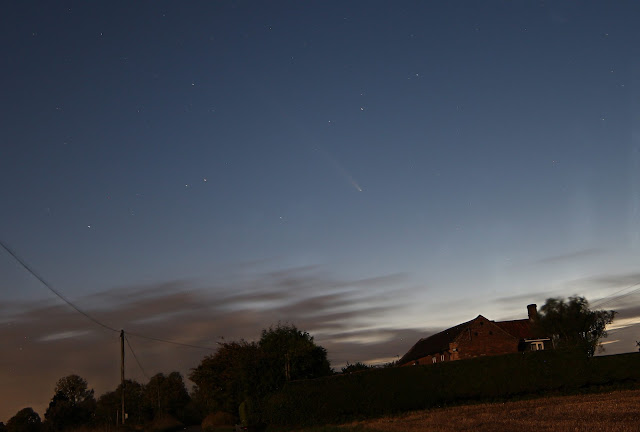
Comet Tsuchinshan-ATLAS, C/2023 A3 , Comet A3,

  A cosmic wanderer, Comet Tsuchinshan-Atlas or more commonly known as Comet A3 has traced its elliptical path through the solar system, a j...