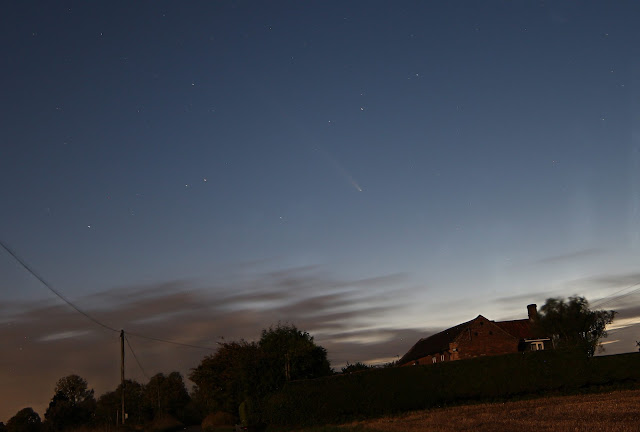
As mentioned previously there was a bright moon not far away at the time of capture.
I am happy with the dusty stuff captured. One thing I have noticed Blogspot appears to brighten the images a fraction from my original.


 Last nights clear night saw the first test of my new Auto focus system from JMI and HiTech Astro from the very speedy and efficient Rother Valley Optics I called them Weds am and was promised a call back as they were busy completing an order. As promised they called back and was offered excellent advice saving me £70. A promise was made for delivery tomorrow. I have to admit I was holding back a laugh when he said it. Sure enough to his word it arrived the following day via courier. Set up was simple the motor just fits between the locking screw for the focusser and a hood onto the 10-1 focus knob. The control box was pre wired with a cigarette socket plug, lucky for me my now redundant dew system used the same connector and a power supply was hooked up. I downloaded the ASCOM drivers and it was recognised by the laptop instantly. I use both Imagesplus and Maxim for image acquisition and connection to the 2 programmes was simple.
  M2 (NGC7089) is one of the largest globular clusters consisting of approximately 150,000 stars
located within our galaxy at a distance of approximately 36,000 light years.
Estimated to
be 13 billion years old, almost as old as time itself. A lovely view at high power resolve the cluster into a swarm of bees. Even with my Megrez 90 I am pleased to resolve nearly all the way to what is a very dense core. Once again Iso 800 works well with the clusters and an hour of 2 minute guided exposures. A fantastic well illuminated wide field has not required a need for flats here.
M2 (NGC7089) is one of the largest globular clusters consisting of approximately 150,000 stars
located within our galaxy at a distance of approximately 36,000 light years.
Estimated to
be 13 billion years old, almost as old as time itself. A lovely view at high power resolve the cluster into a swarm of bees. Even with my Megrez 90 I am pleased to resolve nearly all the way to what is a very dense core. Once again Iso 800 works well with the clusters and an hour of 2 minute guided exposures. A fantastic well illuminated wide field has not required a need for flats here. Stacked in Maxim DL and processed in Photoshop this 1 hour exposure at Iso 800 has had no darks, flats, or Bias frames. A minimal DDP stretch. I find with globulars less is more with the processing. A pleasing result and very happy being being able to resolve stars to the core of M71
A cosmic wanderer, Comet Tsuchinshan-Atlas or more commonly known as Comet A3 has traced its elliptical path through the solar system, a j...