Showing posts with label Orion. Show all posts

Saturday, 24 December 2022

Horsehead Nebula

I would like to say the year would not be complete without an image of the beautiful Horsehead Nebula. This is one object that I just wish was half it's 1375 light years distance from us. It would truly be a spectacular sight filling the winter sky. I am hoping for some more clear sky to complete the HAGB project. So far we have 16 x 5 minute sub frames.


I am so incredibly pleased with my set up, a few people recently have posted issues with the ZWO EAF and I can honestly say thankfully I have had no issues with it achieving nothing short of perfect focus 100% of the time. So I thought I would do a serious crop of the horsehead and yes the Blur exterminator plugin has been run. It will certainly be after Christmas now for the remainder of the data for a HaGB colour image, Ha data looks great so far for 1 hour 20 minutes. 


Sunday, 9 January 2022

My Bucket list.

Ok so lets talk about distance particularly the speed light. 

In a vacuum,  we know that light travels at 670,616,629 mph. So If a little context is needed light from the moon takes 1.3 seconds to arrive at our eyes, Saturn is 1.3 light hours away a measly 0.0001505453985955772 light years distant. So what is a light year?

quite simply the distance light travels in a year 5,878,625,370,000 that's nearly 5.9 Trillion miles. Ok so back to the point I wanted to make IC434 or the Horsehead nebula is an immense cloud of thick dust obscuring star birth inside it and in galactic terms the Horsehead is an insignificant 3.5 light years in diameter but when you compare that against our solar system and our distance to Saturn it would be a huge two hundred and twenty one thousand three hundred and forty four (221,344) times the distance. 

If you ever needed reminding SPACE IS BIG.

My image was captured 2 nights ago at my home observatory with about 4 hours of data. Over the years I have taken many images of this target and I was lucky enough back in April of 2015 to appear in an episode of the Sky at night celebrating Hubble's 25 year Anniversary. One ticked off my bucket list anyway.


Stack of 40x 3 minute Ha frames.


My new laptop has amazing processing power, attempted several times previously to process a starnet++ starless image, it failed several times, introduce Mr Dell and it processes a colour starless image in less than 2 minutes, a chunk of star reduction and hey presto a lovely update to mt=y first process.


Friday, 14 May 2021

The Horsehead Nebula

The winter months were not great from my location, that and the bloody tree facing due south, I only managed just over an hour on this iconic target, it beats too the image I took when featured on the Sky At Night Programme when Pete Lawrence visited our Society Breckland Astronmoical Society to celebrate the 25th Anniversary of Hubble. New image at top.  I know heavily cropped but an amazing difference in camera technology and processing technique.


Sunday, 14 March 2021

M42 The Orion Nebula

A last look at the Great Orion Nebula for a few months. Unfortunately for me it disappears behind the front of the house about an hour past the meridian so a very limited window of capture now in March.

Anyway a short capture of 20 x 180 and 20 x 30 seconds images taken with the ASI294mc pro on the ED100 via the ASI AIR Pro.  Calibrated and stacked in Deep sky stacker and processed in Photoshop. I am always amazed how smooth the result is and even with a huge crop on the Trapezium the resulting image is incredibly clean. One confession to make though for the pixel peepers, the 4 stars of the Trapezium have been made round removing slight halos from processing.


Saturday, 25 April 2015

The sky at Night.

I can finally tick off appearing on The sky at night tv programme from my bucket list. I was lucky enough to have my image of the Horsehead nebula appear with myself and Pete Lawrence on the programme. The interview involved 2 pieces to camera with a number of questions asked. Final edit and broadcast was reduced to about 30 seconds. As mentioned before this is the second time the team has visited Breckland AS. An open invite was given to return if we can offer anymore future programmes.

Monday, 29 December 2014

First post for a long while, Last one of the year.

Due to illness this has been my first post for a few months now. It was great to go out to my observatory and dust off the cobwebs and roll back the roof. I am lucky in that once I have powered & set up approx 10 minutes I can then control all my imaging from the comfort of inside the house. No more endless hours in the cold. Through the 35 years or so I have been an astronomer I feel i have earned & done my time in the cold. I was surprised that everything was working well. I decided an easy target to get me back into the swing. Due to the moon's presence I limited the exposures to 5 minutes. A total of 2 hours 20 minutes has given me this result. I also took a number of 10 second exposures, so the final result was not to over expose the core. Taken through the William Optics GT81. No calibration frames used. Just processed in Photoshop. I hope to return with longer exposures to capture the outer shell of gas. Looking forward to posting pics of Comet Lovejoy too soon.

Wednesday, 5 February 2014

Reprocessed B33

I started again from scratch and had a complete reprocess of the Horsehead nebula. Combined now will calibration frames it is certainly a good deal cleaner. Plus I believe practice makes perfect and I am getting more adept at being more subtle with the techniques of Photoshop, less each time is certainly more!. I have also discovered it is to be turned into A3 size and printed very soon, cant wait to see it.
As mentioned previously there was a bright moon not far away at the time of capture.
I am happy with the dusty stuff captured. One thing I have noticed Blogspot appears to brighten the images a fraction from my original.


Sunday, 12 January 2014

The Horsehead Nebula.

With a magnitude -11.8 moon causing a little concern. I thought I would have a play. I have imaged the Horsehead a few times before so I was not banking on a perfect image. I must admit though I am again impressed with the sensitivity of the camera and scope. I captured 3 hours in 20 minute sub frames.
 Processed in photoshop only using levels & curves. An unsharp mask & high pass filter has done wonders on the dusty stuff & blended using layer masks. A subtle saturationboost and noise filter applied to complete.

Sunday, 3 November 2013

B33 Dark Nebula. The Horsehead.


I have been using Maxim to calibrate the files as I was struggling with Pixinsight batch preprocessing. I am very pleased with the detail in the flame nebula.

 
2 hours worth of data here. still not happy with the gradient in the centre.

Wednesday, 8 February 2012

Runaway Horses

I remembered I had about 35 minutes worth of data from the UHC filter. I have combined them to the original hour, I think the improvement is noticable.

Friday, 6 January 2012

M42


The last week or so has left us all a bit battered by the winds.
The moons phase equally annoying for a deep sky imager. I wanted to just test everything was still working as it has been over a month since rolling back the dome roof. Last year I was able to test my UHC filter on ngc7000 on a series with and without. So last night I pointed towards Orion and done a series of 3 minute images at Iso 800. I love the colour rendition that the filter gives. A more natural look from unfiltered. M42  I think. Just wish we were a few light years closer!!!!!!!

Tuesday, 29 November 2011

Orions Belt

I am happy I was able to capture all 3 stars of Orions belt.
On the left ζ Ori (Alnitak) 800 light years away and 100,000 brighter than our sun.
In the centre ε Ori (Alnilam) 1340 light years and 375,000 times brighter than our sun.
On the right lies Mintaka a mere 915 light years away and just 90,000 times brighter than the sun. 
Mintaka is also a double star and takes less than 6 days to orbit around each other.
This is a 45 minute exposure at Iso 800 on my Canon 40d
 

Saturday, 14 February 2009

M42 & NGC1977 Over Processed

This image is the same as the one below but i used some very aggressive processing using images plus 2.5. I have done this to see what info I could tease out from the stacked master image. Personally I like to keep the images clean with realistic dark backgrounds so if anything I am happy to under process to get a more pleasing result. I am certainly no expert in imaging but I enjoy the challenge of having a go.


So what did I do.

well within images plus there is a video file with a set of typical preset adjustments for a M42 found in the file named "deep sky image set" you can copy and paste these settings upon your own image , the processes include Pixel Maths, Digital Development, Brightness & levels, Saturation & brightness.

I wouldnt be happy with this as a final result but what amazes me is that the information is there. I love the way the running man leaps from his own nebula and M42,s wings completely encirle and join hands. No colour adjustments were made & I love to see the true colours shine through.
Please your comments are welcomed what do you think

Wednesday, 4 February 2009

M42 The Great Orion Nebula


What an amazing night transparency excelent apart from the 62% moon in the way.

I thought I would have another go at M42. I wasnt happy with the previous posted image, well that was really just a test to get the PHD to work ( still no luck ). Apologies for slightly elongated stars.

Object: M42
Type: Reflection & Emission Nebula 1270 Light Years Distant.
Constellation: Orion
Date: 24th January 09
Equipment: William Optics Megrez 90 Canon EOS 40D
Subframes: 30 x 30 second exposures unguided at ISO800 and
Processed: 10 x 30 sec darks were captured & subtracted. Stacked using Deep Sky Stacker,
Processed in Images Plus 2.0 with a DDP stretch. 10 Iterations on a adaptive Richardson Lucy deconvolution filter.
Notes: This cropped Image was taken under a 62% illuminated moon.

Any exposure over 30 seconds was badly washed with moonlight so I kept it to that and the result is excellent. I also used Deep Sky Stacker programme for the calibration and stacking it was very easy to use and a great deal quicker than manual registration of each image. I used med fine quality JPEG as I have a small problem when I ask it to use RAW even with an empty card the camera says it is full and will not take an image.

Sunday, 25 January 2009

M42 The Great Orion Nebula


Object: M42
Type: Reflection & Emission Nebula 1270 Light Years Distant.
Constellation: Orion
Date: 24th January 09
Equipment: William Optics Megrez 90 Canon EOS 40D
Subframes: 4 x 30 second exposures unguided at ISO800 and
Processed: No darks or flats were captured. Processed in Images Plus 2.0 with a Moderate non linear stretch or DDP. 5 Iterations on a adaptive Richardson Lucy deconvolution filter.
Notes: This cropped Image was taken under heavy light pollution of my neighbouring town of Watton in Norfolk. M42 is the brightest nebula in the night sky buried within Orions sword and is the closest region of star formation.

Back In Time: That means when we look up in the winter sky at the nebula- a star making factory, the light started towards us in the year 739AD... For those of you who are history buffs, that is roughly five years after the death of the Venerable Bede- the monk who wrote the first history of Britain- before the Vikings started plundering their way around Europe!

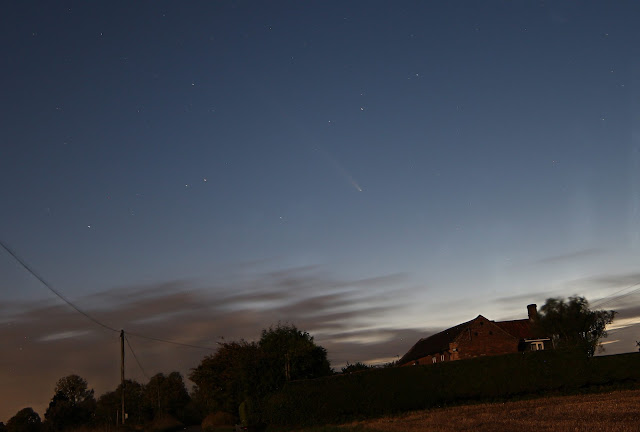
Comet Tsuchinshan-ATLAS, C/2023 A3 , Comet A3,

  A cosmic wanderer, Comet Tsuchinshan-Atlas or more commonly known as Comet A3 has traced its elliptical path through the solar system, a j...