I am very happy with the dust lanes in M81. Dark dust visible circling the galaxy core.
Unfortunatly astronomy for the next week will take a back seat. I am working a set of nights from Monday bad timing with the moon out of the way.
 M103 (Ngc581) is one of the more remote open clusters in Messier's catalog, at about
8,000 light years distant in one of the most recognised constellations of Cassiopeia the queen. Visible in my binoculars against a rich star field it was the last entry to his original catalogue without him actually observing it. Well Mr Messier I have seen it. and I have ticked it off my list. The bright star also visible at the top is Ruchbah or(δ) Delta Cassiopeiae Cassiopeiae. See finder chart. To me this star is a little more interesting than the cluster. It is an eclipsing binary star system consisting of a pair of stars that orbit about each other over a period of 759 days.

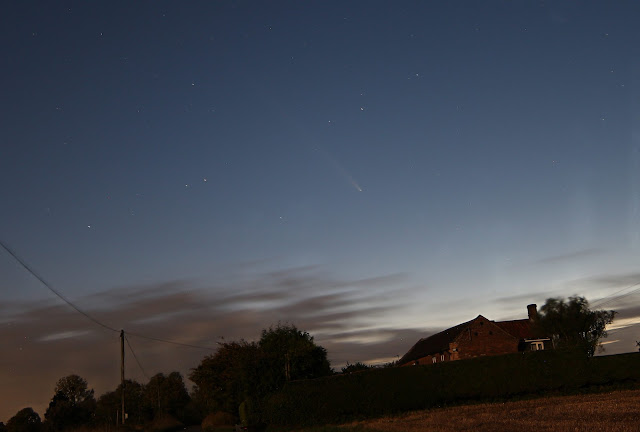
A cosmic wanderer, Comet Tsuchinshan-Atlas or more commonly known as Comet A3 has traced its elliptical path through the solar system, a j...