Showing posts with label Canes Venatici. Show all posts

Wednesday, 5 April 2023

M3

 First discovered in Dec 1764 by French astronomer Charles Messier, M3 is again a globular cluster with over 500,000 stars and an age of a mind blowing 11.4 Billion years old. Easily visible in binoculars or a telescope.


12 x 2 minute exposures in RGB channels combined in Pixinsight. Core Brightness reduction in Photoshop.

Sunday, 26 February 2023

Messier 63

Over recent weeks I have been looking at NINA, a freeware program for the control of our telescopes and connected equipment. I have watched lots of YouTube videos and felt I would give it a try. A very complex programme capable of lots of fantastic features, too many to list off the top of my head, all backed up by a large community of users and a host of additional plugins to create a truly customisable experience. Perhaps it is my impatience speaking here as I am now the proud owner of the new Altair 130 EDT scope and the need for collecting some photons is perhaps leading my frustrations. 

I have been now the user of the ASIair pro for several years and have been more than pleased with it's simplicity and ease of use. A clean user interface and an uncomplicated processes leads to the quick set up and start of imaging. So I thought a new challenge was needed....

When building the observatory I ran a powered USB extension into the house as well as a wired internet to allow the flexibility of future connectivity for wired and wireless To set NINA up I rerouted all data cables via my new powered USB hub and through to the extension cable to inside. Connectivity to NINA was simple opening up EQ Mod and PHD2 all stable with no dropouts to the laptop. Using the sky atlas selecting a target was easy and sending it to the framing tool prepares you for the imaging process. From there is where I found some issues, I ran the Hocus focus plugin a number of times but struggled to achieve focus using a number of filters. Making numerous adjustments to the focus steps in the attempt to replicate the demonstrated parabolic curve. Mine looked more like a top hat with odd dips and jumps. I am sure it is just settings but the frustrations exist that following the videos made no difference I just could not replicate anything resembling a good focus. It has also been a long while since I used PHD 2 and encountered similar issues with guiding calibration and not enough star movements. Aghhhhhh. I don't think it helps that I also feel awful, a really bad cough and cold. So for now I have reconnected everything back to the ASIAir, programmed an autorun sequence on M63, Auto focus has achieved and guiding is currently running at .45 RMS Perfectly acceptable. So for tonight anyway I will enjoy the clear sky and continue with this short run of subs. As of this minute I am at 26 from 40 x 5 minutes frames in LRGB. 

The following night was not so great with 95% humidity. So I have ended up with 19 x 5 minute subs in RGB, the Luminance data was for me too blown out so not used.

The Sunflower Galaxy, also known as Messier 63 or M63 and designated as NGC 5055 in the New General Catalogue, is a spiral galaxy located in the northern constellation Canes Venatici. It lies roughly 37 million light years from Earth and has an apparent magnitude of 9.3.

The galaxy is enormous in size, with an apparent size of 12′.6 × 7′.2. This makes it roughly the same size as the Milky Way galaxy, and it has a mass 140 billion times that of the Sun. It is also believed to have a supermassive black hole with a mass of up to 30 million Suns.


There are a number of fainter PGC galaxies here most of which are a hundred times or more further away. A Pixinsight annotation shows their locations.


Tuesday, 11 May 2021

M106

There are a handful of Galaxies that present themselves at such an angle you get to see the the immense spiral structure, dust lanes and nebulae in all their splendour at once. M106 is one such beauty right above us this evening. 5 minute sub exposures controlled via the ASI air pro2 reveal some amazing structure in the spiral arms and dust. Numerous other fuzzies are clearly visible within the frame and one immediately caught my eye as the first frame came in is Ngc4217. Believed to me associated to M106, Ngc4217 is viewed edge on and has a very prominent dust lane splitting it in two from our perspective.  At 60 Million light years plus away, appears to me in sub frames very much like M104 The Sombrero Galaxy, my meagre 554mm focal length does not do it justice. Ohhhhhhhh for an 11" SCT. 


The screenshot is the a 5 minute sub frame for the ASI Air Pro. A revolutionary micro computer that has dedicated software for communication, Imaging, Guiding, Auto focus, Scope control and filter wheel (not used). The latest beta release now includes planning to allow multiple targets unattended. A typical imaging session starts with rolling back the dome shutter and power up. I have connected a TP Link travel router to provide greater wifi signal for control inside the house. It takes a minute or so to run it's start up and connect to my tablet. This connects automatically to the ASI Air pro and we are away. My permanent set up means polar alignment is not required every session so I can go straight to target and plate solve. I start a plan in tonight's case M106 from there I leave the obsy and return inside the house. It starts will cooling the main imaging camera to -10 then runs the auto focus routine, guiding initiates and starts guiding using multiple stars, when the guiding has settled the autorun of imaging begins. I have auto focus set to run every hour as in the dome I don't think I need the temperature probe.

 Currently into hour 2 and I have rejected a couple of frames as there are a few gusts of wind that cause the guiding jitters. So averaging at just over .50 arc sec guiding very happy with that. Just opened Carte du Ceil to identify a very faint dot around mag 15 to the north west of the galaxy. It identifies it as PGC 39615 a mag 16.05 irregular galaxy. I really enjoy seeking out  and identifying the obscure and faint within an image. 


Saturday, 24 May 2014

The dogs go hunting.

As mentioned in the previous post this was the first time in a month the kit had been powered up. A fellow Breckland AS member has emailed an alert stating a new type II supernova has been discovered near the core of the barred spiral galaxy M106 in Canes Venatici (the hunting dogs). A quick set up and focus gave me the scope pointing near verticle. PHD had it's guide star and ran its set up. A few minutes later everything was ready to go. I programmed my usual 20 minute exposures and left it to it. I returned after the first image to find everything had gone haywire. PHD had lost its star nearly 15 minutes earlier. I spent the next hour running tests and shorter subs not to capture anything worth keeping. All I could manage was 3 x 3 minute exposures. Even these show elongated stars. Very annoyed.

 It appears that a star 23.5 million light years away a rare red supergiant star ended it's life in the most violent way. Nuclear fusion burns in it's core creating heavier elements. Fusion stops at the production of iron from Silicon. With no more energy being created to continue cooking the elements, Gravity takes over, collapsing the star and the resulting shockwave tears the star apart. Barely visible here the nova is situated just to the left of the bright core.

The only that redeems itself is the capture of a few NGC's. NGC 4248 just below M106. below him the pair NGC 4231 & NGC 4232 Bottom left is NGC 4217 & lower right NGC 4220.


Friday, 18 May 2012

M63 Sunflower Galaxy

The first clear night in 5 weeks. I was desperate to get out and roll back the roof. M63 was my target. A central disk surrounded by a wealth of short spiral arm segments. A cropped 30 x 2 minute guided exposures at Iso 800. I am not really happy with the image. Sky quality was not amazing. I was just glad it was clear. I think a revisit will be required soon!

Monday, 26 March 2012

Galactic Globulars M3,M53

I cant believe the good run we have had over the last week five from five here in Sunny Norfolk. I am feeling a bit gutted too as I have missed Breckland Astronomical societies first star party & I have a week of night to do starting tonight so the skies are bound to get even better!!. I shouldn't complain either as I have addeed a handful of Pics to my own messier chart

Having bagged a few galaxies this week I turned my attention to the old and weary (globulars) that is....

M5 & M53 became the clusters of choice.  

                      M5

Astronomers like Messier, Kirch, Koehler & Bode all described their first observations of M5 back in the mid 1700's as a nebula without stars. It wasn't until 1783 when William & Caroline Herschel viewed through their 7  & 20 foots reflector. it was resolved into the myriad of stars we can capture today. Although Caroline still mistook it for a comet.

 M53 & Ngc 5053

M53 and NGC5053 are shown in this field. M53 is the bright globular cluster in the centre; NGC5053 is the dimmer globular cluster in the lower right. ngc5053 is about 53,500 light years distant from Earth which is close to the distance of M53. This puts both globular clusters relatively close to each other in space. I had made a slight miscalculation and thought I could not fit both in the same field of view. I only looked at the framing of M53 in my test image. I will have to have another go sometime framing them both appropriately.

Wednesday, 27 April 2011

M3

I was not going to give up on the chance of was last imaging run before we move and be without a working observatory over the summer months.

A few outside lights left on by my soon to be ex neighbour caused a few issues so I reduced the ISO to 400 and let off a few 5 minute exposures. This image was a total of 1 hour 20 minutes with a DDP stretch and star spikes. I am quite pleased with result despite the fact it is not the perect focus I have achieved before.

Sunday, 10 April 2011

The cosmic shiner

The last few nights has seen some lovely clear skies, despite light pollution from the local town of Watton approx 3 miles away and  a 30% illuminated moon. I thought I would have a go at M64 The Blackeye Galaxy


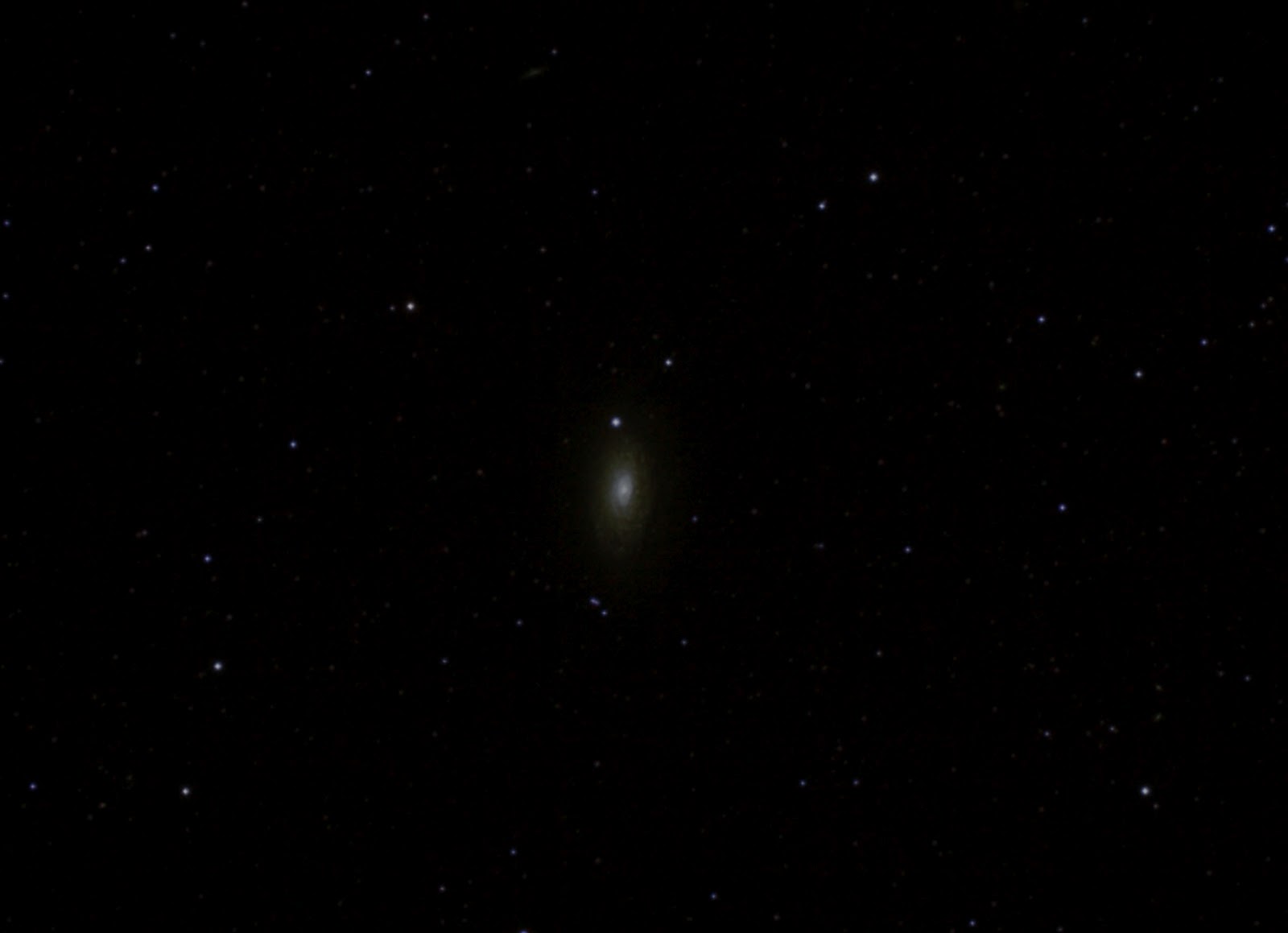
This cosmic punchbag of a galaxy has taken a recent pounding well about a billion years ago as experts believe, a small galaxy collision has left its mark. Messier added it to his collection despite it's discovery a year earlier. Resting a mere 24 million light years away. This is a combination of 1 hour 40 minutes of exposures @ ISO 1600. A final crop just show the bruise.


Friday, 16 April 2010

M51 Whirlpool Galaxy NGC 5194

After many hours of adjusting and checking the cameras are fixed correctly and square to the scope I have come to the conclusion that the generic Field flattener I had bought just doesn't work I know it was for a f5.5 to f6 scope and my scope is f6.7 but I lived in the vein hope that it wouldn't be that bad. Alas to no avail. Last week I put out a cry for help on UK Astro Ads and asked if anyone had a William Optics Mk3 field flattener which is dedicated for my scope. I had a reply from a really nice chap who said he had one, and a generic William Optics field flattener for refractors as well. He offered the mk 3 to me at a good price and offered to post both of them for me to test. I like so many others have had a few bad transactions on such sites so I as of course a little unsure when I clicked the pay pal button and duly paid up. A couple of days later a package arrives and you know that feeling you get in your stomach when you think things are about to go hideously wrong. I sat staring at the box while I drank my coffee and reluctantly opened it. What a surprise 2 immaculate field flatteners. Having hurdled our youngest happily playing on the carpet in front of me I grabbed the keys to my observatory and had a play. I attached my Canon T fitting to it and connected to scope focussed on a neighbours chimney and checked it out for defects. Last night we had a fantastic clear night despite the fear of a few hundred tonnes of Icelandic volcanic ash about to land on me I set about focusing using my live view and one of my fellow members who makes superb quality Batninov Masks see Keiths Astro over to your right. Now lets try this thing out. a quick 30 seconds to see if everything was there. I took 7 x 3 minute guided exposures and a few darks and started to stack. Here below is the summation of those Images of M51. Slightly over processed I know for a short duration image. BUT Astounded, Amazed, Totally shocked I have star shapes to the edge of the field I am so pleased to finally have an image that doesn't need 80% cropping. Now the bad news. I have had to dump my entire collection of Darks,Flats and Bias frames to start a new with the new Flattener. My Sincere thanks goes to Dr John and his faith and trust in mankind.(the flattener I didn't require now posted back)

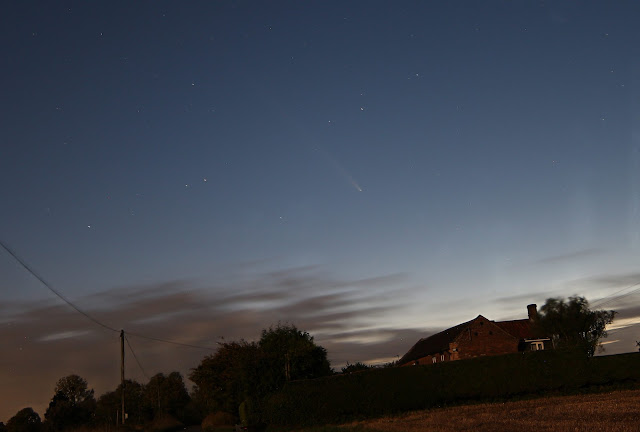
Comet Tsuchinshan-ATLAS, C/2023 A3 , Comet A3,

  A cosmic wanderer, Comet Tsuchinshan-Atlas or more commonly known as Comet A3 has traced its elliptical path through the solar system, a j...