Showing posts with label Planets. Show all posts

Saturday, 4 April 2015

Jupiter


Some recent captures under less than average seeing. Using my ZWO ASI120MC camera and the clubs Celestron C9.25 with a 2x Barlow lens. Captured at 11 frames per second approx 90 seconds of recoding to avoid image rotation. The best 50% of frames captured was the result. My best capture of the Great red spot I like the small white disturbance into the south equatorial belt, that defines the red spot nicely. I can also see  some lovely striation detail to the North Belt. I am pleased with it despite the seeing, but not as happy as I would like when seeing some of the other jupiter images posted on Facebook groups. I will of course endeavour to get a little more each capture and produce an image worthy of publicaion.


I am very happy with this image capture of Jupiter and Ganymede. A steadier atmosphere gave a small improvement to the overall image quality. Captured to the right is Ganymede. It looked like a horrible blur at first. An RGB realign later has given a pleasing result to it's disk. I also gave a small increase in colour vibrance and some contrast adjustment. Some distinct patterns in the north & south temperate belts can also be seen. I have a few more Avi's to process and I will add to this post if anything new comes from them..


Friday, 18 April 2014

Mars

This must have been the 4th Tuesday in a row for me to get over to the Observatory at Great Ellingham. A great opportunity was taken with good seeing I set about to image Mars. I was not happy with the images taken the previous week, Seeing was very poor and @f20 offered no image stability. So gave it up as a bad job. This Tuesday gone was however a surprising and welcome change. Still low on the horizon at the point of capture. Details teased and flashed with clarity on the screen. Registax processing and some work in Photoshop has revealed a pleasing result. Syrtis Major the largest dark feature demonstrates perfectly the dichotomy of the region as the vast expanse of Arabia Terra extends all the way to the Northern polar cap. Terra Meridiani sweeps across the bottom of the image and out of shot, as Hellas basin also appears bright . Overall I am happy with this image. Visually you can see why astronomers like Giovanni Schiaparelli back in 1877 thought there were canals on the surface. Optical illusions  and the seasonal changes gave this impression of a changing living surface. It was only the Mariner probes in the 60's and 70's that finally dispelled the myths and legends of little green men from Mars.

Thursday, 13 March 2014

Celestron C9.25

Tuesday night was a good night with reasonable seeing. We that is Myself and fellow BAS Member Richard Harmon had a second opportunity to have an imaging session with his Celestron C9.25. Using the societies new Ioptrom IEQ45 mount (same as my own)We tested and were happy with the balance / polar alignment & collimation. Having made more sense of the instruction manual for the ZWO camera we connected and started up firecapture. A recommended programme that comes with the driver software for image acquisition. It seems to be well respected with a great deal of control. I tested the camera for the first time last week (Pic right) using no gain at all. Initial results of Jupiter last week were under saturated. However the software recommend a setting of 50%, with an active histogram scale showing saturation, a new set of captures were initiated. Dew quickly covered the optics and required de misting every 10 minutes. Inbetween that some nice captures were collected.
First up was Jupiter. Working at f20 images were much brighter. This will be a learning curve I am sure because the quality is not as good as some I have seen posted, Anyway here is the first effort. The shadow of Callisto can be seen quite clearly. At about half past nine on the disc's edge you can just see the great red spot. Image capture was at 640 x 560 at 35 frames per second approx 4000 frames with the best 65% processed with wavelets in Registax. An unsharp mask and despeckle and colour boost was used in photoshop.  This was the best jupiter we got So I turned my attention to the lunar disc whilst hot drinks were being made inside.
My first lunar target was Clavius after another de-misting.  A run of just 38 seconds a @ 16 frames per second size of 1280 x 960 is the largest size, this does slow up the frames per second though. Like I said a learning curve and a lot of practice needed to get things right!!!
Watching the capture on the screen was amazing. Moments of perfect seeing were staggering as craters came into perfect focus. Only 600 frames capture and the best 80% stacked gave me this one.  
 
Not a great deal of processing needed. An unsharp mask and contrast boost. The focus appears to bring the image toan almost 3D perspective. This was just luck as I was concentrating on the central craters. No electronic focus on the 9.25 so there was a bit of scope movement with the micro adjustments made. Still very pleased with this one.


Not sure what happened to Copernicus. It appears the capture was just 7 seconds and about 100 frames. I did not take another shot must have been drinking the coffee at that point? A lovely image though with the walls well defined and central peaks have contrast down the slopes. The view from the top must be amazing.
The Vallis Alpes or the Alpine valley is a valley feature that bisects the Montes Alpes range. Running for 166km and at it's widest is 10km. Not the best illumination here as there is no shadow or contrast to show the escarpment.


A bit of wandering around landed me on top of Crater Archmedes. Same resolution as before for this 83km crater. No central peaks like Copernicus suggest that the crated floor filled with lava to conceal any peaks. No ejecta ray system either that is usaually associated with the younger craters, telling us of it's early formation. Not so happy with this image, again only a few hundred frames.
 
By now it was getting late and everyone wanted to pack up & go. My last quick capture was of course Plato. My favourite crater on the lunar surface, since my first view through a scope. I just remember thinking wow which one is that. It just stood out above all others. The smooth surface just caught my interest.

I have caught some of the craterlets on the lava fllor so that also takes care of number 83 of the lunar 100.....
 

Tuesday, 4 June 2013

Planetary Alignment

We had a night flight travelling home from our holiday in the Dominican Republic last week. Our seats were nicely positioned to get a view and a snapshot of the Alignment of Mercury, Venus & Jupiter. Sorry it's a bit shakey. The best one I could get travelling at 500mph. Taken over the Atlantic ocean 700 miles East of Bermuda at approx 35,000 ft.

Saturday, 20 October 2012

By Jove

My imaging set up is not designed for planetary imaging. But I couldnt resist having a go at the true king of the planets Jupiter. Taken with my 90mm refractor with the DSLR attatched to a 2 x barlow using 5 x live view magnification and video recording a stack of 500 frames aligned and stacked in registax. Wavelet sharpening and thats it. By no means an image of quality compared to some of the dedicated planetary imagers out there. I might have a go with our societies planetary imager on the 20". I will post the resulting image when it happens.

Thursday, 1 March 2012

Moon & Venus

Taken on the evening of the 25th Feb The moon passes close by the planet Venus At the time this was taken the moon was 248,819 miles Venus was 87,104,049 miles away making the moon a cool 350 times closer to us than venus. I just about managed to fit them into the same frame. I deliberatly over exposed the picture to get earthshine.It is caused by sunlight that reflects off the Earth onto the Moon's night side.


Friday, 7 May 2010

Dynamic Duo Venus & Mercury

Had a break in the cloud coverage to take this pic of Venus & Mercury
taken @ 85mm with a .5 second exposure on the 8th April at 20.14
I would have liked to wait a little longer for a darker sky, but the clouds kept rolling in.

Sorry there has'nt been much activity here recently still stuck doing nights. Hopefully a light at the end of the tunnel coming soon though.

Good to see my fellow bloggers are producing some great work while I am locked (literally) inside. Take a few minutes to look at their stirling efforts please.

Wednesday, 5 March 2008

Mercury Transit


Mercury Transit 7th May 2003


The transit or passage of a planet across the face of the Sun is a relatively rare occurrence. As seen from Earth, only transits of Mercury and Venus are possible. On the average, there are 13 transits of Mercury each century.


On Wednesday, 2003 May 07, We were indeed treated to another transit of a lifetime when Mercury's transit of the Sun was seen for the first time since 1999. The entire event was widely visible from the Europe, Africa and Asia,. Japan Australia, and New Zealand and witnessed the beginning of the transit but the Sun had set before the event ended. Similarly, observers in western Africa, eastern North America and eastern South America saw the end of the event since the transit will already be in progress at sunrise from those regions. But luckily here in the UK we were treated to a cloud free entire transit.


Thursday, 28 February 2008

Solar


As this is a new site for me I have found a few of the nice images I have taken in the past.


Here are a couple of my Images from the Venus Transit of 8th June 2004.

On this beautifully clear summer morning we experienced a once-in-a-lifetime rare astrological and astronomical event. Approximately every 121 years, the planet Venus moves between the Sun and our line of vision so that Venus passes directly across the face of the Sun. When the Moon passes across the face of the Sun it's called an eclipse. When a planet passes across the Sun's face it's more precisely known as an occultation.


Telescope used was my 10" Orion Optics F4.8 reflector on a Vixen Polaris GP mount.

I used a baader solar filter on the scope and a yellow filter over the camera lens.

I was very pleased with the results.

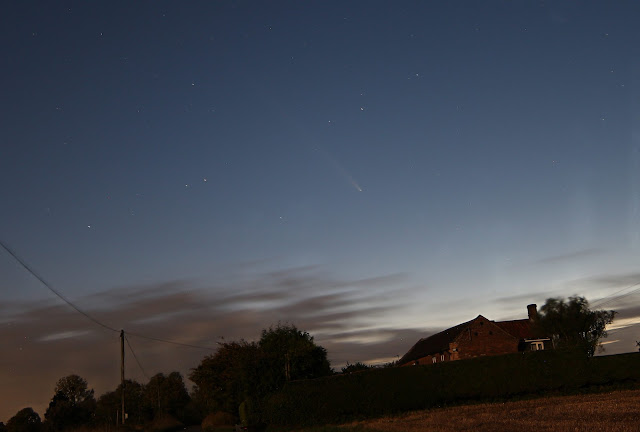
Comet Tsuchinshan-ATLAS, C/2023 A3 , Comet A3,

  A cosmic wanderer, Comet Tsuchinshan-Atlas or more commonly known as Comet A3 has traced its elliptical path through the solar system, a j...