Showing posts with label Stephans quintet. Show all posts

Friday, 7 April 2023

Stephans Quintet.

A project started at the end of October last year with my now sold 100mm scope, and will be finished this year with the new 130mm. NGC 7331 and Stephan’s quintet are a fascinating group of targets. This is a huge crop of the original image(a) now just less than one by half a degree at a pixel scale of 1.44 arc sec per pixel(b).


The enigmatic galaxy at the top is NGC 7331 a wonderful example of a spiral galaxy located some 40 million light years away in the constellation of Andromeda. The half a dozen smaller galaxies behind are a good deal further away at on average of 350 million light years distance. The light you see here left when Earth was in the Paleozoic era when Amphibians left the water to first roam the land. A time long, long, long before the dinosaurs emerged, lived and perished.

However, the objects of interest that inspired this image are located below. A visual group of 5 interacting galaxies known as Stephan’s Quintet. 4 of which are interacting with each other 270 million light years away and one NGC 7320 that is in the foreground at just 40 million light years.


The strange morphology of these galaxies has been defined by several theories including a head on collision between two of the group NGC 7318 & 7319 causing a tidal shock in the intergalactic gas. You can see clearly the stream from 7319 that is larger than our entire galaxy and moving at a million miles per hour. This was followed by a collision between 2 more galaxies and all contribute to the chaos of what you see. There are very few of these galactic interactions visible and they have helped astronomers over the years refine the physics & theories into galaxy interactions.

The image you see here is a composite exposure of just one hour using the green filter on the mono camera. The idea is to capture data in the Red, Green & Blue filters to produce a full colour image. This is programmed ready in the Autumn when the constellation rises again in the East.


A handy finder chart shows the location.

The Little red box on the sky map is the field of view for my old telescope. The new scope will have a smaller box giving higher magnification. I hope it gives you an idea of how small these objects are. 

Thursday, 15 August 2013

A Mamoth Cosmic Collision

300 Million lights years away lies a quintet of interacting galaxies.
 
NASA/ ESA Hubble Space Telescope has imaged  the central part of Stephan's Quintet, giving a magnificent view of a gigantic cosmic collision. Weird, highly distorted features, dust lanes crossing between galaxies and long filaments of stars and gas extending far beyond the central regions all suggest galaxies twisted by violent encounters. The galaxies float through space, distorted shapes moulded by tidal interactions, weaving together in the intricate figures of an immense cosmic dance, choreographed by gravity. My lowely 90mm Set up does not quite achieve the resolution of hubble but none the less I am very happy with the 1.5 hours of 5 minute sub exposures giving me a lovely sharp image. I also like the way Ngc7331 frames itself with it's gaggle of galaxies in tow.

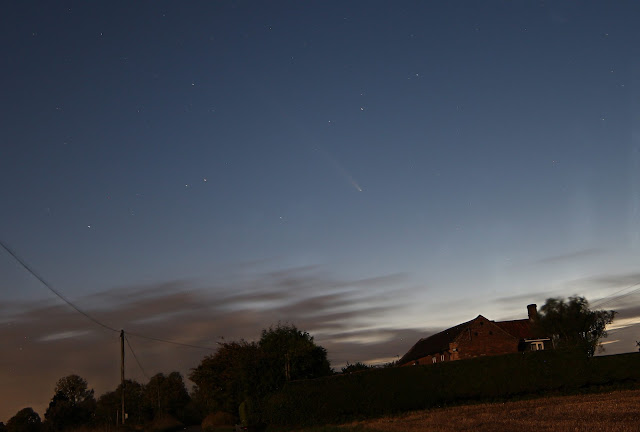
Comet Tsuchinshan-ATLAS, C/2023 A3 , Comet A3,

  A cosmic wanderer, Comet Tsuchinshan-Atlas or more commonly known as Comet A3 has traced its elliptical path through the solar system, a j...