Showing posts with label Optolong Narrowband filters. Show all posts

Wednesday, 2 August 2023

Elephants Trunk Nebula

So it is a school night but while the skies remain clear I will start with a couple of hours of new target data on the Elephants trunk Nebula. 3 minute subs using the Optolong narrowband filters starting with Ha. A great night of data capture using the ASI air pro I managed to capture 71 x 180 second exposures resulting in just over three and a half hours. As normal a 3 minute stretched sub is noisy but with a promising amount of data.
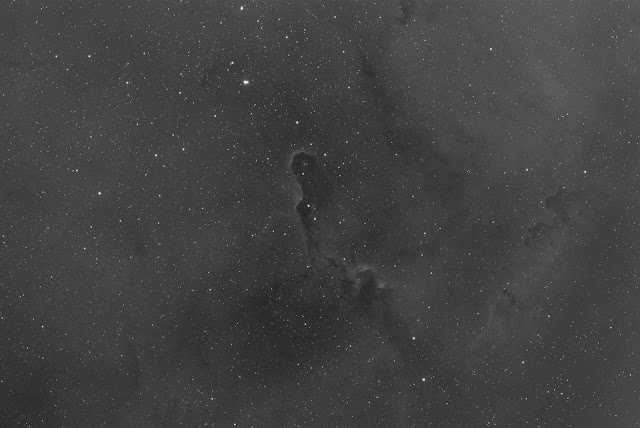
No processing here other than a histogram stretch.

WBPP is an incredible script that combines all the sub frames with calibration frames and does an amazing job. This is the combined efforts of those 71 frames. I have also included the starless image.


I am posting these about a month after processing, it would appear there is a brightness difference between the two. 

Update Aug 2nd. The weather has been awful for the whole of the UK and I have not completed any further progress on this project. If this keeps weather keeps up I will crack on and finish it next spring..... Further updates to follow.


Monday, 12 June 2023

Cygnus Wall

The light June nights can be a very difficult time to image deep sky objects, if the moon doesn't interfere then the lack of darkness here at 52 degrees is just as bad. A few years ago I imaged the NGC7000 region in a mosaic capturing both the North America Nebula and the Pelican as well. This time would be a little different with more focal length I knew the Cygnus wall would frame up quite nicely. Over a period of 4 nights I have managed to capture around nine hours of data using the ha and Oiii filters in the hope to produce a HOO image.

I will be capturing data using my Optolong narrowband filters inside the Zwo 36mm filter wheel.

The Cygnus wall is a small part of the overall North America Nebula, The nebula is an emission type intermixed with a wall of dust, the final region covers a huge 70 light years.

My rig like most are under sampled using 3.76 micron pixels on the 130mm refractor so when processing I use a 2 drizzle integration. The downside to this was leaving it overnight to process the data in WBPP

Single 180 second Ha frame


113 x 180 seconds combined master. ABE, Blur X, & Noise X applied

Single 180 second Oiii


83 x 180 seconds combined master. ABE, Blur X, & Noise X applied


I used a pixel Maths expression to combine the 2 frames


Lets go Starless


 Red & Blue masks created to tease out some additional colour, plenty of contrast added added some Convolution to blur the colour data. I duplicated the Ha master giving some high contrast and some serious deconvolution adding sharpness and added to the near completed image. Finally I added the star back in.


I am very pleased with the final result. What do you guys think?


Monday, 29 May 2023

Pillars of creation

Holy smokes, sometimes you just need to stop in your tracks and just behold the beauty, majesty and enormity of space. M16, The Eagle Nebula or more commonly known as "The Pillars of Creation" is probably the most iconic and well known images of deep space and the legacy of the Hubble space telescope. First captured by Hubble back in 1995. The "Pillars of Creation" is a star forming cloud of Hydrogen gas 90 trillion kilometers wide. The tiny section in the centre of my image resemble fingers, stalagmites of condensing clouds of Hydrogen gas and dust forever reaching into the darkness, lying deep within and not visible to conventional cameras are eggs or incubators of newly formed stars ready for birth in a few hundred million years.

The Black & White images here are my own from my 130mm telescope and cooled camera capturing light at the frequency of 656.21nm or the wavelength Hydrogen Alpha.


An ever increasing zoom into my image reveals the Pillars in all their glory. 
Seven hours of data capture this incredible region.


Finally I get to compare my image to the most celebrated of Hubble's images. With Hubble's final cost of around $10 billion and my modest set up around a million times less I don't think I have done a bad job.


NASA, ESA, and the Hubble Heritage Team (STScI/AURA) - http://hubblesite.org/image/3471/news_release/2015-01

Sunday, 1 January 2023

The Tadpoles SHO processed

About 9 hours of data used to create the HSO version of the IC 410 nebula.

This was a project started lst year with just some Ha data.

48 x 5Min subs Ha
30 x 5Min subs for Oiii & Sii
Plan mode on the AIR incorporating the EAF during acquisition has produced an incredible set of sub frames. Processed in Pixinsight.

Full calibration using WBPP script. DBE, and Linear fit to the Oiii channel, Channel Combination, Generalised Hyperbolic stretch, Correct Magenta Stars, Starnett++Generalised Hyperbolic stretch, Curves, Blur Exterminator, Noise Exterminator, Colour Mask, Convolution, LRGB Combination to add Luminance, Curves, Colour Masks,

I would love to do a video on the processing, but just not that confident in front of the camera.

Anyway the final results are as follows.


A crop of the Tadpoles.


Go on the a little more cropping.


Tuesday, 20 December 2022

The Jellyfish Nebula

30,000 years ago, our planet was in the grip of our last ice age, about the same time Neanderthals were painting the earliest images found in the caves of India. Above early man’s head in the night sky a super massive star has succumbed to the forces of gravity and collapses in on itself, the resulting supernova outshines every other star in the heavens. As we fast forward the thousands of years what we see now is the ever-expanding cloud of dust and gas resembling a jellyfish forever swimming in the cold inky black ocean. Imaged over the last two cold clear nights, nearly nine hours of data were needed to capture this cosmic Scyphozoa.


At the time of posting there has been a new Pixinsight plugin that is creating a great deal of attention by the incredible Russell Crowman. The Blur Xterminator plug in. So there will be an update shortly incorporating this into my workflow.


An except from Russel's Website. BlurXTerminator (rc-astro.com)


BlurXTerminator is an AI-based deconvolution tool designed specifically for astronomical images taken with equipment commonly used by amateur astrophotographers. It is available as a process module plug-in for PixInsight only.

Not all AI is created equal. AI-based sharpening tools for general photography exist but, when applied to astronomical images, they are prone to "inventing" detail that does not exist. They also don't usually handle stars very well. Their neural networks were not trained on astronomical images, so they often make bad "guesses" as to what the original, unblurred scene looks like.

The design intent of BlurXTerminator is to recover as much detail as possible based on low-contrast information actually present in an image, without fabricating detail that does not in fact exist just for the sake of an image that appears sharper. Great care has been taken in the architecture and training of the neural network to ensure that its output is as faithful as possible to reality if it is properly used.

Saturday, 8 October 2022

A lobster and a bubble

Oh the weather is a fickle thing, yes the nights are drawing in seriously now but so has the cloud too. In a rare few evenings of clear skies I have started a new project. A previous effort a couple of years ago for this target was a bit of a disappointment. I cannot quite remember but I think the project was unfinished so time to have another go. I have managed to create a lovely framing of the Lobster Claw with the Bubble nebula for this image. Night 1 was a 3h55m aquasition of Ha data. A quick process has revealed some lovely clean data.
Night 2 at the time of writing has been a little hit and miss with some high fast moving cloud, quickly clearing and returning some great guiding numbers again. This too is without any PEC training on the mount and I would love to get these numbers more consistent and will have a look at training over the weekend. I am hoping for 6 plus hours of Oiii so looks like a 4.00am finish if the clouds hold off, forecast now looking a good deal better. 1hr 15 so far.
Managed an exact 6 hours or 72 x 5 minute sub frames. Night 3 was again a wonderful night and managed 4 hours with 48 z 5 minute sub frames.
Pixinsight process Background extraction Deconvolution Noise reduction Stretch to non linear Pixel Maths combine channels Curves ACDNR Local Histogram equalisation Dark structure enhance Final curves Star reduction I love the starless image created just before final star reduction.
Final Image
I have also in recent weeks completed a complete new set of calibration frames. As per the image above it looks like a great set and a relief. As I had a few issues with flats a few months ago so a new set needed doing. Pixinsight too has also seen some updates and has updated it's WBPP (weighted batch pre processing script) and it worked flawlessly with the new calibration set. I am really starting to enjoy using it now, still a complete novice and relying on tutorials but the results speak volumes. I am sure there are plenty of die hard fans who want to run all the calibration manually, but there are plenty of trusted you tubers and of course imagers like Adam Block who are increasinly confident that it is doing everything in the background a a full manual run. Like I said I am far from competent with the programme so will enjoy and take all the help I can get.
I along with my family are suffering from Covid. For us all it has been a struggle, having escaped it over the last 2 years it has caught up with us all. On the mend now but has been a real struggle to breath and a cough so bad it made my throat bleed. As I said thank god we are all on the mend now.

Thursday, 1 September 2022

Heart Nebula

Having recently returned from an amazing week on Lake Windemere and some lovely clear skies, that is apart from the full moon obliterating any decent view of the Perseid meteors. I had a few great eveinings doing some light painting on the lake. This means the scope has had a week off from action. So the new project is going to be an HOO image of the Heart Nebula IC1805. 5 minute sub exposures starting with the Optolong Ha filter. A total so far of 40 subs with a total of 200 minutes. A lucky capture on my first sub was a meteor breaking the Heart in two.
Over 3 nights I have been able to shoot Oiii data with 73 x 5 minute sub frames totalling 6Hr & 5 minutes. An induvidual sub offers the faintest hint of detail.
The full stack of 73 frames shows a vast amount of detail and a really clean noise free master frame. For some reason my blog will not let me upload the TIFF file so these Oiii frames are JPEGS (aghhhhhh)
I followed the same Pixinsight processing as before for the Crescent nebula. I am still new to this amazing programme and need YouTube tutorials to follow. I feel I have overdone the contrast here of on the final Star reduced image, so I will be looking at a few more Ha hours to boost the outer ring of Hydrogen gas. Watch this space. But for now please enjoy my Heart Nebula. A fitting tribute to Mum too, she sadly passed away some twelve years ago on this day.
One last thing to mention is the guiding, after some welcome rain the skies have been very transparent and the guide numbers have been incredible with RMS totals under 0.25 arc seconds. Images of the guide screen are on the tablet so I will try and upload a screenshot.

Sunday, 6 February 2022

Simies 147 Part 2

 A restart to the project of Simies 147, the previous below 4 pane mosaic was captured using data from the fantastic Telescopius website. It suggested that the 4 panes would work and stich together, as you can see further down that didn't work. So I have re planned a 6 pane mosaic with a greater 30% overlap. I ran a test with 2 frames and with a stretch and alignment in Photoshop and Bingo it works. I would like to run with more data looking at 4-5 hours on each frame, more data equals more signal and less noise. So below is the first run of 50 minutes data per frame. So far with so little data I am very pleased that there is the full shell on view. Shown in negative here you can see the joins and the noise is very apparent. Very happy so far.


Sunday, 30 January 2022

Simies 147


 New project time. I have never attempted this object before even with widefield DSLR.  Simeis 147, also known as the Spaghetti Nebula, or Sharpless 2-240, is a supernova remnant (SNR) in the Milky Way, so huge it straddles the border between the constellations Auriga and Taurus. Discovered in 1952 at the Crimean Astrophysical Observatory by Grigory Shajn and his team using a Schmidt camera and a narrowband filter that was close to the Hydrogen Alpha transmission line. It is difficult to observe due to its extremely low brightness. I honestly was not sure if I would be able to capture anything using 300 second exposures. My first attempt was a 4 pane mosaic using Telescopius to copy the CSV file and pasting it into the ASI air pro. As you can see things did not quite align with a 15% overlap.


My second go will be a 6 pane with a 30% overlap 

Hey Hey it's a Monkey

The Monkey Head Nebula is a star-forming region located 6,400 lightyears away in the Orion constellation.

NGC 2174, to give it is formal name, is a place where new stars are being born at a fierce and rapid rate, and these newly born stars emit powerful streams of charged particles known as stellar winds that blow the gas and dust away, removing the ingredients necessary for future stars to be born.

Dark dust streams among the glowing cosmic cloud to give the nebula its ape-like appearance.

The Monkey Head Nebula is an emission nebula, which means it is a cloud of gas that emits its own light. This is as opposed to a reflection nebula in which hot stars cause surrounding gas to glow.

It is associated with open star cluster NGC 2175 and can be found in the can be found in the Orion constellation.

We have below the Ha, S2 & Oiii  frames of 1Hr 30 Mins each.


Friday, 14 January 2022

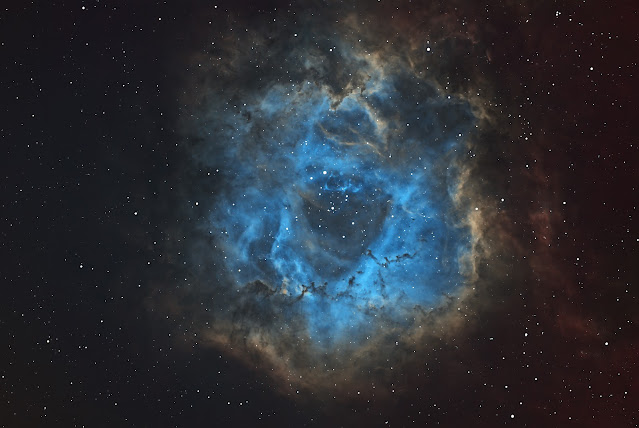
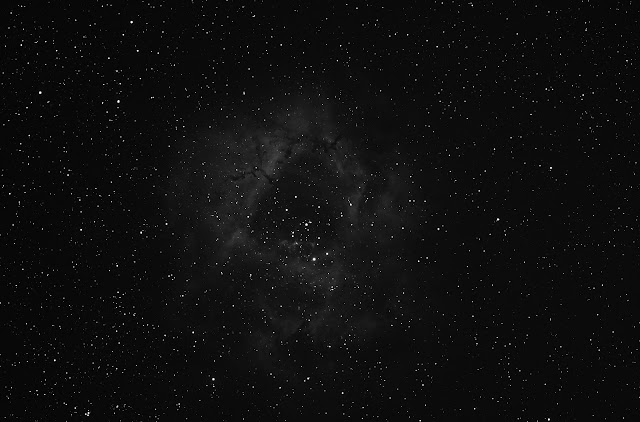
Rosette Nebula

 An 85% waxing gibbous moon phase is certainly a distraction for astrophotographers looking for faint fuzzies. But what can we do (launch a virgin rocket at it).. Thank goodness for the Ha filter, Because of the brightness of the sky background I reduced the exposure time to two minute subs and captured 4 hours worth of data. Imaging with the incredible ZWO ASI 2600MM and the 36mm filter wheel. I invested  also in a set of Optolong narrowband filters. I was incredibly impressed with the L- Enhance and it's ability to keep halo's and star sizes to a minimum. So for me it was a no brainer to add these to the arsenal. Saying that their LRGB filter set were new and untested at the time of purchase so I opted for the ZWO filter set. I am happy with them so far. But as I said the Ha filter was deployed last night and with a image stretch and dark dust enhancement I have a really clean image. Desperate for for some Oiii & Sii now.

Right so update alert last night was a clear night so had the opportunity to shoot 2 hours each on Oiii & Sii.

Processed on my new laptop and wow it is fast. 

Registered aligned & stacked in Deep Sky Stacker.

Starnet++

Processed in photoshop with

HSO colour mapped & selective colour

Levels & Curves

Photokemi astro tools Space dust & Dark details medium

Topaz denoise.


Ha

Oiii

Sii

Photo Details

  • Total Exposure: 9 Hours, 0 Minutes 120 x 2 Mins Ha , 30 x 3Mins Oiii, 30 x 3Mins Sii 
  • Image Acquisition: ZWO ASIair Pro
  • Camera Settings:  ZWO ASI2600mm pro Gain 100, 0°C
  • Accessories: ZWO 7 position Filter wheel
    •                Optolong narrowand filters 
    •                ZWO broadband filters
    •                ZWO EAF
  • Calibration Frames: No Calibration
  • Stacking and Processing: DeepSkyStacker, Adobe Photoshop 2020, 
  • Size: 2.26 x 1.38 deg 
  • Pixel Scale: 1.41 arcsec/pixel

Sunday, 9 January 2022

My Bucket list.

Ok so lets talk about distance particularly the speed light. 

In a vacuum,  we know that light travels at 670,616,629 mph. So If a little context is needed light from the moon takes 1.3 seconds to arrive at our eyes, Saturn is 1.3 light hours away a measly 0.0001505453985955772 light years distant. So what is a light year?

quite simply the distance light travels in a year 5,878,625,370,000 that's nearly 5.9 Trillion miles. Ok so back to the point I wanted to make IC434 or the Horsehead nebula is an immense cloud of thick dust obscuring star birth inside it and in galactic terms the Horsehead is an insignificant 3.5 light years in diameter but when you compare that against our solar system and our distance to Saturn it would be a huge two hundred and twenty one thousand three hundred and forty four (221,344) times the distance. 

If you ever needed reminding SPACE IS BIG.

My image was captured 2 nights ago at my home observatory with about 4 hours of data. Over the years I have taken many images of this target and I was lucky enough back in April of 2015 to appear in an episode of the Sky at night celebrating Hubble's 25 year Anniversary. One ticked off my bucket list anyway.


Stack of 40x 3 minute Ha frames.


My new laptop has amazing processing power, attempted several times previously to process a starnet++ starless image, it failed several times, introduce Mr Dell and it processes a colour starless image in less than 2 minutes, a chunk of star reduction and hey presto a lovely update to mt=y first process.


Monday, 3 January 2022

IC405


Rippling dust and gas give name to this wonderful nebula. Located very close to my previous image of IC410. The Flaming star Nebula or IC405 is a mix of emission and reflection nebula. A future colour image when the project is complete will show just what I am talking about but for now with a close to full moon this Mono image is captured using just my Optolong Ha filter. Just 2 hours 10 minutes so far of data in 5 minute sub frames shows incredible detail already.  


At the time of this update 3rd Jan there has still been no clear nights. So posting now rather than a complete image. I am sure more updates to follow.


Saturday, 11 December 2021

IC410 The Tadpoles.
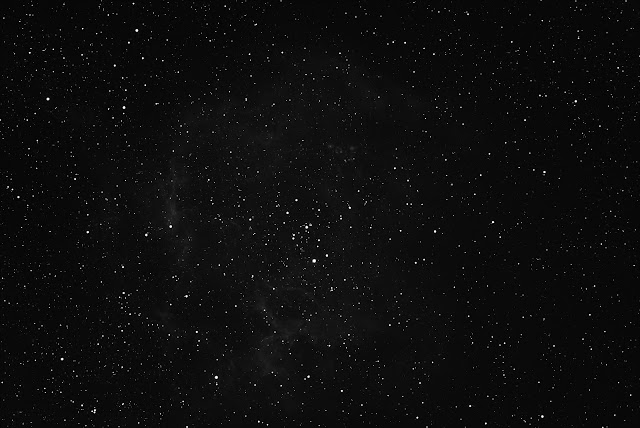

As I may have mentioned before on my facebook page and even on here too the last 5 plus weeks of weather have been truly awful. However, 2 nights from Friday last week have been cold and clear but somewhat spoilt by the approaching full moon. So the filter wheel has rotated to the HA filter and the start of 2 projects IC410 & IC405 are born.

IC410 is a dusty emission nebula located in the constellation of Auriga at about 12.000 light years from Earth. It is part of a larger star forming region that also contains the Flaming Star Nebula (IC405). The gas structures in this picture are lit by the radiation from the open star cluster Ngc1893 that lies in the center of the nebula. This star cluster is about 4 million years old, but in astronomical terms it is still very young, with hot, massive stars. Just right of the star cluster two more dense structures are visible. Affectionately known as The Tadpoles these two structures are approximately 10 light years long these are similar to the famous Pillars of Creation and they are composed of dust and gas leftover from the formation of the star cluster and are very likely to give birth to more stars in the future. As can be seen in the image, these structures point away from the center of the nebula. This is because of the stellar winds and radiation pressure from the stars in NGC 1893. The really do look like they are trying to get back to the centre.


    25x 5 minute Ha subframes.

    Tadpoles crop
    Looking a little closer they really do look like tadpoles.

Lets hope for a few more hours of data to complete a Hubble Palette image.
Watch this space:

Image Details

  • Total Exposure:  2 Hours, 5 Minutes ( 25 Frames) x 5 Mins Ha (10/12/21)
  • Image Acquisition: ZWO ASIair Pro
  • Camera Settings:  ZWO ASI2600mm pro Gain 100, 0°C
  • Accessories: ZWO 7 position Filter wheel
    •                Optolong narrowand filters 
    •                ZWO broadband filters
    •                ZWO EAF
  • Calibration Frames: No Calibration
  • Stacking and Calibration: DeepSkyStacker
  • Processing: Adobe Photoshop 2020, 
  • Size: 2.26 x 1.38 deg 
  • Pixel Scale: 1.41 arcsec/pixel

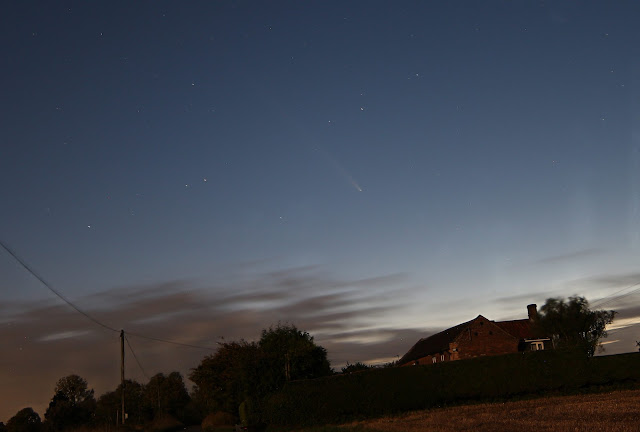
Comet Tsuchinshan-ATLAS, C/2023 A3 , Comet A3,

  A cosmic wanderer, Comet Tsuchinshan-Atlas or more commonly known as Comet A3 has traced its elliptical path through the solar system, a j...