Showing posts with label Ha region. Show all posts

Monday, 29 May 2023

Pillars of creation

Holy smokes, sometimes you just need to stop in your tracks and just behold the beauty, majesty and enormity of space. M16, The Eagle Nebula or more commonly known as "The Pillars of Creation" is probably the most iconic and well known images of deep space and the legacy of the Hubble space telescope. First captured by Hubble back in 1995. The "Pillars of Creation" is a star forming cloud of Hydrogen gas 90 trillion kilometers wide. The tiny section in the centre of my image resemble fingers, stalagmites of condensing clouds of Hydrogen gas and dust forever reaching into the darkness, lying deep within and not visible to conventional cameras are eggs or incubators of newly formed stars ready for birth in a few hundred million years.

The Black & White images here are my own from my 130mm telescope and cooled camera capturing light at the frequency of 656.21nm or the wavelength Hydrogen Alpha.


An ever increasing zoom into my image reveals the Pillars in all their glory. 
Seven hours of data capture this incredible region.


Finally I get to compare my image to the most celebrated of Hubble's images. With Hubble's final cost of around $10 billion and my modest set up around a million times less I don't think I have done a bad job.


NASA, ESA, and the Hubble Heritage Team (STScI/AURA) - http://hubblesite.org/image/3471/news_release/2015-01

Monday, 10 April 2023

Spider Nebula (update)

Started in December last year with some lovely 5h 50m of Ha data, I have managed to capture some Oiii & Sii data as well during January. 4 hours from each filter will give me a total of 11hrs 50 minutes to produce an SHO image. A JPEG of each processed image. Looking at them now I have done a star reduction on the Ha.

Ha


Oiii

Sii

Combined data 


Also a starless version just because I love the way it looks.


Photo Details

  • Total Exposure:  11 Hours, 50 Minutes ( 46 x 300 sec Ha, 48 x 300 sec Oii, 48 x 300 sec Oiii Frames)
  • Telescope: Skywatcher Esprit ED100
  • Image Acquisition: ZWO ASIair Pro
  • Camera Settings:  ZWO ASI2600mm pro Gain 100, 0°C
  • Accessories: ZWO 7 position Filter wheel
    •                Optolong narrowand filters 
    •                ZWO EAF
  • Calibration Frames: Darks, Flats calibrated.
  • Stacking and Processing: Pixinsight & touch ups in Photoshop. 
  • Size: 2.26 x 1.38 deg 
  • Pixel Scale: 1.41 arcsec/pixel

Friday, 30 December 2022

Spider Nebula

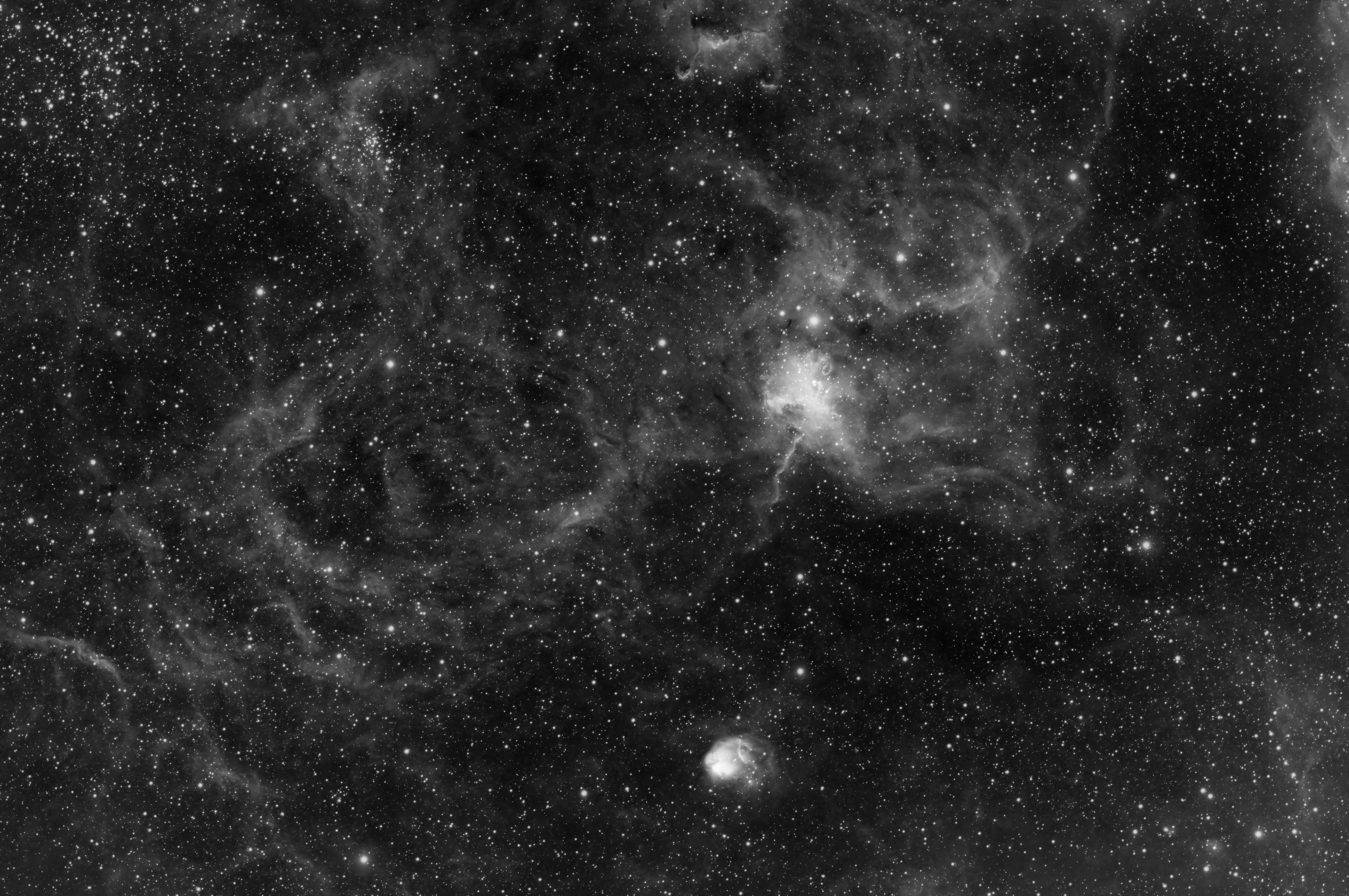
I have a few targets in the constellation of Auriga that I continue to look at capturing, some of which  were captured last winter, seems like a long time since I captured IC405 & 410 now, I should have a re process using what I have learnt over this last year from Pixinsight...But as for last night I managed 3hrs 50 mins of Ha data on  IC417 the Spider Nebula. I plan on an SHO image using 5 hours from each filter. As a start we have here an ASI air quick stack and screen stretch of the ha data. Looks lovely on the tablet but just a little processing via Pixinsight I have some lovely clean data and some lovely details too.

1. ASI AIR PRO stack & screen stretch.


2. Pixinsight process.

Using full calibration, Darks, Flats, Dark flats using WBPP script, 2 x Drizzle,
Automatic background subtraction, Blur Exterminator, Noise Exterminator, Histogram Transformation, Starnett++ Curves Transformation & PixelMath to re add the stars at 75%.

The are some interesting objects here in amongst the clouds of ionised hydrogen gas. We will start with 

IC 417 just left of centre of the image (also known as Sh2-234) is an emission nebula of almost 100 light-years across, located some 10,000 light-years away from Earth in the constellation of Auriga (the Charioteer). It is often referred to as the Spider Nebula and in that case its prey is a nearby (above) emission nebula called the Fly (NGC 1931).The nebula contains a young open cluster of about 40 stars, and is energized by its hot, massive blue stars which are still embedded in glowing hydrogen gas.


In the bottom right hand corner is the Charles Messier famed M38 open cluster a much closer 3480 light years and to it's left NGC1912 starfish cluster.

 3. Starless


I really love a starless image you can really explore the Ha regions here.

There will be a great deal more to add to this post as time moves into 2023, there will be at least 5 hours of Ha, Oiii & Sii data to create a SHO palette image. 

Malcolm. aka The Astrogeek

Saturday, 24 December 2022

Horsehead Nebula

I would like to say the year would not be complete without an image of the beautiful Horsehead Nebula. This is one object that I just wish was half it's 1375 light years distance from us. It would truly be a spectacular sight filling the winter sky. I am hoping for some more clear sky to complete the HAGB project. So far we have 16 x 5 minute sub frames.


I am so incredibly pleased with my set up, a few people recently have posted issues with the ZWO EAF and I can honestly say thankfully I have had no issues with it achieving nothing short of perfect focus 100% of the time. So I thought I would do a serious crop of the horsehead and yes the Blur exterminator plugin has been run. It will certainly be after Christmas now for the remainder of the data for a HaGB colour image, Ha data looks great so far for 1 hour 20 minutes. 


Saturday, 12 November 2022

Sadr in Ha

Captured over 2 nights a day before and a day after the full moom. I wanted to test out the mosaic feature in the latest V2 update to the ASIair pro. A simple and easy feature to use. select you target of choice, set 2x2 / 3x3 ect for framing of the mosaic, export as a plan. Set plan with the filter, number of images and duration. Done. Result is 24 x 5 minute Ha exposures in a 2 x 2 pane mosaic with a 25% overlap. Processed with pixinsight, calibrated and Histogram transormation stretch and EZ de noise. 2 verions one with and one without stars.

Thursday, 1 September 2022

Heart Nebula

Having recently returned from an amazing week on Lake Windemere and some lovely clear skies, that is apart from the full moon obliterating any decent view of the Perseid meteors. I had a few great eveinings doing some light painting on the lake. This means the scope has had a week off from action. So the new project is going to be an HOO image of the Heart Nebula IC1805. 5 minute sub exposures starting with the Optolong Ha filter. A total so far of 40 subs with a total of 200 minutes. A lucky capture on my first sub was a meteor breaking the Heart in two.
Over 3 nights I have been able to shoot Oiii data with 73 x 5 minute sub frames totalling 6Hr & 5 minutes. An induvidual sub offers the faintest hint of detail.
The full stack of 73 frames shows a vast amount of detail and a really clean noise free master frame. For some reason my blog will not let me upload the TIFF file so these Oiii frames are JPEGS (aghhhhhh)
I followed the same Pixinsight processing as before for the Crescent nebula. I am still new to this amazing programme and need YouTube tutorials to follow. I feel I have overdone the contrast here of on the final Star reduced image, so I will be looking at a few more Ha hours to boost the outer ring of Hydrogen gas. Watch this space. But for now please enjoy my Heart Nebula. A fitting tribute to Mum too, she sadly passed away some twelve years ago on this day.
One last thing to mention is the guiding, after some welcome rain the skies have been very transparent and the guide numbers have been incredible with RMS totals under 0.25 arc seconds. Images of the guide screen are on the tablet so I will try and upload a screenshot.

Saturday, 19 September 2020

Heart & Soul Nebula Nebula

I am fascinated by the latest Hubble palette processing for OSC cameras. I thought I would have a go with the Heart & Soul nebulas in Cassiopeia. There are more and more videos on You Tube. Both images are a little over 4 hours of exposure time captured with the Optolong L-enhance filter. This is solely my creative interpretation of that style as I have not figured out yet how to extract the Ha & Oiii from the master and recombine. Every time I have tried it in APP I only get a black & white image despite what the You Tube videos show, something I am doing wrong somewhere..


As always comments are welcome.

Friday, 21 August 2020

The Bubble Nebula

When radiation from a star several hundreds of thousand times more luminous than our sun expels energy  at incredible speeds the result is what looks like the most delicate bubble. The bubble itself is approx. 10 light years across intermixed within a soup of galactic dust and gas around 11,000 light years away. 


Monday, 29 June 2020

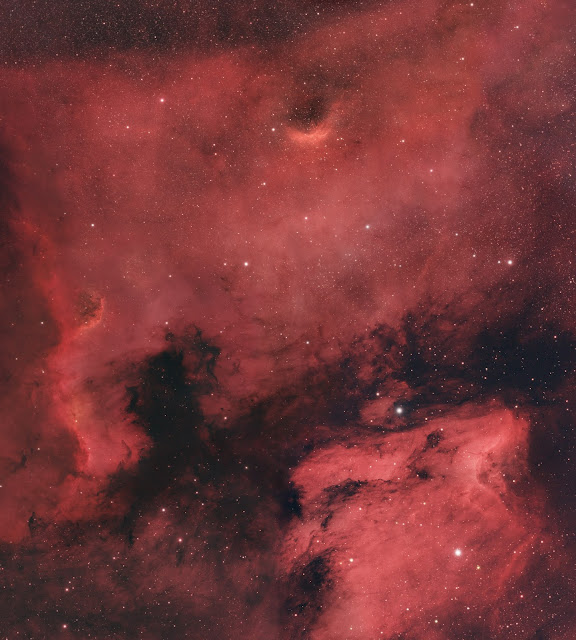
Pelican Nebula/ North American Nebula

A favourite summer target has always been the Pelican Nebula IC5070. A wonderful target for us astrophotographers. As technology improves it forces us back for longer exposure, improved guiding building mosaics. But the one thing we always seek is a better image smoother, sharper better contrast. Looking at back at my early images through the DSLR's it's hard to believe we were happy with them. Always seeking those small improvements to create the perfect image.

New and old

Old and new


A mosaic of just 3 images has created this image. My first real attempt at bringing multiple long exposures into one. A total of approx 12 hours in total captured over a couple of weeks.


Wednesday, 24 June 2020

M27 The Dumbell Nebula

I never get bored of the Dumbell Nebula. I love the way it just floats there in the cosmic abyss. It was the first planetary Nebula discovered by Charles Messier in 1764 so not a lot has changed in the last 250 years or so. In 1970, its velocity was estimated at 31 km per second giving an expansion of about  2.3" per century. 

My equipment is still quite new to me so getting used to things more each session. However guiding tonight was erratic at just over 1' RMS.  I am hoping to start on the new observatory soon still though deciding on the design.


A night of two targets

The California Nebula 

The California Nebula  NGC1499 is an emission nebula located in the constellation of Perseus located along the Orion arm of our galaxy roughly 1000 light years away. Energetic particles exciting gas are creating a huge nebula, all created by that little blue fellow just below the centre of the image. I say little Menkib is actually about 20 times more massive than our sun and burns hotter than 25,000 degrees.  Captured with the Optolong L-Enhance 2" filter perfect for those faint Ha regions.


The Iris Nebula 

The Iris Nebula NGC7023 a faint reflection nebula. Dust & gas illuminated by the bright star in the middle of the nebula. Filter removed for this one and refocussed m anually via the ASIAIR pro and my Bhatinov mask. Just a couple of hours of 3 minutes sub frames for this one.


Thursday, 21 May 2020

Testing Testing Testing

 Testing the new Kit.

IC1396, The Elephants Trunk Nebula. So called because of the dark patch with a bright sinuous rim resembling the tip of the trunk. Yes you got to love where some of these names come from.. One star in this image (well actually three, two of which orbit each other every four days create violent out bursts of ultra violet radiation that strip electrons from the hydrogen gas and illuminate it in this wonderful colour. This in turn causes compression in the clouds of gas and starts star formation. The dark areas you see are the nurseries formed. 


This officially is the first target from the new set up. I spent the day setting up and balancing all seemed to go well and the guiding shown an RMS of just under .80. I am quite happy with this for a start. 3 minute sub frames were used and guided using the Altair Astro 60mm guide scope and ZWO ASI 1120MM for a total of four hours integration time.

The Optolong L-Enhance duoband filter was used using the ZWO filter drawer a fantastic and clever way to introduce and replace filters. 

Overall I am more than pleased with the new set up.

Saturday, 13 October 2012

CHIPS

I am sure many people will remember the American tv programme CHIPS. Based on the Californian highway patrol motorcycle cops. Well I thought it was a good title for a post ha ha!!

Having spent most of the session imaging the wonderful Comet Hergenrother. I wanted to just have my first go at the huge California nebula NGC 1499 before closing up.

This image is very noisy as only 22 minutes were captured at ISO 1600. My 40D is unmodded so I was pleasantly surprised with the amount of red light captured. Also worth a session with the UHC filter too.  A target with good altitude for UK observers so I will definately revisit with some long exposure. Keep looking for the latest pics. I cant wait to see a difference. I was so pleased last year when I images the horsehead for the first time. A very smooth image with some fine detail was the result. shortcut to it here https://blogger.googleusercontent.com/img/b/R29vZ2xl/AVvXsEj5yUWG_b1MxqxKDpW1QfgK_NzPd_lrb4CaWiP1EfBa5ZZtaZeviBYKpWyLSVKw7iQYsQxIasCqc2FXrTZ6BsGgUveIJPOeBUciUfAI7PRGSUcWhsEgWVfbKdhMmTa1KpEn1gFWagxKv0Q/s1600/flame+horse+weirdcropped.jpg


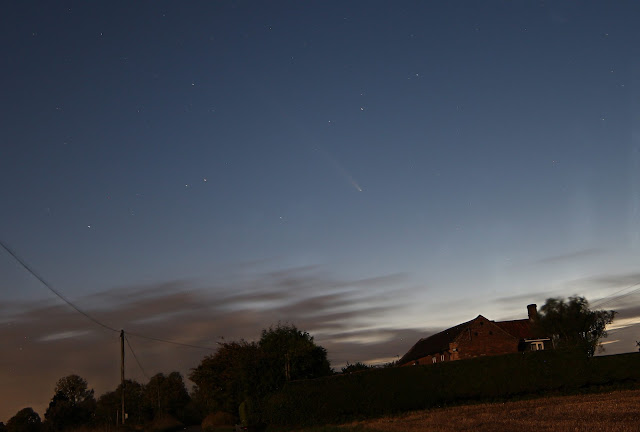
Comet Tsuchinshan-ATLAS, C/2023 A3 , Comet A3,

  A cosmic wanderer, Comet Tsuchinshan-Atlas or more commonly known as Comet A3 has traced its elliptical path through the solar system, a j...