Showing posts with label eos movie record. Show all posts
Showing posts with label eos movie record. Show all posts
Sunday, 4 August 2013
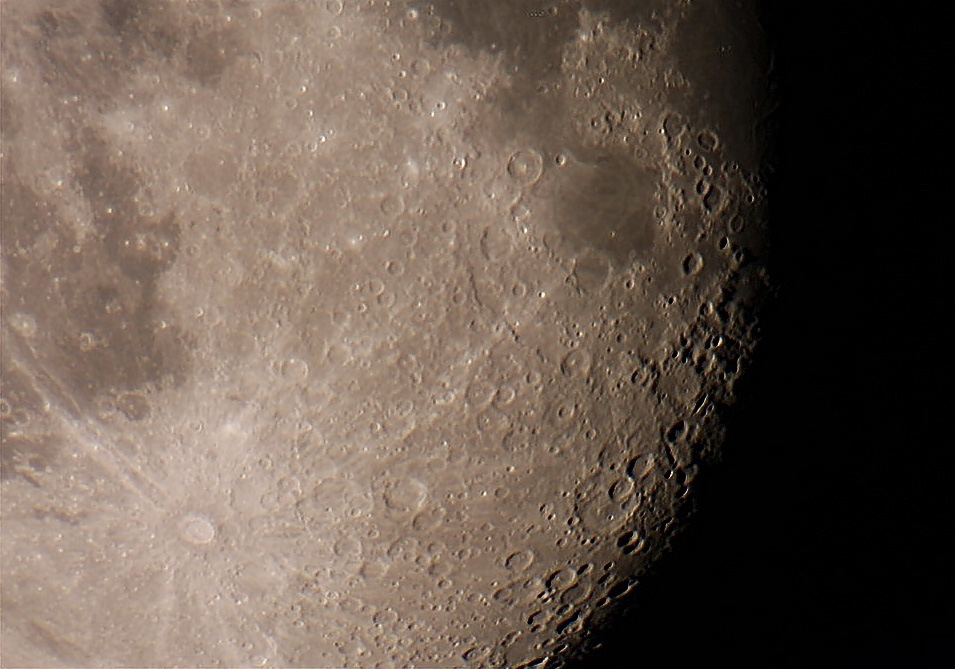
Tycho
Captured on the evening of the 25th July. I love tracing the ejecta rays from the 108 million year old Tycho. I get the impression of a near verticle impact from the ejecta dispersion that can be traced across every quadrant of the moon.


Schiller.
 The somewhat unusual is the crater Schiller. A fusion of two craters with a meteor strike at a very shallow angle. Captured here using the many time mentioned EOS Record. Capturing a live view zoomed avi. Processed in Regitax 6 and 10 iterations using an adaptive Richardson Lucy deconvolution filter.
 Seeing was poor at best and sun's angle of illumination angle gave poor contrast. Although the perfect angle to highlight one rim in shadow. The Rim is well defined and a pair of ridges on the lava flooded floor are easily visible.
Saturday, 20 April 2013
No deep sky for a week or two.
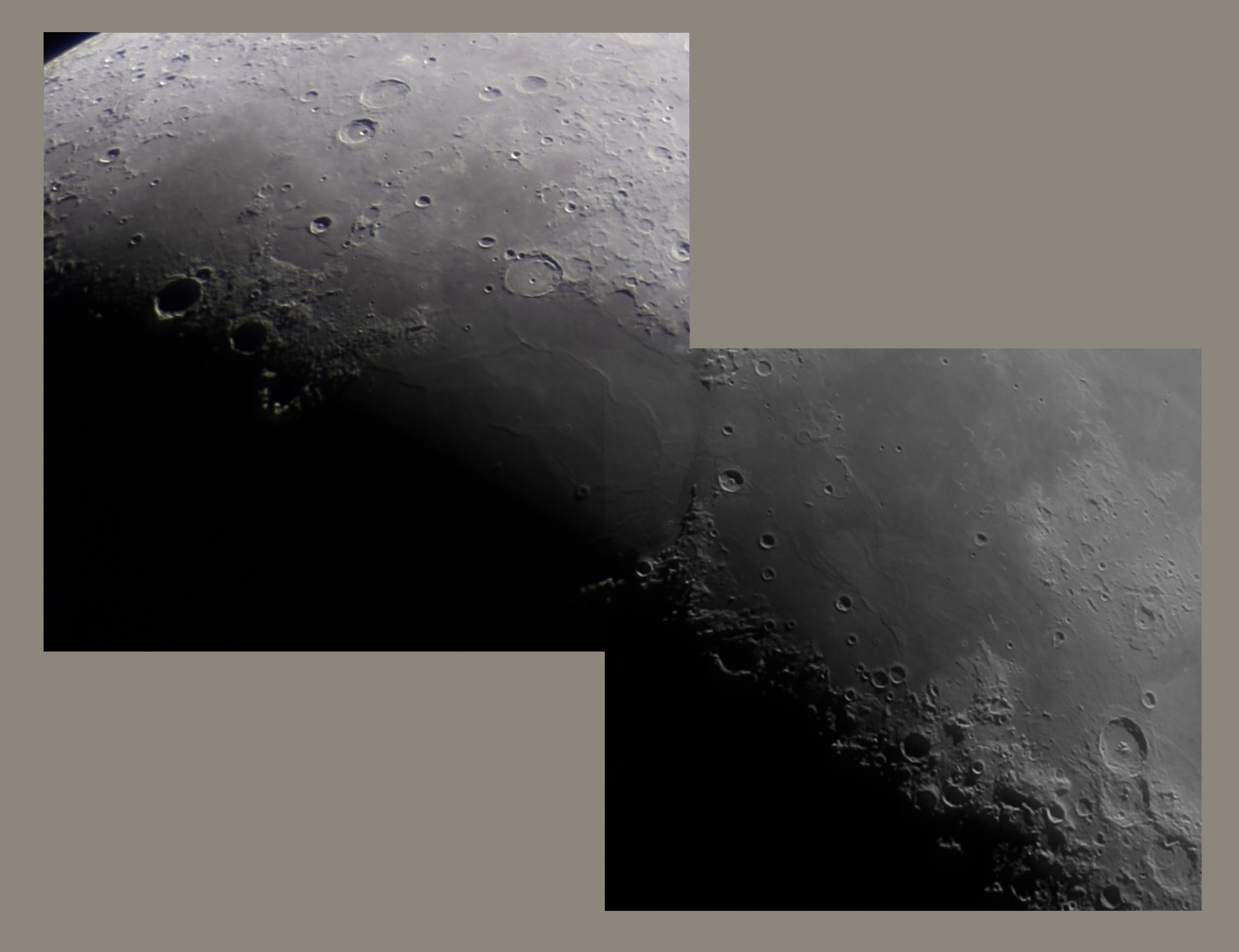
Although the moon is the bain of us deep sky imagers, we unfortunately cannot get away from it. So rather than moan about it I thought I would take advantage on a rare clear night. Using a 2x Barlow and the 40D. I use a programme I have mentioned a few times before called EOS movie record to record an HD video than can be stacked in Registax.
I have spent a great deal of time perfecting a wavelet algorithm to give the right amount of sharpness against the often seen over saturation into noise.
 Mistaken by early astronomers as seas they were dubbed maria Latin for "Seas".
These Basalt plains were formed 3 to 4 billion years ago as lava flows erupted over the cooling surface of the moon.You can see clearly area of thicker magma that give the appearance of rivers flowing through the plains. The 8-9 largest craters you see are all between 70-100 miles wide. The light across the terminator has illuminated the back walls of several craters.
These walls are on average 10,000 feet high.
The areas are less reflective than the Highlands and thus appear darker.
I have spent a great deal of time perfecting a wavelet algorithm to give the right amount of sharpness against the often seen over saturation into noise.
 Mistaken by early astronomers as seas they were dubbed maria Latin for "Seas".
These Basalt plains were formed 3 to 4 billion years ago as lava flows erupted over the cooling surface of the moon.You can see clearly area of thicker magma that give the appearance of rivers flowing through the plains. The 8-9 largest craters you see are all between 70-100 miles wide. The light across the terminator has illuminated the back walls of several craters.
These walls are on average 10,000 feet high.
The areas are less reflective than the Highlands and thus appear darker.
Friday, 2 November 2012
Moon Mosaic no2

Saturday, 20 October 2012
By Jove
 My imaging set up is not designed for planetary imaging. But I couldnt resist having a go at the true king of the planets Jupiter. Taken with my 90mm refractor with the DSLR attatched to a 2 x barlow using 5 x live view magnification and video recording a stack of 500 frames aligned and stacked in registax. Wavelet sharpening and thats it. By no means an image of quality compared to some of the dedicated planetary imagers out there. I might have a go with our societies planetary imager on the 20". I will post the resulting image when it happens.
Subscribe to:
Posts (Atom)
Comet Tsuchinshan-ATLAS, C/2023 A3 , Comet A3,
A cosmic wanderer, Comet Tsuchinshan-Atlas or more commonly known as Comet A3 has traced its elliptical path through the solar system, a j...
-
ASTRONOMER: When you rearrange the letters: MOON STARER Does anyone know any more that are astro related??
-
 A cosmic wanderer, Comet Tsuchinshan-Atlas or more commonly known as Comet A3 has traced its elliptical path through the solar system, a j...