Showing posts with label Star. Show all posts

Saturday, 20 July 2013

Summer Triangle

High above us in July we can see 3 of the brightest stars in the summer sky. They form an astronomical "asterim" ( an imaginary) triangle that cuts into the soft glow of the milky way.The closest of the three is Altair 16 light years away and 10 times as bright as our Sun. Secondly is Vega 25 light years away and featured in the Jodie Foster film "Contact" as a possible source of
intelligent life. Our final giant is Deneb. It appears only slightly dimmer than the other two but fires up at a massive 70,000 times brighter than the sun and a mind
blowing 1550 light years or 26 times the distance of Vega. As you are aware this composite of of course not to scale.

Monday, 15 July 2013

Alberio


In the heart of the summer triangle floating in the sea of stars from ourown milky way's spiral arm lies Albireo . A close binary star system resolved here
and appears to make the star egg shaped. At approx 430 light years away. Visually
this yellow star has a wonderful companion that is a striking Blue. This 50 minute exposure
has drowned the faint colour away. Sorry!!
Perhaps a bit more aggressive processing will bring out some colour.

Saturday, 30 June 2012

Altair.

Having repositioned the guidescope further foward to allow easier connectability for the Canon. A complete rebalance was required after realligning the scopes. Altair was bright in the east and a suitable candidate for practicing on. Guidescope in perfect sync to the canon so I ran a test of 2 each of one two five and ten minute exposures at ISO 800. The ten minute was very bright and I did think that it would be unusable but no it stacked along with the others to produce a 36 minute guided image of  α Aquilae our 12th closest star to us Altair at 16.7 light years it is one of the closest stars to be directly imaged. Altair is an A type main sequece star that's nearly double our suns size but an increase in luminosity of approx 11 times.
Altair possesses an extremely rapid rate of rotation; it has a rotational period of
approximately 9 hours. For comparison, the equator of the sun requires just over 25 days for a complete rotation. This rapid rotation forces Altair to be oblate, its equatorial
diameter is over 20 percent greater than its polar diameter. Below image

 False-color image of the rapidly rotating star Altair, made with the MIRC imager on the CHARA array on Mt. Wilson

Image from Wikipedia

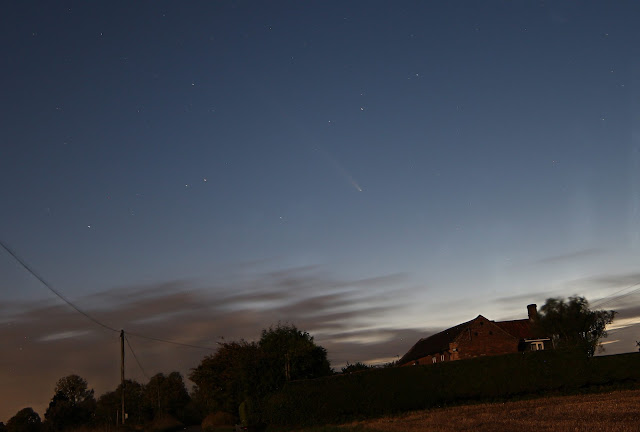
Comet Tsuchinshan-ATLAS, C/2023 A3 , Comet A3,

  A cosmic wanderer, Comet Tsuchinshan-Atlas or more commonly known as Comet A3 has traced its elliptical path through the solar system, a j...