Showing posts with label ZWO ASIair Pro. Show all posts

Monday, 29 May 2023

Pillars of creation

Holy smokes, sometimes you just need to stop in your tracks and just behold the beauty, majesty and enormity of space. M16, The Eagle Nebula or more commonly known as "The Pillars of Creation" is probably the most iconic and well known images of deep space and the legacy of the Hubble space telescope. First captured by Hubble back in 1995. The "Pillars of Creation" is a star forming cloud of Hydrogen gas 90 trillion kilometers wide. The tiny section in the centre of my image resemble fingers, stalagmites of condensing clouds of Hydrogen gas and dust forever reaching into the darkness, lying deep within and not visible to conventional cameras are eggs or incubators of newly formed stars ready for birth in a few hundred million years.

The Black & White images here are my own from my 130mm telescope and cooled camera capturing light at the frequency of 656.21nm or the wavelength Hydrogen Alpha.


An ever increasing zoom into my image reveals the Pillars in all their glory. 
Seven hours of data capture this incredible region.


Finally I get to compare my image to the most celebrated of Hubble's images. With Hubble's final cost of around $10 billion and my modest set up around a million times less I don't think I have done a bad job.


NASA, ESA, and the Hubble Heritage Team (STScI/AURA) - http://hubblesite.org/image/3471/news_release/2015-01

Monday, 10 April 2023

Spider Nebula (update)

Started in December last year with some lovely 5h 50m of Ha data, I have managed to capture some Oiii & Sii data as well during January. 4 hours from each filter will give me a total of 11hrs 50 minutes to produce an SHO image. A JPEG of each processed image. Looking at them now I have done a star reduction on the Ha.

Ha


Oiii

Sii

Combined data 


Also a starless version just because I love the way it looks.


Photo Details

  • Total Exposure:  11 Hours, 50 Minutes ( 46 x 300 sec Ha, 48 x 300 sec Oii, 48 x 300 sec Oiii Frames)
  • Telescope: Skywatcher Esprit ED100
  • Image Acquisition: ZWO ASIair Pro
  • Camera Settings:  ZWO ASI2600mm pro Gain 100, 0°C
  • Accessories: ZWO 7 position Filter wheel
    •                Optolong narrowand filters 
    •                ZWO EAF
  • Calibration Frames: Darks, Flats calibrated.
  • Stacking and Processing: Pixinsight & touch ups in Photoshop. 
  • Size: 2.26 x 1.38 deg 
  • Pixel Scale: 1.41 arcsec/pixel

Monday, 27 February 2023

Well If it is there I might as well take a picture of it.

 Well it is here again above us for another week or so rising right between all these faint galaxies that need imaging. So I might as well take a few pics of it. 

My ZWO ASI 2600mm is not a planetary camera it records an not very impressive 6 frames per second however a couple of minutes of capture and a quick Autostakkert later. The ASIair software allows captures at various resolutions from 1920 all the way down to 240. I have attempted a couple of captures at this setting but the images are so pixelated it is not worth displaying. Working at a longer focal length now I need to capture a 2 pane mosaic to capture the full lunation.


Mare Serenitatis or the “Sea of Serenity” is a lunar Mare. A Mare is a large Basalt plain formed by ancient asteroid impacts on the far side of the moon that have triggered volcanic eruptions on the opposite near side some 3 billion years ago. The word Maria is latin for sea as to early astronomers these dark areas look like seas.

Ancient asteroid impacts on the far side of the moon nearly 4 billion years sent shockwaves through the moon causing volcanic eruptions on the opposite side or the nearside leaving huge Basalt lava basins. Known today as Mare these darker plains looked just like seas to the ancient astronomers and so they now bear their Latin name of Mare. Mare Serenitatis or the “Sea of Serenity” has not changed for billions of years. It has a diameter of 674km and has plenty of features. First we have the crater Posidonius a 95km impact crater located at the north east in this view. The rim of the crater is very shallow a clear indication of its age as it was filled by lava flows giving it almost an appearance of being slowly washed away. Just south of the centre we have a much smaller 16km impact crater called Bessell, circular in shape is an indicator of an impact from directly above as opposed to at an oblique angle creating ejecta in the surround area. The mountain range running north to south at the left edge is part of the Appenine range running nearly 600 km in length. Finally we have the locations of the landing sites of Apollo 15 & 17.


The top most crater of three central craters in the picture below. is Theophilus together with Cyrillus and Catharina they form a prominent group of craters. Theophilus rim rises about 4200m above its floor. It was created in the Eratosthenian period, so it is pretty old. Its central mountain is 1400m high and has four summits. Both Cyrillus and Catharina are much older craters – it can be easily seen how these craters overlap each other.


Sunday, 26 February 2023

Messier 63

Over recent weeks I have been looking at NINA, a freeware program for the control of our telescopes and connected equipment. I have watched lots of YouTube videos and felt I would give it a try. A very complex programme capable of lots of fantastic features, too many to list off the top of my head, all backed up by a large community of users and a host of additional plugins to create a truly customisable experience. Perhaps it is my impatience speaking here as I am now the proud owner of the new Altair 130 EDT scope and the need for collecting some photons is perhaps leading my frustrations. 

I have been now the user of the ASIair pro for several years and have been more than pleased with it's simplicity and ease of use. A clean user interface and an uncomplicated processes leads to the quick set up and start of imaging. So I thought a new challenge was needed....

When building the observatory I ran a powered USB extension into the house as well as a wired internet to allow the flexibility of future connectivity for wired and wireless To set NINA up I rerouted all data cables via my new powered USB hub and through to the extension cable to inside. Connectivity to NINA was simple opening up EQ Mod and PHD2 all stable with no dropouts to the laptop. Using the sky atlas selecting a target was easy and sending it to the framing tool prepares you for the imaging process. From there is where I found some issues, I ran the Hocus focus plugin a number of times but struggled to achieve focus using a number of filters. Making numerous adjustments to the focus steps in the attempt to replicate the demonstrated parabolic curve. Mine looked more like a top hat with odd dips and jumps. I am sure it is just settings but the frustrations exist that following the videos made no difference I just could not replicate anything resembling a good focus. It has also been a long while since I used PHD 2 and encountered similar issues with guiding calibration and not enough star movements. Aghhhhhh. I don't think it helps that I also feel awful, a really bad cough and cold. So for now I have reconnected everything back to the ASIAir, programmed an autorun sequence on M63, Auto focus has achieved and guiding is currently running at .45 RMS Perfectly acceptable. So for tonight anyway I will enjoy the clear sky and continue with this short run of subs. As of this minute I am at 26 from 40 x 5 minutes frames in LRGB. 

The following night was not so great with 95% humidity. So I have ended up with 19 x 5 minute subs in RGB, the Luminance data was for me too blown out so not used.

The Sunflower Galaxy, also known as Messier 63 or M63 and designated as NGC 5055 in the New General Catalogue, is a spiral galaxy located in the northern constellation Canes Venatici. It lies roughly 37 million light years from Earth and has an apparent magnitude of 9.3.

The galaxy is enormous in size, with an apparent size of 12′.6 × 7′.2. This makes it roughly the same size as the Milky Way galaxy, and it has a mass 140 billion times that of the Sun. It is also believed to have a supermassive black hole with a mass of up to 30 million Suns.


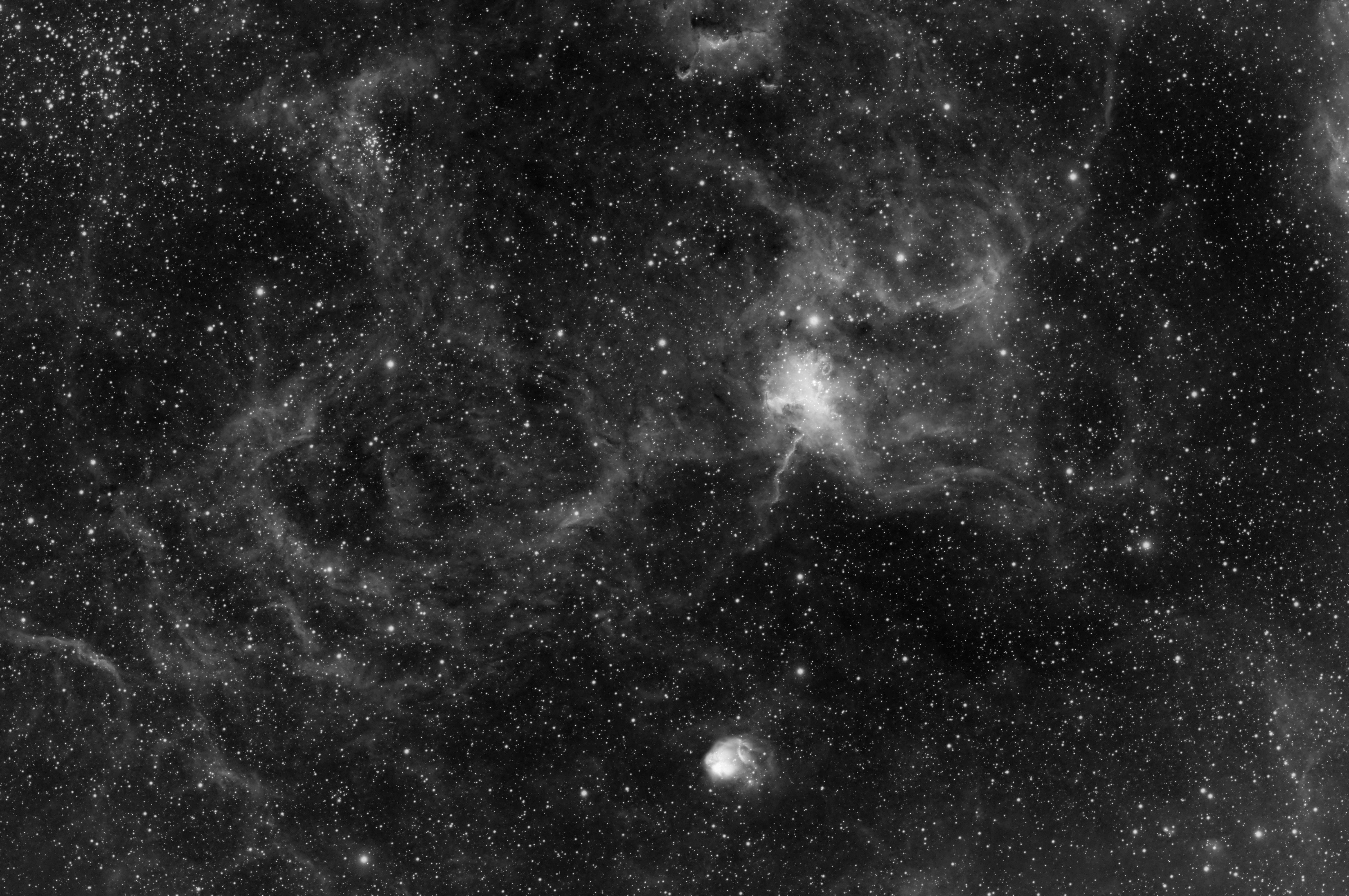
There are a number of fainter PGC galaxies here most of which are a hundred times or more further away. A Pixinsight annotation shows their locations.



Monday, 2 January 2023

Shiney bright thing

 My scope is only 550mm focal length so not designed for lunar imaging. Also my camera is not a planetary camera imaging at just 6 frames a second. So no chance really of capturing good seeing. So the next 3 images are captured with the ASIAir pro. AVI processed in the software and the final jpegs are not huge in size. 


Sunday, 1 January 2023

The Tadpoles SHO processed

About 9 hours of data used to create the HSO version of the IC 410 nebula.

This was a project started lst year with just some Ha data.

48 x 5Min subs Ha
30 x 5Min subs for Oiii & Sii
Plan mode on the AIR incorporating the EAF during acquisition has produced an incredible set of sub frames. Processed in Pixinsight.

Full calibration using WBPP script. DBE, and Linear fit to the Oiii channel, Channel Combination, Generalised Hyperbolic stretch, Correct Magenta Stars, Starnett++Generalised Hyperbolic stretch, Curves, Blur Exterminator, Noise Exterminator, Colour Mask, Convolution, LRGB Combination to add Luminance, Curves, Colour Masks,

I would love to do a video on the processing, but just not that confident in front of the camera.

Anyway the final results are as follows.


A crop of the Tadpoles.


Go on the a little more cropping.


Friday, 30 December 2022

Spider Nebula

I have a few targets in the constellation of Auriga that I continue to look at capturing, some of which  were captured last winter, seems like a long time since I captured IC405 & 410 now, I should have a re process using what I have learnt over this last year from Pixinsight...But as for last night I managed 3hrs 50 mins of Ha data on  IC417 the Spider Nebula. I plan on an SHO image using 5 hours from each filter. As a start we have here an ASI air quick stack and screen stretch of the ha data. Looks lovely on the tablet but just a little processing via Pixinsight I have some lovely clean data and some lovely details too.

1. ASI AIR PRO stack & screen stretch.


2. Pixinsight process.

Using full calibration, Darks, Flats, Dark flats using WBPP script, 2 x Drizzle,
Automatic background subtraction, Blur Exterminator, Noise Exterminator, Histogram Transformation, Starnett++ Curves Transformation & PixelMath to re add the stars at 75%.

The are some interesting objects here in amongst the clouds of ionised hydrogen gas. We will start with 

IC 417 just left of centre of the image (also known as Sh2-234) is an emission nebula of almost 100 light-years across, located some 10,000 light-years away from Earth in the constellation of Auriga (the Charioteer). It is often referred to as the Spider Nebula and in that case its prey is a nearby (above) emission nebula called the Fly (NGC 1931).The nebula contains a young open cluster of about 40 stars, and is energized by its hot, massive blue stars which are still embedded in glowing hydrogen gas.


In the bottom right hand corner is the Charles Messier famed M38 open cluster a much closer 3480 light years and to it's left NGC1912 starfish cluster.

 3. Starless


I really love a starless image you can really explore the Ha regions here.

There will be a great deal more to add to this post as time moves into 2023, there will be at least 5 hours of Ha, Oiii & Sii data to create a SHO palette image. 

Malcolm. aka The Astrogeek

Thursday, 22 December 2022

M45


One the most recognisable objects in the night sky is the Pleidies or the 7 sisters. In Greek mythology they were the 7 daughters of the Titan Atlas & and his wife Pleione. Legend says with the weight of the world on Atlas’s shoulders he was unable to protect his daughters from the great hunter Orion, so In order to save them Zeus transformed them into stars placed them in the heavens away from Orion’s reach.

In reality the cluster contains more than three thousand young hot stars all formed within the last 100 million years with only the brightest visible to the naked eye. The blue nebula that is visible is a cloud of dust these cosmic wanderers are just passing through. My image here was captured over several recent clear nights and is a total of just over 3 hours through my telescope.

20 x 3 minute exposures for each Red, Green & Blue ZWO filters, processed in Pixinsight using the new Blur Exterminator plug in.


The Merope Nebula is the brightest reflection nebula in the Pleiades cluster. It is also known as Tempel’s Nebula. It was discovered by the German astronomer Wilhelm Tempel from Venice, Italy on October 19, 1859. Tempel used a 4-inch refractor to observe the famous open cluster.


You can also see here a small object about the 4.00 O'clock position. The nebula contains a small bright knot, designated IC 349, that is located only 0.06 light years from Merope. The knot was discovered by the American astronomer Edward Emerson Barnard in November 1890 and is also known as Barnard’s Merope Nebula. Barnard observed the knot using a 36-inch telescope at the Lick Observatory in California. IC 349 is about half an arc minute wide. It is the brightest part of the Merope Nebula because it lies so close to the central star. A recent capture from Hubble shows the knot being destroyed by 11km per second stellar winds.


Tuesday, 20 December 2022

The Jellyfish Nebula

30,000 years ago, our planet was in the grip of our last ice age, about the same time Neanderthals were painting the earliest images found in the caves of India. Above early man’s head in the night sky a super massive star has succumbed to the forces of gravity and collapses in on itself, the resulting supernova outshines every other star in the heavens. As we fast forward the thousands of years what we see now is the ever-expanding cloud of dust and gas resembling a jellyfish forever swimming in the cold inky black ocean. Imaged over the last two cold clear nights, nearly nine hours of data were needed to capture this cosmic Scyphozoa.


At the time of posting there has been a new Pixinsight plugin that is creating a great deal of attention by the incredible Russell Crowman. The Blur Xterminator plug in. So there will be an update shortly incorporating this into my workflow.


An except from Russel's Website. BlurXTerminator (rc-astro.com)


BlurXTerminator is an AI-based deconvolution tool designed specifically for astronomical images taken with equipment commonly used by amateur astrophotographers. It is available as a process module plug-in for PixInsight only.

Not all AI is created equal. AI-based sharpening tools for general photography exist but, when applied to astronomical images, they are prone to "inventing" detail that does not exist. They also don't usually handle stars very well. Their neural networks were not trained on astronomical images, so they often make bad "guesses" as to what the original, unblurred scene looks like.

The design intent of BlurXTerminator is to recover as much detail as possible based on low-contrast information actually present in an image, without fabricating detail that does not in fact exist just for the sake of an image that appears sharper. Great care has been taken in the architecture and training of the neural network to ensure that its output is as faithful as possible to reality if it is properly used.

Sunday, 18 December 2022

Monday, 23 May 2022

M94

My second capture and full process with Pixinsight is a spectacular galaxy with a double shell. M94 is a bit of a cosmic mystery. Studies suggest very little to no dark matter. Possible suggestions of a galactic collision also seem to be dispelled so overall a bit of a mystery.

M94 has an inner ring with a diameter of 70". Given its distance, about 5,400 light-years (1,700 pc)) and an outer ring with a diameter of 600″ (about 45,000 light-years (14,000 pc)). These rings appear to form at resonance points in the disk of the galaxy. The inner ring is the site of strong star formation activity and is sometimes referred to as a starburst ring. This star formation is fueled by gas driven dynamically into the ring by the inner oval-shaped bar-like structure. Considering my image scale is jus under 2 arc seconds per pixel, the structure in the spiral arms is seriously impressive.


I must admit also I am seriously impressed by the quality of the last 2 posts that have been fully processed in Pixinsight.

Monday, 11 April 2022

System set up


Well everything is all set up again in the observatory and despite a near full moon when taken everything is working well.


A few small tweaks on the aggression settings and guiding  numbers are down to a really impressive set of low numbers.

Sunday, 6 February 2022

Simies 147 Part 2

 A restart to the project of Simies 147, the previous below 4 pane mosaic was captured using data from the fantastic Telescopius website. It suggested that the 4 panes would work and stich together, as you can see further down that didn't work. So I have re planned a 6 pane mosaic with a greater 30% overlap. I ran a test with 2 frames and with a stretch and alignment in Photoshop and Bingo it works. I would like to run with more data looking at 4-5 hours on each frame, more data equals more signal and less noise. So below is the first run of 50 minutes data per frame. So far with so little data I am very pleased that there is the full shell on view. Shown in negative here you can see the joins and the noise is very apparent. Very happy so far.


Sunday, 30 January 2022

Simies 147


 New project time. I have never attempted this object before even with widefield DSLR.  Simeis 147, also known as the Spaghetti Nebula, or Sharpless 2-240, is a supernova remnant (SNR) in the Milky Way, so huge it straddles the border between the constellations Auriga and Taurus. Discovered in 1952 at the Crimean Astrophysical Observatory by Grigory Shajn and his team using a Schmidt camera and a narrowband filter that was close to the Hydrogen Alpha transmission line. It is difficult to observe due to its extremely low brightness. I honestly was not sure if I would be able to capture anything using 300 second exposures. My first attempt was a 4 pane mosaic using Telescopius to copy the CSV file and pasting it into the ASI air pro. As you can see things did not quite align with a 15% overlap.


My second go will be a 6 pane with a 30% overlap 

Monday, 3 January 2022

IC405


Rippling dust and gas give name to this wonderful nebula. Located very close to my previous image of IC410. The Flaming star Nebula or IC405 is a mix of emission and reflection nebula. A future colour image when the project is complete will show just what I am talking about but for now with a close to full moon this Mono image is captured using just my Optolong Ha filter. Just 2 hours 10 minutes so far of data in 5 minute sub frames shows incredible detail already.  


At the time of this update 3rd Jan there has still been no clear nights. So posting now rather than a complete image. I am sure more updates to follow.


Saturday, 4 December 2021

Lobster Claw Nebula

This hobby can be so frustrating, it has been weeks since I have had the observatory open. In fact it was the 28th October since the dome shutter was rolled back for some photon capture.
My intended target was Sh2-157 The Lobster Claw Nebula, where my aim was to complete my longest imaging capture 24 hours total integration time using Narrowband filters. Narrowband filters are tuned to specific wavelengths of light emitted by Hydrogen, Sulphur & Oxygen and aiming for 4-10-10 hours respectively to create a Hubble palette colour image. One dismal failure later in respect to the weather that is, has left me with what was the initial capture of 1hr of Ha and 1.5 hours of Oiii and just 36 mins of S2 on the night of the 28th.
Patiently waiting now for weeks to further and complete the project. With more rubbish weather forecast over the next week I thought I would have a quick process to see what I have. I am not disappointed with the limited data captured and I guess It will have to wait now as there are winter targets I want to image and of course Comet 2021 A1 Leonard has brightened to becoming a serious contender for comet of the year. Agggggggggggggghhhhhhhhhhhhhh so frustrating.


Photo Details

  • Total Exposure: 3 Hours, 12 Minutes (64 Frames) 20x 3Mins Ha 32x 3 mins Oiii 12x 3 mins Sii
  • Image Acquisition: ZWO ASIair Pro
  • Camera Settings: Gain 100 -10°C
  • Calibration Frames: No Calibration
  • Stacking and Calibration: DeepSkyStacker
  • Processing: Adobe Photoshop 2020, Starnet ++ 
  • Size: 2.26 x 1.38 deg cropped to approx 60%
  • Pixel Scale: 1.41 arcsec/pixel
Additional

Guiding numbers were incredible for the session.


Wednesday, 3 November 2021

Western Veil Nebula

We astronomers are used to time travel, imagine if you could travel back, way back say 8000 years or so. You would have been witness to the supernova that created the Veil Nebula. A new star in that night sky would have been brighter than any other and visible for months. Fast forward to today and we see the remnant of that stellar explosion still moving at over a million miles an hour through space. This is not a true colour image but a bi colour capturing emissions of Hydrogen & Oxygen wavelengths..... This is My first Bi-colour project and a wonderful target it is too.


Photo Details

  • Total Exposure: 4 Hours, 57 Minutes (64 Frames) 30x 3Mins Ha 54x 3 mins Oiii
  • Image Acquisition: ZWO ASIair Pro
  • Calibration Frames: No Calibration
  • Stacking and Calibration: DeepSkyStacker
  • Processing: Adobe Photoshop 2020, Starnet ++ 
  • Size: 2.26 x 1.38 deg 
  • Pixel Scale: 1.41 arcsec/pixel

Sunday, 24 October 2021

CTB1

My most recent project is a target rarely photographed. Probably because of the low surface brightness

Supernova remnants represent the residual effects of massive stars which have reached the end of their life-cycle, including a massive stellar explosion as a grand finale, and which leave behind them spectacular gas clouds and stellar remnants) which cover vast areas in width across the sky. Regrettably, for residents of the northern hemisphere, only four supernova remnants (SNR) are visible

The Crab Nebula (M1) in Taurus,

the massive Veil complex (NGC 6960, 6974, 6979, 6992, 6995 and Simeis 188) in Cygnus,

the Jellyfish Nebula (IC 433) in Gemini and

Simeis 147 (aka Shajn 147, Sh 2-240) also in Taurus.

The most recognized supernova remnant is perhaps the Crab nebula in Taurus which is believed to have exploded in 1054 AD as documented by Chinese astronomers of the time whereas CTB 1 and Simeis 147 are especially dim and represent some of the faintest objects in the sky.

The extended galactic supernova remnant CTB 1 in Cassiopeia is one of the closest SNR's known lying at a distance of about 9,800 light-years away. Measuring approximately 35.2 arc-minutes in diameter and physically spanning 98 light-years across, this circular formation rich with filamentary structure lies immediately east of Caph (β-Cas, mag 2.26) and is characterized with dominant optical, x-ray and radio sources. CTB 1 was originally thought to be a large planetary nebula and was included by Abell in his catalog of planetary nebula (Abell 85) but it was suggested by van den Bergh in 1960 and comfirmed by Willis & Dickel in 1971 to be, in fact, not a planetary nebula but rather a galactic SNR.


Captured also here is a plethora of Open clusters.

Ngc7790 The widows web cluster

Ngc7788

Frovlov 1

Harvard 21

King12

Berk 58


Sunday, 17 October 2021

67P/Churyumov–Gerasimenko

5 years ago now I witnessed one the most incredible feats of engineering skill man has created thus far, not happy with just dropping into orbit around Comet 67P but sending a lander onto the surface too. With gravity at 1/10000 that of earth Philae didn't quite manage to stay put when the cold gas thrusters and harpoon failed to operate. So it bounced twice and settled, wedged into the side of a hill. 


Beautiful imagery was captured and returned by the Rosetta spacecraft detailing the shape and structure. Resembling a peanut shell (image above courtesy of Rosetta) this 2 lobed comet has tumbled through the solar system for billions of years. 

I have been keeping an eye of it's location each night in the hope of a capture worthy of posting. But in typical UK weather the clouds rolled in after less than ten minutes of imaging time against the lovely backdrop of Messier 35.  My intent was an RGB image through filters and using the comet stack in DSS to keep both stars are comet a pinpoint. However plans were scuppered after 7 minutes through the red filter.


Just had a look back at my comet images and this one will be my 16th Comet imaged to date.

In no particular order we have:


All of my previous comet images can be found in the previous pages of my blog.


Thursday, 30 September 2021

M31

Almost a year ago was my M31 Globular clusters project. A fantastic project capturing a staggering 244 globular clusters associated with M31.

A year has passed and another M31 image is forthcoming. This time captured in HaRGB with my newish Mono camera, filter wheel and filters.

All of course captured with the ZWO ASI Air pro, a wonderful little device that has seen countless updated that include plan mode now. This allows an imaging run of multiple targets during a night. It allowed me on this occasion to run an imaging session on M31 swapping over filters and running the autofocus routine after each swap. It ran flawlessly.

So we have a basic stretch on each of the filters and a final combination giving a total of 4 hours, 1 hour on each filter.

Red


Green


Blue


Ha

4 hour Combination HaRGB

Crop


Overall I am very pleased with the image despite no calibration frames used at all here.


Comet Tsuchinshan-ATLAS, C/2023 A3 , Comet A3,

  A cosmic wanderer, Comet Tsuchinshan-Atlas or more commonly known as Comet A3 has traced its elliptical path through the solar system, a j...