Showing posts with label Autoguiding. Show all posts

Monday, 11 April 2022

System set up


Well everything is all set up again in the observatory and despite a near full moon when taken everything is working well.


A few small tweaks on the aggression settings and guiding  numbers are down to a really impressive set of low numbers.

Saturday, 4 December 2021

Lobster Claw Nebula

This hobby can be so frustrating, it has been weeks since I have had the observatory open. In fact it was the 28th October since the dome shutter was rolled back for some photon capture.
My intended target was Sh2-157 The Lobster Claw Nebula, where my aim was to complete my longest imaging capture 24 hours total integration time using Narrowband filters. Narrowband filters are tuned to specific wavelengths of light emitted by Hydrogen, Sulphur & Oxygen and aiming for 4-10-10 hours respectively to create a Hubble palette colour image. One dismal failure later in respect to the weather that is, has left me with what was the initial capture of 1hr of Ha and 1.5 hours of Oiii and just 36 mins of S2 on the night of the 28th.
Patiently waiting now for weeks to further and complete the project. With more rubbish weather forecast over the next week I thought I would have a quick process to see what I have. I am not disappointed with the limited data captured and I guess It will have to wait now as there are winter targets I want to image and of course Comet 2021 A1 Leonard has brightened to becoming a serious contender for comet of the year. Agggggggggggggghhhhhhhhhhhhhh so frustrating.


Photo Details

  • Total Exposure: 3 Hours, 12 Minutes (64 Frames) 20x 3Mins Ha 32x 3 mins Oiii 12x 3 mins Sii
  • Image Acquisition: ZWO ASIair Pro
  • Camera Settings: Gain 100 -10°C
  • Calibration Frames: No Calibration
  • Stacking and Calibration: DeepSkyStacker
  • Processing: Adobe Photoshop 2020, Starnet ++ 
  • Size: 2.26 x 1.38 deg cropped to approx 60%
  • Pixel Scale: 1.41 arcsec/pixel
Additional

Guiding numbers were incredible for the session.


Friday, 6 September 2013

M33 The Triangulum Galaxy.

 The weather recently has been quite good. Forecast was excellent and clear the whole night. No work either for me this week so I decided to go an all nighter. Happy that the mount was working fine, I decided that 10 minute exposures would be the order of play. My Eastern view is excellent and suffers no light pollution so should not be too detremental of the Canon 40D in noise. I managed to grab 220 minutes in total in 10 minute subs. As this is a test for the new set up I have yet to take 10 minute darks, so no darks subtraction. Stacked in DSS and processed in Imagesplus I am pleased with the result. Pic 2 is a reprocess by fellow Blogger Andrew via his pix insight software. Considerable difference in detail. I may just have to invest in. Just not sure if I have the time at present to learn a whole new processing pathway.


First test of the mount

Having completed the set up and install of cables etc. time has come to test the mount from it,s initial switch on. I aimed at a familiar target and let PHD do it's set up. My first test shot was a 10 minute exposure this would have been a personal record in itself. The second was 20 minutes and the third 30 minutes. to say the least I was very excited in seeing an image appear like these on the screen.


I am very pleased with the initial results and I want to look into recording the periodic error, using the data from that to guide more accurately.

I used the familiar Canon 40D as the imaging camera, I am of course used to it's set up and user friendliness. I would restrain myself and set up the starlight express when I am happy everthing works.

It appears everything is working well.

Monday, 15 July 2013

M 52 & a Bubble


Picture the scene, France was bathed in a period of mourning for
King Louis XV a struggling economy and battle scarred France
decended futher into dissaray from decades of war that was soon
to fall to the people in the French Revolution . Meanwhile French
astronomer and comet hunter Charles Messier had found another faint object to add to his expanding catalogue of (non cometary bodies), whilst observing a comet in the same region .Catalogued as galactic open star cluster (M52) Approx 5000 light years away and 35 million years old, this collection of approx 200 stars has shone for countless eons of time. You will also notice a bubble of glowing gas, at more than twice the distance of M52 this shockwave of expanding gas & dust was created and illuminated by the energetic radiation from a
massive star. This image was taken last night or should I say early this morning for what was an all nighter. The guiding worked well all night allowing for 5 minute sub frames to give me this 1hour 15 minute shot. Focus was a few microns off though.

Thursday, 14 March 2013

It's About Time.

Comet C/2001 L4 PANNSTARRS has finally graced our northern hemisphere skies. This evening for me was a little frustrating. Located below a new moon it should have been visible. Except there was a horizon of cloud that stayed put for the duration. It was good to see via facebook a couple of fellow bloggers and Breckland AS society members, Dr Dan Barnfield Bob catch a glimpse of the comet this evening.The skies however have cleared. The seeing not perfect but I have set the cameras in motion. Having done very little astronomy since christmas it feels good to get back to it. I had planned on a slight modification to my set up in which the 66mm guidescope would come off and used as a grab and go. My imaging scope would then be connected to an off axis guider and camera, thus lightening the load on my ageing mount. But unfortunatly the focusser just could not take the weight for the auto focus to work. So I have gave up on the idea and rebuilt the 66mm back on board. I have also increased the counterweight slightly and this seems to help with the guiding consistency. With this I wanted an easy target to test the system. I caught about 90 mins will process in the morning.

As promised from last night I managed to capture some photons of that were travelling through the darkness of space for 35 million years to arrive last night at my camera lens. This trio of galaxies all look slightly different as the galactic discs are tilted to different angles from our line of sight.The galaxy on the left is known as NGC 3628, seen edge on with obscuring dust lanes cutting across the plane of the galaxy. while the disks of M65(top) and M66 are both inclined enough to show off their spiral structure. There is evidence that all 3 galaxies have interacted with each other some 800 million years ago.

Saturday, 30 May 2009

M27 The Dumbell Nebula


Object: Dumbbell Nebula M27
Type: Planetary Nebula
Constellation: Velpecula
Date: 30 May 09 01.30am
Equipment: William Optics Megrez 90 Canon EOS 40D guided usin 66mm William Optics refractor & Atik 16IC camera.
Subframes: 1 x 8 minute exposures at ISO800, 1 x 8 minute dark, Bias & light frame calibrated
Stacked: by Deep Sky Stacker.
Processed: In Images Plus 3.75 with a DDP stretch.

Notes: This is the first opportunity to guide using my new Atik 16IC camera. I was able to guide using what I estimate to be a 9th Mag star. I am seeing a much better signal to noiseratio by generating a longer exposure rather than 16 x 30 seconds. I look foward to future tests.

Monday, 27 April 2009

Auto Guiding works On M57


Before I send my LXD 75 mount for a service I wanted to have a go myself. Stripped & rebuilt, remounted and a perfect polar alignment later. I thought lets put the DSLR on and test PHD as it was tracking very badly (the fault of the mount by the way)and see what I get.
I wanted a target that was nebulous to also put to the test my new Lumicon 2" deep sky filter. Generally considered the best all purpose nebula filter on the market.With a transmission of 486nm Hydrogen-Beta @ 94%, 656nm Hydrogen-Alpha @ 92% & the double ionised lines of Oxygen III of 496nm to 501nm @92%. The Deep Sky Filter also passes infrared light, making it an excellent filter for photographing most deep space objects through light-polluted skies.
Enough of the tech stuff did it work?. The simple answer is the pic above. This Image was a 20 minute Phd guided exposure. My jaw hit the floor as everything performed flawlessly.

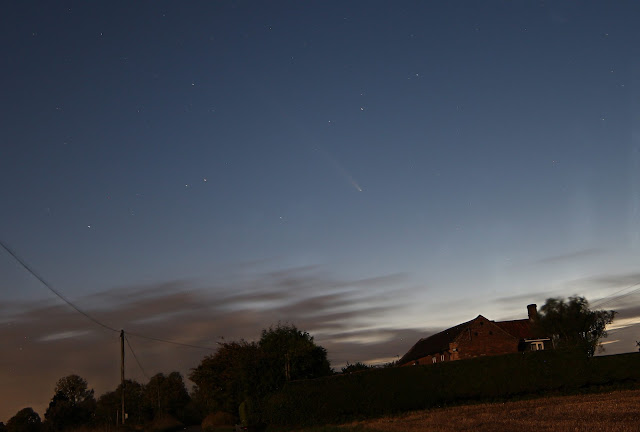
Comet Tsuchinshan-ATLAS, C/2023 A3 , Comet A3,

  A cosmic wanderer, Comet Tsuchinshan-Atlas or more commonly known as Comet A3 has traced its elliptical path through the solar system, a j...