Showing posts with label RGB imaging. Show all posts

Sunday, 13 August 2023

M13 The Great Cluster

Without doubt the finest of globular clusters visible in the northern hemisphere. Located outside the plane of our galaxy and some 25,000 light years away.

An easy target to find.

M13 is located in the constellation Hercules, between summertime’s two brightest stars, Vega and Arcturus. About 1/3 of the way from Vega to Arcturus, locate the four modestly bright stars forming the Keystone of Hercules. On the Arcturus side of the Keystone, M13 lies between the stars Eta Herculis and Zeta Herculis.

A typical binocular field is about 5 to 7 degrees in diameter, and the Hercules cluster is found about 2.5 degrees south of Eta Herculis. The Hercules cluster’s position is Right Ascension: 16h 41.7m; Declination: 36 degrees 28′ north.

M13 was one of my first targets I captured many years ago. The cluster will not have changed since it's discovery over 300 years ago,  but my imaging and processing have. This Image is just 1.5 hours of data using the ZWO RGB filters, 30 minutes per filter.


Cropped image


Processed in Pixinsight.

Monday, 29 May 2023

M10

Well a first for me I think in the last couple of years. 3 yes, three nights clear in a row and no work, so that means 3.00am finishes each night. Tonight would be night 4 but the forecast is for clouds. Oh well it was good while it lasted.

The plan to continue with the E nebula when it rises high enough so for now just 45 minutes 15x 60 sec RGB on M10. It will soon disappear into the tree so very limited time on target. I have a high fence around the house and a tree at due south so anything this low that rises is only visible for an hour or so.

Not a great result but happy I managed to capture it.


Tuesday, 23 May 2023

M12


Not a great deal has changed in the 259 years since its discovery by French astronomer Charles Messier, M12 is a densely packed cluster of hundreds of thousands of the galaxies very oldest stars estimated to be over 13 billion years old, bound by gravity this cluster is 75 light years in diameter or about 435 trillion miles in length in comparison that would be approx. 74,000 yes seventy four thousand times the size of our own solar system of planets.

It took the new horizons probe 9.5 years to get to Pluto so that would mean it would take another seven hundred thousand years before it arrives at the majestic M12.

This image is an RGB combination of 20 x 120 second exposures using all 3 filters so a total of 2 hours combined data, processed in PI.

Considering this for me is very low down and just above the fence line I am very pleased with the result.


Sunday, 16 April 2023

M5

A reprocess of the M5 data using drizzle, still unsure if I am happy with the difference.


Discovered in 1702, M5 by German astronomer Gottfried Kirch whilst observing a comet, M5 is very nearly a naked eye object, I cannot confess to observing it naked eye myself but visually through a telescope a stunning object. Though the camera even more spectacular resolving stars all the way to the core. Combined as a RGB image displays a wealth bright colourful stars. M5 contains a large number of Cepheid variable stars that have allowed astronomers to accurately to 24,500 light years.


  • Total Exposure:  1 Hour, 30 Minutes ( 30 x 60 sec in the R,G & B filters)
  • Telescope: Altair Astro EDT130 Triplet.
  • Image Acquisition: ZWO ASIair Pro
  • Camera Settings:  ZWO ASI2600mm pro Gain 100, 0°C
  • Accessories: ZWO 7 position Filter wheel
    •                ZWO Broadband filters 
    •                ZWO EAF
  • Calibration Frames: Darks, Flats calibrated.
  • Stacking and Processing: Pixinsight & touch ups in Photoshop. 
  • Size: 44 x 33 arc minutes
  • Pixel Scale: 1.05 arcsec/pixel

Friday, 24 March 2023

Springtime Galaxies

The clear nights are so few and far between. I have been desperate to update some of the older images from my collection, Last imaged 10 years ago and really not that good.

A minute collection of data here as the clouds rolled in again. Had a few issues with the guiding and binned a large amount of subs. My error though. I had left the guiding set to Lunar DOH........

So in all I have just 10 x 5 minutes Red, 4 x 5 minutes Green & just 3 x 5 minutes in Blue.

Quite pleased that there are over a 100 faint fuzzies in the frame.


Friday, 20 January 2023

M42 The Great Orion Nebula

The Great Orion Nebula has always been a firm favourite to view visually or to image. I was lucky enough to view the trapezium through the clubs 20 reflector. A beautiful sight in a quality eyepiece. I also had some fun imaging it too. Not a very favorably placed object for my backyard with the fence and a number of electricity cables stretching across from  The South to the North East. So an imaging run consist of a lot of rejected frames with wires.


I created a starless image to process the nebula, looks quite nice


The we have the Running Man Nebula

Monday, 23 May 2022

M94

My second capture and full process with Pixinsight is a spectacular galaxy with a double shell. M94 is a bit of a cosmic mystery. Studies suggest very little to no dark matter. Possible suggestions of a galactic collision also seem to be dispelled so overall a bit of a mystery.

M94 has an inner ring with a diameter of 70". Given its distance, about 5,400 light-years (1,700 pc)) and an outer ring with a diameter of 600″ (about 45,000 light-years (14,000 pc)). These rings appear to form at resonance points in the disk of the galaxy. The inner ring is the site of strong star formation activity and is sometimes referred to as a starburst ring. This star formation is fueled by gas driven dynamically into the ring by the inner oval-shaped bar-like structure. Considering my image scale is jus under 2 arc seconds per pixel, the structure in the spiral arms is seriously impressive.


I must admit also I am seriously impressed by the quality of the last 2 posts that have been fully processed in Pixinsight.

Sunday, 17 October 2021

67P/Churyumov–Gerasimenko

5 years ago now I witnessed one the most incredible feats of engineering skill man has created thus far, not happy with just dropping into orbit around Comet 67P but sending a lander onto the surface too. With gravity at 1/10000 that of earth Philae didn't quite manage to stay put when the cold gas thrusters and harpoon failed to operate. So it bounced twice and settled, wedged into the side of a hill. 


Beautiful imagery was captured and returned by the Rosetta spacecraft detailing the shape and structure. Resembling a peanut shell (image above courtesy of Rosetta) this 2 lobed comet has tumbled through the solar system for billions of years. 

I have been keeping an eye of it's location each night in the hope of a capture worthy of posting. But in typical UK weather the clouds rolled in after less than ten minutes of imaging time against the lovely backdrop of Messier 35.  My intent was an RGB image through filters and using the comet stack in DSS to keep both stars are comet a pinpoint. However plans were scuppered after 7 minutes through the red filter.


Just had a look back at my comet images and this one will be my 16th Comet imaged to date.

In no particular order we have:


All of my previous comet images can be found in the previous pages of my blog.


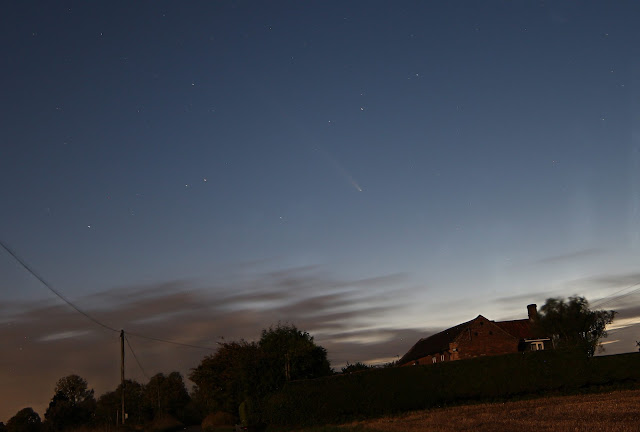
Comet Tsuchinshan-ATLAS, C/2023 A3 , Comet A3,

  A cosmic wanderer, Comet Tsuchinshan-Atlas or more commonly known as Comet A3 has traced its elliptical path through the solar system, a j...