Showing posts with label M1. Show all posts

Tuesday, 14 February 2023

A new beginning.

It is with a heavy heart I say goodbye to my trusted Esprit ED100, my workhorse for the last couple of years. I do know though it has gone to a good home, Living it's life now on the Kent coast to a lovely chap called Tony who came up this morning with his wife to view and make a purchase. I hope they enjoyed their time here and after seeing my advert on UK astrobuyandsell. I hope the scope gives him the same enjoyment as it has done for me for many years to come.

So for me an unexpected deal has presented itself. My good friend Richard from our society has made a life changing decision and emigrated to Brazil. I happened to mention a few weeks ago I was looking to upgrade to a longer focal length, with that was the offer of his Altair Astro 130EDT triplet refractor. A fantastic scope that has given Richard some wonderful images. Richard was kind enough to offer me the scope to try as I was unsure if it would fit inside my modest dome. My initial set up left me disappointed as there was not a great deal of room as the scope moved around with USB cables brushing the walls, so from there I initially said thanks but no thanks. I think the plan for him was to make a quick sale on UK astrobuyandsell as he did not want to take the scope with him. So I took the plunge and said yes I will have it and make it fit. I have spent the last few days positioning the scope in the rings and finally achieved great balance with a little more headroom than before. So I think this will work well for me.

Side by side they are worlds apart in size. When I built the observatory at the time I never thought any upgrade would be this big. I imagined a 115mm would suffice.


It fits.


Luckily for me too there was a couple of hours reasonably clear before the fog and cloud ruined the remainder of the evening. I opted for a target that was past the meridian and nice and high over the house so M1 the Crab nebula was my first light target.

All I could manage was 5 x 5 minutes in RGB using the ZWO filters. A rough and quick process in Pixinsight with no calibration frames and what is a huge crop. I am very pleased and happy with this initial first light image of 724mm focal length. Initial results in guiding also good with an average RMS of just over .6

The Astrogeek is one happy chappy.


Saturday, 19 November 2011

First Light M1

It has been a long time waiting. But here it is first light from the new Hills Observatory. I thought I would pay homage to Messier's no 1 in his collection of fuzzies to avoid the great Crab Nebula M1. The last two nights have been clear if somewhat damp. A good test or the new home of my scopes. Water has been dripping off the outside of the dome and the grass is soaked you can feel the damp in the air. But I still wanted to have a play. The observatory has worked incredibly well no damp on the internal walls or inner dome. Now moisture build up on the mount or Pier. The optics remained clear too. I didn't even power up the dew heaters. So here is the pic. A wide field shot of M1 in all its glory. A 3 hour guided exposure over 2 nights of 2.5 minute subs at ISO 800 Dark's subtracted. I will do a series of flats over the weekend and re post if I get an improvement. Let me know what you think.

Wednesday, 29 October 2008

M1


Object: Messier 1 (M1, NGC 1952),

Type: Super Nova Remnant

Distance: 6500 Light Years (Approx) Constellation: Taurus
Date: 27th October 08
Equipment: William Optics Megrez 90 Canon EOS 40D
Subframes: 41 x 30 second exposures unguided at ISO800
Processed: No darks or flats were captured. Processed in Images Plus 2.0 with a non linear stretch or DDP. 7


Notes: Observed by a Chinese astronomers on July 4th 1054 AD, the Guest star was seen in daylight for 23 days and visible to the naked eye in the night sky for a staggering 653 nights.

Approx 10 Light years diamater expanding at 1,800 km/sec.


At the center of the nebula lies the Crab Pulsar, a rotating neutron star, which emits pulses of radiation from gamma rays to radio waves with a spin rate of 30.2 times per second. The nebula was the first astronomical object identified with a historical supernova explosion.


I am not entirely happy with this shot a bit more processing perhaps or a new series without frosty optics I really wanted to glimpse the Pulsar.

Back In Time: As the light left M1 we travel back to the year 4493BC. Chronicles suggest early Mesopotamian cultures in present day Iraq and Egyptian civilizations on the Nile. In England the Neolithic period was just commencing and Stonehenge wasn't far off being constructed.

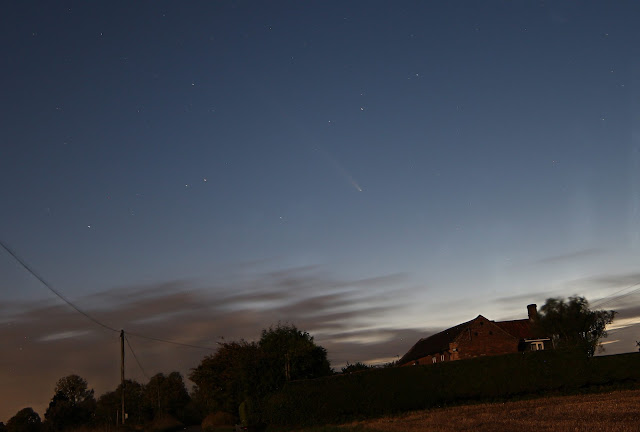
Comet Tsuchinshan-ATLAS, C/2023 A3 , Comet A3,

  A cosmic wanderer, Comet Tsuchinshan-Atlas or more commonly known as Comet A3 has traced its elliptical path through the solar system, a j...