Showing posts with label The Pleidies. Show all posts

Thursday, 22 December 2022

M45


One the most recognisable objects in the night sky is the Pleidies or the 7 sisters. In Greek mythology they were the 7 daughters of the Titan Atlas & and his wife Pleione. Legend says with the weight of the world on Atlas’s shoulders he was unable to protect his daughters from the great hunter Orion, so In order to save them Zeus transformed them into stars placed them in the heavens away from Orion’s reach.

In reality the cluster contains more than three thousand young hot stars all formed within the last 100 million years with only the brightest visible to the naked eye. The blue nebula that is visible is a cloud of dust these cosmic wanderers are just passing through. My image here was captured over several recent clear nights and is a total of just over 3 hours through my telescope.

20 x 3 minute exposures for each Red, Green & Blue ZWO filters, processed in Pixinsight using the new Blur Exterminator plug in.


The Merope Nebula is the brightest reflection nebula in the Pleiades cluster. It is also known as Tempel’s Nebula. It was discovered by the German astronomer Wilhelm Tempel from Venice, Italy on October 19, 1859. Tempel used a 4-inch refractor to observe the famous open cluster.
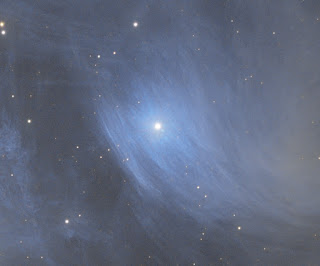

You can also see here a small object about the 4.00 O'clock position. The nebula contains a small bright knot, designated IC 349, that is located only 0.06 light years from Merope. The knot was discovered by the American astronomer Edward Emerson Barnard in November 1890 and is also known as Barnard’s Merope Nebula. Barnard observed the knot using a 36-inch telescope at the Lick Observatory in California. IC 349 is about half an arc minute wide. It is the brightest part of the Merope Nebula because it lies so close to the central star. A recent capture from Hubble shows the knot being destroyed by 11km per second stellar winds.


Monday, 3 January 2022

M45 The Pleiades


Unchanged for eons. The Pleiades or the 7 sisters look the same today as they did for the first humans that walked the earth 1.9 million years ago. Without doubt the most beautiful and most recognisable of all the objects we can see in the night sky, this cluster of stars shine and reflects a hypnotic blue light onto dust that the stars are passing through. There is even a bronze age 1600bc artifact called the Nebra sky disk that is believed to depict the cluster. Located at a distance of around 400 light years. This means the light we see today left at the time Galileo Galilei made his first observations with the first telescope.


Nebra Sky Disk image first published Dec 2006 Copyright Dbachmann

Galileo's drawings of the Pleiades star cluster from Sidereus NunciusImage courtesy of the History of Science Collections, University of Oklahoma Libraries.

Thursday, 1 April 2021

Multiple M45 views

The Pleiades is always a favourite from Autumn to spring, 2020 saw a few different compositions. from a conjunction with Venus to an unfinished multi panel mosaic.


Saturday, 7 November 2020

Pleiades

A star cluster known to every civilisation and buried within the folklore across every culture on the planet, The Pleiades or the seven sisters is probably the most recognisable of all the 88 constellations. I think also the best example of a reflection nebula. Containing over a thousand members mostly of hot young stars. Slowly moving through space through an unrelated dust cloud, the dust is illuminated by light and the energy of the stars.


I love the way the dust is sculpted in front of the stars Maia & Merope.


Just under two hours of exposure time captured in 3 minute exposures using the ZWO ASI294MC pro, Calibrated with Flats, Darks and Dark Flats The first real test too using the new auto focus routine with the ZWO EAF focuser. All I can say is incredible, A quick and simple procedure that takes 2-3 minutes and can be incorporated into the autorun of a sequence. You can add a change to focus via temp difference or time. A Video to follow.


Monday, 11 October 2010

M 45 Revisited

     As I mentioned previously I am returning to those treasures that I had previously captured using my Canon 300D. After a wonderful clear sky day at the zoo with my family. I wanted to get what could be the last trip outside before my training starts, and that will mean well into Jan before another opportunity comes along.

So here is the result.

There was a 86% humidity last night so the dew heaters were working overtime but did their job well.

    This image is a stack of 61 x 1 minute Iso 800 unguided exposuress in RAW. No darks or other calibration files used.
I may even have another go with the Lumicon deep sky filter on too?

    I can see a gradient across the image but do not posess the gradient remover tool. Contains a good DDP stretch . This is the first run of this set so I may return and update it if I get chance to look at what else I can do in Images plus. I have the untouched master Tiff file is anyone wants to have a go with it too just drop me an email.

I am quite pleased with the result the wispy tendrills are much more pronounced around Merope and Maia. Everything about the image is a good deal more natural I also like the horizontal shock waves under Electra.

PS poor jpeg compression . I will look at it when I can.

Tuesday, 28 October 2008

M45 The Pliedies


Object: M45Type: Open Cluster
Distance: 380Light Years (Approx)
Constellation: Taurus
Date: 27th October 08
Equipment: William Optics Megrez 90 Canon EOS 40D
Subframes: 6 x 30 second exposures unguided at ISO800 and 1 x 3.5 Minute Autoguided exposure again at 800 ISO
Processed: No darks or flats were captured. Processed in Images Plus 2.0 with a Moderate non linear stretch or DDP. 7 Iterations on a adaptive Richardson Lucy deconvolution filter.
Notes: The Pleiades nebulae are blue-colored, which indicates that they are reflection nebulae, reflecting the light of the bright stars situated near (or within) them.
Back In Time: As the light left back in 1627, back on earth a Dutch ship sighted the coast of southern Australia, while the English were colonising the island of Barbados. An earthquake devastated southern Italy and astronomer Johannes Keppler published his laws on planetary motion The Rudolphine Times


Comet Tsuchinshan-ATLAS, C/2023 A3 , Comet A3,

  A cosmic wanderer, Comet Tsuchinshan-Atlas or more commonly known as Comet A3 has traced its elliptical path through the solar system, a j...