Showing posts with label ZWO RGB filters. Show all posts

Sunday, 13 August 2023

M13 The Great Cluster

Without doubt the finest of globular clusters visible in the northern hemisphere. Located outside the plane of our galaxy and some 25,000 light years away.

An easy target to find.

M13 is located in the constellation Hercules, between summertime’s two brightest stars, Vega and Arcturus. About 1/3 of the way from Vega to Arcturus, locate the four modestly bright stars forming the Keystone of Hercules. On the Arcturus side of the Keystone, M13 lies between the stars Eta Herculis and Zeta Herculis.

A typical binocular field is about 5 to 7 degrees in diameter, and the Hercules cluster is found about 2.5 degrees south of Eta Herculis. The Hercules cluster’s position is Right Ascension: 16h 41.7m; Declination: 36 degrees 28′ north.

M13 was one of my first targets I captured many years ago. The cluster will not have changed since it's discovery over 300 years ago,  but my imaging and processing have. This Image is just 1.5 hours of data using the ZWO RGB filters, 30 minutes per filter.


Cropped image


Processed in Pixinsight.

Wednesday, 19 April 2023

M88 & M91

It has been a very windy day today, bright and clear but very windy, I wasn't hopeful looking at the weather app today for anything useful tonight. However image capture started at around 21.15 tonight with just a little wind and possibly the odd swirl inside the dome as guiding tonight is around and just under 1.00 arc second, happy with that of course but higher than the usual numbers. Looking at the subs appear every 5 minutes on the tablet, each one battered with satellites. At least I don't have to bin the subs anymore I wouldn't have anything after the first hour.

3 Hour RGB integration


Annotated


Inverted


M88 Crop 24 by 17 arc minutes


M88 Inverted

M91 Crop 19 by 18 arc minutes

M91 Inverted


NGC 4571 Crop 15 by 13 arc minutes

  • Total Exposure:  3 Hours, 12 x 5 Minutes RGB Filters per filter
  • Telescope: Altair Astro EDT130 Triplet.
  • Image Acquisition: ZWO ASIair Pro
  • Camera Settings:  ZWO ASI2600mm pro Gain 100, 0°C
  • Accessories: ZWO 7 position Filter wheel
    •                Optolong Broadband filters 
    •                ZWO EAF
  • Calibration Frames: Darks, Flats calibrated.
  • Stacking and Processing: Pixinsight & touch ups in Photoshop. 
  • Size:   1d 47' 22.2" x 1d 11' 18.0"
  • Pixel Scale: 1.046 arcsec/pixel


Friday, 7 April 2023

Stephans Quintet.

A project started at the end of October last year with my now sold 100mm scope, and will be finished this year with the new 130mm. NGC 7331 and Stephan’s quintet are a fascinating group of targets. This is a huge crop of the original image(a) now just less than one by half a degree at a pixel scale of 1.44 arc sec per pixel(b).


The enigmatic galaxy at the top is NGC 7331 a wonderful example of a spiral galaxy located some 40 million light years away in the constellation of Andromeda. The half a dozen smaller galaxies behind are a good deal further away at on average of 350 million light years distance. The light you see here left when Earth was in the Paleozoic era when Amphibians left the water to first roam the land. A time long, long, long before the dinosaurs emerged, lived and perished.

However, the objects of interest that inspired this image are located below. A visual group of 5 interacting galaxies known as Stephan’s Quintet. 4 of which are interacting with each other 270 million light years away and one NGC 7320 that is in the foreground at just 40 million light years.


The strange morphology of these galaxies has been defined by several theories including a head on collision between two of the group NGC 7318 & 7319 causing a tidal shock in the intergalactic gas. You can see clearly the stream from 7319 that is larger than our entire galaxy and moving at a million miles per hour. This was followed by a collision between 2 more galaxies and all contribute to the chaos of what you see. There are very few of these galactic interactions visible and they have helped astronomers over the years refine the physics & theories into galaxy interactions.

The image you see here is a composite exposure of just one hour using the green filter on the mono camera. The idea is to capture data in the Red, Green & Blue filters to produce a full colour image. This is programmed ready in the Autumn when the constellation rises again in the East.


A handy finder chart shows the location.

The Little red box on the sky map is the field of view for my old telescope. The new scope will have a smaller box giving higher magnification. I hope it gives you an idea of how small these objects are. 

Wednesday, 5 April 2023

M3

 First discovered in Dec 1764 by French astronomer Charles Messier, M3 is again a globular cluster with over 500,000 stars and an age of a mind blowing 11.4 Billion years old. Easily visible in binoculars or a telescope.


12 x 2 minute exposures in RGB channels combined in Pixinsight. Core Brightness reduction in Photoshop.

Tuesday, 4 April 2023

M53


M53 is one of about 250 globular clusters belonging to our Milky Way galaxy. At a distance of 60,000 light years, M53 is one of the more distant clusters. The globular contains many older red stars, but it also has a number of blue stars. Such young blue stars are fairly uncommon in globular clusters.

One atypical feature of this image is that I collected all of the sub exposures for this image when the Moon was89% full. Usually I don't photograph Broadband targets when the Moon is out, as the bright light from the Moon washes out the faint parts of most images. However, I was able to capture this image fairly well, because globular clusters consist entirely of stars. Almost all of the stars are individually brighter than the background light from the Moon.

Image capture was 12 x 3 minute exposures in the RGB filters and Pixinsight processed.


In the same field of view from the full frame NGC5053 is a much fainter cluster of stars a  little closer at 57,000 light years, very faint tidal streams suggest some interaction between the two in the past.


Friday, 20 January 2023

M42 The Great Orion Nebula

The Great Orion Nebula has always been a firm favourite to view visually or to image. I was lucky enough to view the trapezium through the clubs 20 reflector. A beautiful sight in a quality eyepiece. I also had some fun imaging it too. Not a very favorably placed object for my backyard with the fence and a number of electricity cables stretching across from  The South to the North East. So an imaging run consist of a lot of rejected frames with wires.


I created a starless image to process the nebula, looks quite nice


The we have the Running Man Nebula

Thursday, 22 December 2022

M45


One the most recognisable objects in the night sky is the Pleidies or the 7 sisters. In Greek mythology they were the 7 daughters of the Titan Atlas & and his wife Pleione. Legend says with the weight of the world on Atlas’s shoulders he was unable to protect his daughters from the great hunter Orion, so In order to save them Zeus transformed them into stars placed them in the heavens away from Orion’s reach.

In reality the cluster contains more than three thousand young hot stars all formed within the last 100 million years with only the brightest visible to the naked eye. The blue nebula that is visible is a cloud of dust these cosmic wanderers are just passing through. My image here was captured over several recent clear nights and is a total of just over 3 hours through my telescope.

20 x 3 minute exposures for each Red, Green & Blue ZWO filters, processed in Pixinsight using the new Blur Exterminator plug in.


The Merope Nebula is the brightest reflection nebula in the Pleiades cluster. It is also known as Tempel’s Nebula. It was discovered by the German astronomer Wilhelm Tempel from Venice, Italy on October 19, 1859. Tempel used a 4-inch refractor to observe the famous open cluster.


You can also see here a small object about the 4.00 O'clock position. The nebula contains a small bright knot, designated IC 349, that is located only 0.06 light years from Merope. The knot was discovered by the American astronomer Edward Emerson Barnard in November 1890 and is also known as Barnard’s Merope Nebula. Barnard observed the knot using a 36-inch telescope at the Lick Observatory in California. IC 349 is about half an arc minute wide. It is the brightest part of the Merope Nebula because it lies so close to the central star. A recent capture from Hubble shows the knot being destroyed by 11km per second stellar winds.


Monday, 23 May 2022

M94

My second capture and full process with Pixinsight is a spectacular galaxy with a double shell. M94 is a bit of a cosmic mystery. Studies suggest very little to no dark matter. Possible suggestions of a galactic collision also seem to be dispelled so overall a bit of a mystery.

M94 has an inner ring with a diameter of 70". Given its distance, about 5,400 light-years (1,700 pc)) and an outer ring with a diameter of 600″ (about 45,000 light-years (14,000 pc)). These rings appear to form at resonance points in the disk of the galaxy. The inner ring is the site of strong star formation activity and is sometimes referred to as a starburst ring. This star formation is fueled by gas driven dynamically into the ring by the inner oval-shaped bar-like structure. Considering my image scale is jus under 2 arc seconds per pixel, the structure in the spiral arms is seriously impressive.


I must admit also I am seriously impressed by the quality of the last 2 posts that have been fully processed in Pixinsight.

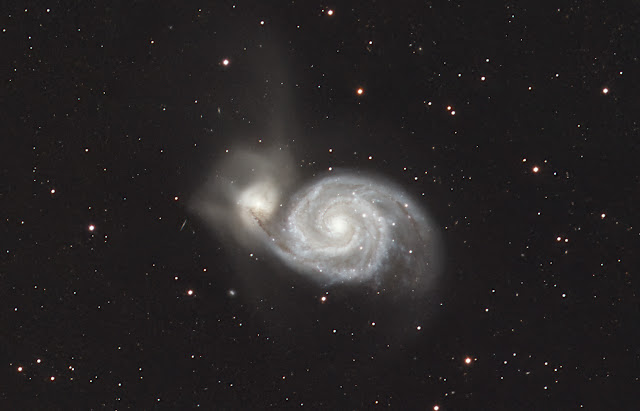
M51 The Whirlpool Galaxy

The usual Malcolm luck happened last month, I closed down the observatory for some maintenance and what do we get a week full of clear skies. Still it gave me chance to get some  jobs complete such as wiring the dome to the wireless controller. Disappointing that the weather was clear but since rebuild, a PA and test of tracking and guiding was needed,  Every set up nicely and as expected and  from there I have managed over 4 nights captured five and a half hours of LRGB data on target.

Guiding has been excellent with excellent with numbers as low as .30 arc seconds accuracy. I will be happy if these numbers continue. As you can see target was M51, always a favourite and captured many times previously. 

     I am always astounded and I love the ZWO Asiair pro for its simplicity in doing almost everything now. Some  lovely new additions to the software update now include now sky atlas and the ability to name filters. There are of course many things that it cannot do including composing mosaics but I can live with it for now simply because there are other pieces of software such as Telescopius that communicates perfectly with the ability to download a CSV file with the mosaic parameters. There are several summer projects that will use this feature so look out for my updates on this feature. 

So the target was M51 using the LRGB filters with an aim for a couple of hours on each filter. In case of bad weather I set the imaging run to 30 minutes a filter. At least I would have something to process if the project fell flat. I have also the zwo electronic focusser so the whole process is totally automated when switching from filter to filter to imaging again takes under two minutes.

A Typical stretched 180 second sub frame (right) A small target for 550mm of focal length but I am hopeful for a decent crop out of the final data stack.

So after three good nights I have managed five and half hours of data with 30x 3 minutes sub frames on RGB and 1 hour of Luminance data.

During bad nights I also took the opportunity and captured a complete set of calibration frames too from darks, dark flats, & Flats.

To top it all I have finally taken the plunge into the technical world of Pixinsight. A scary thought but with the help of some serious video instruction from Adam Block I have created my first image.

Prior to starting the image processing I used Image calibration & Image combination to create all my master calibration frames.

Again this is all very new to me and I followed this process to create my first image.

Calibrated and stacked using the new WBPP (weighted batch pre processing) script new and updated script that works every bit as good as six or seven steps of manual image registration. 

Part of this hobby also includes trawling the expanse of YouTube and looking for videos that suit you knowledge set and by chance I found a chap called Richard Bloch. and found Basic image processing in Pixinsight 1.8, the cover image was of M51 and I was processing M51 so thought it worth a look, Turns out his explanations and information were spot on. I will send him a message to say hello and thank you

Dynamic Crop

Autoomatic background extractor

Colour Calibration

Histogram transformation

TGV Noise

Range select

Unsharp mask

curves.

Final result I am more than pleased with.


Sunday, 9 January 2022

My Bucket list.

Ok so lets talk about distance particularly the speed light. 

In a vacuum,  we know that light travels at 670,616,629 mph. So If a little context is needed light from the moon takes 1.3 seconds to arrive at our eyes, Saturn is 1.3 light hours away a measly 0.0001505453985955772 light years distant. So what is a light year?

quite simply the distance light travels in a year 5,878,625,370,000 that's nearly 5.9 Trillion miles. Ok so back to the point I wanted to make IC434 or the Horsehead nebula is an immense cloud of thick dust obscuring star birth inside it and in galactic terms the Horsehead is an insignificant 3.5 light years in diameter but when you compare that against our solar system and our distance to Saturn it would be a huge two hundred and twenty one thousand three hundred and forty four (221,344) times the distance. 

If you ever needed reminding SPACE IS BIG.

My image was captured 2 nights ago at my home observatory with about 4 hours of data. Over the years I have taken many images of this target and I was lucky enough back in April of 2015 to appear in an episode of the Sky at night celebrating Hubble's 25 year Anniversary. One ticked off my bucket list anyway.


Stack of 40x 3 minute Ha frames.


My new laptop has amazing processing power, attempted several times previously to process a starnet++ starless image, it failed several times, introduce Mr Dell and it processes a colour starless image in less than 2 minutes, a chunk of star reduction and hey presto a lovely update to mt=y first process.


Thursday, 30 September 2021

M31

Almost a year ago was my M31 Globular clusters project. A fantastic project capturing a staggering 244 globular clusters associated with M31.

A year has passed and another M31 image is forthcoming. This time captured in HaRGB with my newish Mono camera, filter wheel and filters.

All of course captured with the ZWO ASI Air pro, a wonderful little device that has seen countless updated that include plan mode now. This allows an imaging run of multiple targets during a night. It allowed me on this occasion to run an imaging session on M31 swapping over filters and running the autofocus routine after each swap. It ran flawlessly.

So we have a basic stretch on each of the filters and a final combination giving a total of 4 hours, 1 hour on each filter.

Red


Green


Blue


Ha

4 hour Combination HaRGB

Crop


Overall I am very pleased with the image despite no calibration frames used at all here.


Tuesday, 24 August 2021

New arrivals

 Arriving tomorrow from my favourite astronomical retailer Widescreen Centre https://www.widescreen-centre.co.uk/

Should be my new ZWO 7 position filter wheel, this is the new mk2 version that is slightly larger than the mark 1 and better compatibility with the newer ZWO cameras. 


 No off axis guider used on my system so I will follow the set up here to create the correct 55mm back focus,


Along side it will be the 36mm unmounted LRGB from ZWO and 6nm narrow band filter sets from Optolong. I was incredibly impressed by Optolong's L-enhance tri band & L pro filter light pollution filter. Many images of their use can be seen in the previous posts. Unmounted filters will require fitting rather than them having a screw thread. 36mm are needed for the APS-C chip on the camera to avoid the vignette.


   These filters will allow the full range of wavelengths of light through to create images that will

 The Optolong 6.5nm SHO narrowband filters set is for astrophotographers who want to obtain the maximum contrast of nebulae while cutting out background emission and suppressing star lights. This filter set includes a 7nm hydrogen-alpha filter and 6.5nm sulphur-II & oxygen-III filters.These filters cover the major emission lines of emission type nebulae. These filters are also commonly used by astrophotographers to present their photos in Hubble Pallete. I cannot wait to capture some starlight. I will wait and see what arrives tomorrow.
Update:19/8/21  Well everything has arrived and I have now inserted the filters into their new home, installed and rebalanced scope.  Just need a few clear skies. 
22/8/21 Aghhhhh was promised a clear sky last night albeit with the full moon, but alas clouded out.
23/8/21 For about an hour and a half tonight despite a near full moon I managed to find focus for each filter and they all focus within 10 clicks of each other happy with that for par focal.
I couldn't resist running a very basic stretch on this before bed now at 1.20am.
So 12 x 5 minute exposures with the Ha filter.


Images used from ZWO and Optolong websites.


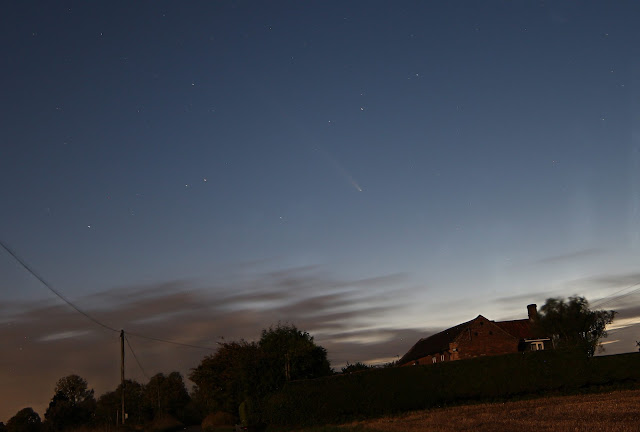
Comet Tsuchinshan-ATLAS, C/2023 A3 , Comet A3,

  A cosmic wanderer, Comet Tsuchinshan-Atlas or more commonly known as Comet A3 has traced its elliptical path through the solar system, a j...