Showing posts with label Sky-Watcher Esprit ED100 Triplet. Show all posts

Monday, 10 April 2023

Spider Nebula (update)

Started in December last year with some lovely 5h 50m of Ha data, I have managed to capture some Oiii & Sii data as well during January. 4 hours from each filter will give me a total of 11hrs 50 minutes to produce an SHO image. A JPEG of each processed image. Looking at them now I have done a star reduction on the Ha.

Ha


Oiii

Sii

Combined data 


Also a starless version just because I love the way it looks.


Photo Details

  • Total Exposure:  11 Hours, 50 Minutes ( 46 x 300 sec Ha, 48 x 300 sec Oii, 48 x 300 sec Oiii Frames)
  • Telescope: Skywatcher Esprit ED100
  • Image Acquisition: ZWO ASIair Pro
  • Camera Settings:  ZWO ASI2600mm pro Gain 100, 0°C
  • Accessories: ZWO 7 position Filter wheel
    •                Optolong narrowand filters 
    •                ZWO EAF
  • Calibration Frames: Darks, Flats calibrated.
  • Stacking and Processing: Pixinsight & touch ups in Photoshop. 
  • Size: 2.26 x 1.38 deg 
  • Pixel Scale: 1.41 arcsec/pixel

Friday, 7 April 2023

Stephans Quintet.

A project started at the end of October last year with my now sold 100mm scope, and will be finished this year with the new 130mm. NGC 7331 and Stephan’s quintet are a fascinating group of targets. This is a huge crop of the original image(a) now just less than one by half a degree at a pixel scale of 1.44 arc sec per pixel(b).


The enigmatic galaxy at the top is NGC 7331 a wonderful example of a spiral galaxy located some 40 million light years away in the constellation of Andromeda. The half a dozen smaller galaxies behind are a good deal further away at on average of 350 million light years distance. The light you see here left when Earth was in the Paleozoic era when Amphibians left the water to first roam the land. A time long, long, long before the dinosaurs emerged, lived and perished.

However, the objects of interest that inspired this image are located below. A visual group of 5 interacting galaxies known as Stephan’s Quintet. 4 of which are interacting with each other 270 million light years away and one NGC 7320 that is in the foreground at just 40 million light years.


The strange morphology of these galaxies has been defined by several theories including a head on collision between two of the group NGC 7318 & 7319 causing a tidal shock in the intergalactic gas. You can see clearly the stream from 7319 that is larger than our entire galaxy and moving at a million miles per hour. This was followed by a collision between 2 more galaxies and all contribute to the chaos of what you see. There are very few of these galactic interactions visible and they have helped astronomers over the years refine the physics & theories into galaxy interactions.

The image you see here is a composite exposure of just one hour using the green filter on the mono camera. The idea is to capture data in the Red, Green & Blue filters to produce a full colour image. This is programmed ready in the Autumn when the constellation rises again in the East.


A handy finder chart shows the location.

The Little red box on the sky map is the field of view for my old telescope. The new scope will have a smaller box giving higher magnification. I hope it gives you an idea of how small these objects are. 

Tuesday, 14 February 2023

A new beginning.

It is with a heavy heart I say goodbye to my trusted Esprit ED100, my workhorse for the last couple of years. I do know though it has gone to a good home, Living it's life now on the Kent coast to a lovely chap called Tony who came up this morning with his wife to view and make a purchase. I hope they enjoyed their time here and after seeing my advert on UK astrobuyandsell. I hope the scope gives him the same enjoyment as it has done for me for many years to come.

So for me an unexpected deal has presented itself. My good friend Richard from our society has made a life changing decision and emigrated to Brazil. I happened to mention a few weeks ago I was looking to upgrade to a longer focal length, with that was the offer of his Altair Astro 130EDT triplet refractor. A fantastic scope that has given Richard some wonderful images. Richard was kind enough to offer me the scope to try as I was unsure if it would fit inside my modest dome. My initial set up left me disappointed as there was not a great deal of room as the scope moved around with USB cables brushing the walls, so from there I initially said thanks but no thanks. I think the plan for him was to make a quick sale on UK astrobuyandsell as he did not want to take the scope with him. So I took the plunge and said yes I will have it and make it fit. I have spent the last few days positioning the scope in the rings and finally achieved great balance with a little more headroom than before. So I think this will work well for me.

Side by side they are worlds apart in size. When I built the observatory at the time I never thought any upgrade would be this big. I imagined a 115mm would suffice.


It fits.


Luckily for me too there was a couple of hours reasonably clear before the fog and cloud ruined the remainder of the evening. I opted for a target that was past the meridian and nice and high over the house so M1 the Crab nebula was my first light target.

All I could manage was 5 x 5 minutes in RGB using the ZWO filters. A rough and quick process in Pixinsight with no calibration frames and what is a huge crop. I am very pleased and happy with this initial first light image of 724mm focal length. Initial results in guiding also good with an average RMS of just over .6

The Astrogeek is one happy chappy.


Friday, 20 January 2023

M42 The Great Orion Nebula

The Great Orion Nebula has always been a firm favourite to view visually or to image. I was lucky enough to view the trapezium through the clubs 20 reflector. A beautiful sight in a quality eyepiece. I also had some fun imaging it too. Not a very favorably placed object for my backyard with the fence and a number of electricity cables stretching across from  The South to the North East. So an imaging run consist of a lot of rejected frames with wires.


I created a starless image to process the nebula, looks quite nice


The we have the Running Man Nebula

Monday, 2 January 2023

Shiney bright thing

 My scope is only 550mm focal length so not designed for lunar imaging. Also my camera is not a planetary camera imaging at just 6 frames a second. So no chance really of capturing good seeing. So the next 3 images are captured with the ASIAir pro. AVI processed in the software and the final jpegs are not huge in size. 


Friday, 30 December 2022

Spider Nebula

I have a few targets in the constellation of Auriga that I continue to look at capturing, some of which  were captured last winter, seems like a long time since I captured IC405 & 410 now, I should have a re process using what I have learnt over this last year from Pixinsight...But as for last night I managed 3hrs 50 mins of Ha data on  IC417 the Spider Nebula. I plan on an SHO image using 5 hours from each filter. As a start we have here an ASI air quick stack and screen stretch of the ha data. Looks lovely on the tablet but just a little processing via Pixinsight I have some lovely clean data and some lovely details too.

1. ASI AIR PRO stack & screen stretch.


2. Pixinsight process.

Using full calibration, Darks, Flats, Dark flats using WBPP script, 2 x Drizzle,
Automatic background subtraction, Blur Exterminator, Noise Exterminator, Histogram Transformation, Starnett++ Curves Transformation & PixelMath to re add the stars at 75%.

The are some interesting objects here in amongst the clouds of ionised hydrogen gas. We will start with 

IC 417 just left of centre of the image (also known as Sh2-234) is an emission nebula of almost 100 light-years across, located some 10,000 light-years away from Earth in the constellation of Auriga (the Charioteer). It is often referred to as the Spider Nebula and in that case its prey is a nearby (above) emission nebula called the Fly (NGC 1931).The nebula contains a young open cluster of about 40 stars, and is energized by its hot, massive blue stars which are still embedded in glowing hydrogen gas.


In the bottom right hand corner is the Charles Messier famed M38 open cluster a much closer 3480 light years and to it's left NGC1912 starfish cluster.

 3. Starless


I really love a starless image you can really explore the Ha regions here.

There will be a great deal more to add to this post as time moves into 2023, there will be at least 5 hours of Ha, Oiii & Sii data to create a SHO palette image. 

Malcolm. aka The Astrogeek

Saturday, 24 December 2022

Horsehead Nebula

I would like to say the year would not be complete without an image of the beautiful Horsehead Nebula. This is one object that I just wish was half it's 1375 light years distance from us. It would truly be a spectacular sight filling the winter sky. I am hoping for some more clear sky to complete the HAGB project. So far we have 16 x 5 minute sub frames.


I am so incredibly pleased with my set up, a few people recently have posted issues with the ZWO EAF and I can honestly say thankfully I have had no issues with it achieving nothing short of perfect focus 100% of the time. So I thought I would do a serious crop of the horsehead and yes the Blur exterminator plugin has been run. It will certainly be after Christmas now for the remainder of the data for a HaGB colour image, Ha data looks great so far for 1 hour 20 minutes. 


Thursday, 22 December 2022

M45


One the most recognisable objects in the night sky is the Pleidies or the 7 sisters. In Greek mythology they were the 7 daughters of the Titan Atlas & and his wife Pleione. Legend says with the weight of the world on Atlas’s shoulders he was unable to protect his daughters from the great hunter Orion, so In order to save them Zeus transformed them into stars placed them in the heavens away from Orion’s reach.

In reality the cluster contains more than three thousand young hot stars all formed within the last 100 million years with only the brightest visible to the naked eye. The blue nebula that is visible is a cloud of dust these cosmic wanderers are just passing through. My image here was captured over several recent clear nights and is a total of just over 3 hours through my telescope.

20 x 3 minute exposures for each Red, Green & Blue ZWO filters, processed in Pixinsight using the new Blur Exterminator plug in.


The Merope Nebula is the brightest reflection nebula in the Pleiades cluster. It is also known as Tempel’s Nebula. It was discovered by the German astronomer Wilhelm Tempel from Venice, Italy on October 19, 1859. Tempel used a 4-inch refractor to observe the famous open cluster.


You can also see here a small object about the 4.00 O'clock position. The nebula contains a small bright knot, designated IC 349, that is located only 0.06 light years from Merope. The knot was discovered by the American astronomer Edward Emerson Barnard in November 1890 and is also known as Barnard’s Merope Nebula. Barnard observed the knot using a 36-inch telescope at the Lick Observatory in California. IC 349 is about half an arc minute wide. It is the brightest part of the Merope Nebula because it lies so close to the central star. A recent capture from Hubble shows the knot being destroyed by 11km per second stellar winds.


Tuesday, 20 December 2022

The Jellyfish Nebula

30,000 years ago, our planet was in the grip of our last ice age, about the same time Neanderthals were painting the earliest images found in the caves of India. Above early man’s head in the night sky a super massive star has succumbed to the forces of gravity and collapses in on itself, the resulting supernova outshines every other star in the heavens. As we fast forward the thousands of years what we see now is the ever-expanding cloud of dust and gas resembling a jellyfish forever swimming in the cold inky black ocean. Imaged over the last two cold clear nights, nearly nine hours of data were needed to capture this cosmic Scyphozoa.


At the time of posting there has been a new Pixinsight plugin that is creating a great deal of attention by the incredible Russell Crowman. The Blur Xterminator plug in. So there will be an update shortly incorporating this into my workflow.


An except from Russel's Website. BlurXTerminator (rc-astro.com)


BlurXTerminator is an AI-based deconvolution tool designed specifically for astronomical images taken with equipment commonly used by amateur astrophotographers. It is available as a process module plug-in for PixInsight only.

Not all AI is created equal. AI-based sharpening tools for general photography exist but, when applied to astronomical images, they are prone to "inventing" detail that does not exist. They also don't usually handle stars very well. Their neural networks were not trained on astronomical images, so they often make bad "guesses" as to what the original, unblurred scene looks like.

The design intent of BlurXTerminator is to recover as much detail as possible based on low-contrast information actually present in an image, without fabricating detail that does not in fact exist just for the sake of an image that appears sharper. Great care has been taken in the architecture and training of the neural network to ensure that its output is as faithful as possible to reality if it is properly used.

Saturday, 12 November 2022

Sadr in Ha

Captured over 2 nights a day before and a day after the full moom. I wanted to test out the mosaic feature in the latest V2 update to the ASIair pro. A simple and easy feature to use. select you target of choice, set 2x2 / 3x3 ect for framing of the mosaic, export as a plan. Set plan with the filter, number of images and duration. Done. Result is 24 x 5 minute Ha exposures in a 2 x 2 pane mosaic with a 25% overlap. Processed with pixinsight, calibrated and Histogram transormation stretch and EZ de noise. 2 verions one with and one without stars.

Saturday, 8 October 2022

A lobster and a bubble

Oh the weather is a fickle thing, yes the nights are drawing in seriously now but so has the cloud too. In a rare few evenings of clear skies I have started a new project. A previous effort a couple of years ago for this target was a bit of a disappointment. I cannot quite remember but I think the project was unfinished so time to have another go. I have managed to create a lovely framing of the Lobster Claw with the Bubble nebula for this image. Night 1 was a 3h55m aquasition of Ha data. A quick process has revealed some lovely clean data.
Night 2 at the time of writing has been a little hit and miss with some high fast moving cloud, quickly clearing and returning some great guiding numbers again. This too is without any PEC training on the mount and I would love to get these numbers more consistent and will have a look at training over the weekend. I am hoping for 6 plus hours of Oiii so looks like a 4.00am finish if the clouds hold off, forecast now looking a good deal better. 1hr 15 so far.
Managed an exact 6 hours or 72 x 5 minute sub frames. Night 3 was again a wonderful night and managed 4 hours with 48 z 5 minute sub frames.
Pixinsight process Background extraction Deconvolution Noise reduction Stretch to non linear Pixel Maths combine channels Curves ACDNR Local Histogram equalisation Dark structure enhance Final curves Star reduction I love the starless image created just before final star reduction.
Final Image
I have also in recent weeks completed a complete new set of calibration frames. As per the image above it looks like a great set and a relief. As I had a few issues with flats a few months ago so a new set needed doing. Pixinsight too has also seen some updates and has updated it's WBPP (weighted batch pre processing script) and it worked flawlessly with the new calibration set. I am really starting to enjoy using it now, still a complete novice and relying on tutorials but the results speak volumes. I am sure there are plenty of die hard fans who want to run all the calibration manually, but there are plenty of trusted you tubers and of course imagers like Adam Block who are increasinly confident that it is doing everything in the background a a full manual run. Like I said I am far from competent with the programme so will enjoy and take all the help I can get.
I along with my family are suffering from Covid. For us all it has been a struggle, having escaped it over the last 2 years it has caught up with us all. On the mend now but has been a real struggle to breath and a cough so bad it made my throat bleed. As I said thank god we are all on the mend now.

Thursday, 1 September 2022

Heart Nebula

Having recently returned from an amazing week on Lake Windemere and some lovely clear skies, that is apart from the full moon obliterating any decent view of the Perseid meteors. I had a few great eveinings doing some light painting on the lake. This means the scope has had a week off from action. So the new project is going to be an HOO image of the Heart Nebula IC1805. 5 minute sub exposures starting with the Optolong Ha filter. A total so far of 40 subs with a total of 200 minutes. A lucky capture on my first sub was a meteor breaking the Heart in two.
Over 3 nights I have been able to shoot Oiii data with 73 x 5 minute sub frames totalling 6Hr & 5 minutes. An induvidual sub offers the faintest hint of detail.
The full stack of 73 frames shows a vast amount of detail and a really clean noise free master frame. For some reason my blog will not let me upload the TIFF file so these Oiii frames are JPEGS (aghhhhhh)
I followed the same Pixinsight processing as before for the Crescent nebula. I am still new to this amazing programme and need YouTube tutorials to follow. I feel I have overdone the contrast here of on the final Star reduced image, so I will be looking at a few more Ha hours to boost the outer ring of Hydrogen gas. Watch this space. But for now please enjoy my Heart Nebula. A fitting tribute to Mum too, she sadly passed away some twelve years ago on this day.
One last thing to mention is the guiding, after some welcome rain the skies have been very transparent and the guide numbers have been incredible with RMS totals under 0.25 arc seconds. Images of the guide screen are on the tablet so I will try and upload a screenshot.

Sunday, 10 July 2022

NGC6888

It has been a tough couple of weeks wondering what the hell is wrong with my set up, and subsequently been a while since I posted any astro images, A power supply problem caused a few strange issues with the imaging camera, but all resolved now and running on full power again. Eager to capture some photons the dome was rolled back over the weekend and captured 6 hours worth of data on an amazing emission nebula. Ngc6888 is also known as the Crescent Nebula, but for me it resembles a jellyfish adrift on an ocean of stars. The colours you see here are 2 specific wavelength's of light Hydrogen (red) & Oxygen (blue), both are shells of gas produced from violent stellar winds from a star at the heart of this cloud.
Once again I have found a you tuber who has a great and easy to follow workflow. This time it was https://www.youtube.com/watch?v=S6lo2AJcHkU&t=1s

Monday, 23 May 2022

M94

My second capture and full process with Pixinsight is a spectacular galaxy with a double shell. M94 is a bit of a cosmic mystery. Studies suggest very little to no dark matter. Possible suggestions of a galactic collision also seem to be dispelled so overall a bit of a mystery.

M94 has an inner ring with a diameter of 70". Given its distance, about 5,400 light-years (1,700 pc)) and an outer ring with a diameter of 600″ (about 45,000 light-years (14,000 pc)). These rings appear to form at resonance points in the disk of the galaxy. The inner ring is the site of strong star formation activity and is sometimes referred to as a starburst ring. This star formation is fueled by gas driven dynamically into the ring by the inner oval-shaped bar-like structure. Considering my image scale is jus under 2 arc seconds per pixel, the structure in the spiral arms is seriously impressive.


I must admit also I am seriously impressed by the quality of the last 2 posts that have been fully processed in Pixinsight.

M51 The Whirlpool Galaxy

The usual Malcolm luck happened last month, I closed down the observatory for some maintenance and what do we get a week full of clear skies. Still it gave me chance to get some  jobs complete such as wiring the dome to the wireless controller. Disappointing that the weather was clear but since rebuild, a PA and test of tracking and guiding was needed,  Every set up nicely and as expected and  from there I have managed over 4 nights captured five and a half hours of LRGB data on target.

Guiding has been excellent with excellent with numbers as low as .30 arc seconds accuracy. I will be happy if these numbers continue. As you can see target was M51, always a favourite and captured many times previously. 

     I am always astounded and I love the ZWO Asiair pro for its simplicity in doing almost everything now. Some  lovely new additions to the software update now include now sky atlas and the ability to name filters. There are of course many things that it cannot do including composing mosaics but I can live with it for now simply because there are other pieces of software such as Telescopius that communicates perfectly with the ability to download a CSV file with the mosaic parameters. There are several summer projects that will use this feature so look out for my updates on this feature. 

So the target was M51 using the LRGB filters with an aim for a couple of hours on each filter. In case of bad weather I set the imaging run to 30 minutes a filter. At least I would have something to process if the project fell flat. I have also the zwo electronic focusser so the whole process is totally automated when switching from filter to filter to imaging again takes under two minutes.

A Typical stretched 180 second sub frame (right) A small target for 550mm of focal length but I am hopeful for a decent crop out of the final data stack.

So after three good nights I have managed five and half hours of data with 30x 3 minutes sub frames on RGB and 1 hour of Luminance data.

During bad nights I also took the opportunity and captured a complete set of calibration frames too from darks, dark flats, & Flats.

To top it all I have finally taken the plunge into the technical world of Pixinsight. A scary thought but with the help of some serious video instruction from Adam Block I have created my first image.

Prior to starting the image processing I used Image calibration & Image combination to create all my master calibration frames.

Again this is all very new to me and I followed this process to create my first image.

Calibrated and stacked using the new WBPP (weighted batch pre processing) script new and updated script that works every bit as good as six or seven steps of manual image registration. 

Part of this hobby also includes trawling the expanse of YouTube and looking for videos that suit you knowledge set and by chance I found a chap called Richard Bloch. and found Basic image processing in Pixinsight 1.8, the cover image was of M51 and I was processing M51 so thought it worth a look, Turns out his explanations and information were spot on. I will send him a message to say hello and thank you

Dynamic Crop

Autoomatic background extractor

Colour Calibration

Histogram transformation

TGV Noise

Range select

Unsharp mask

curves.

Final result I am more than pleased with.
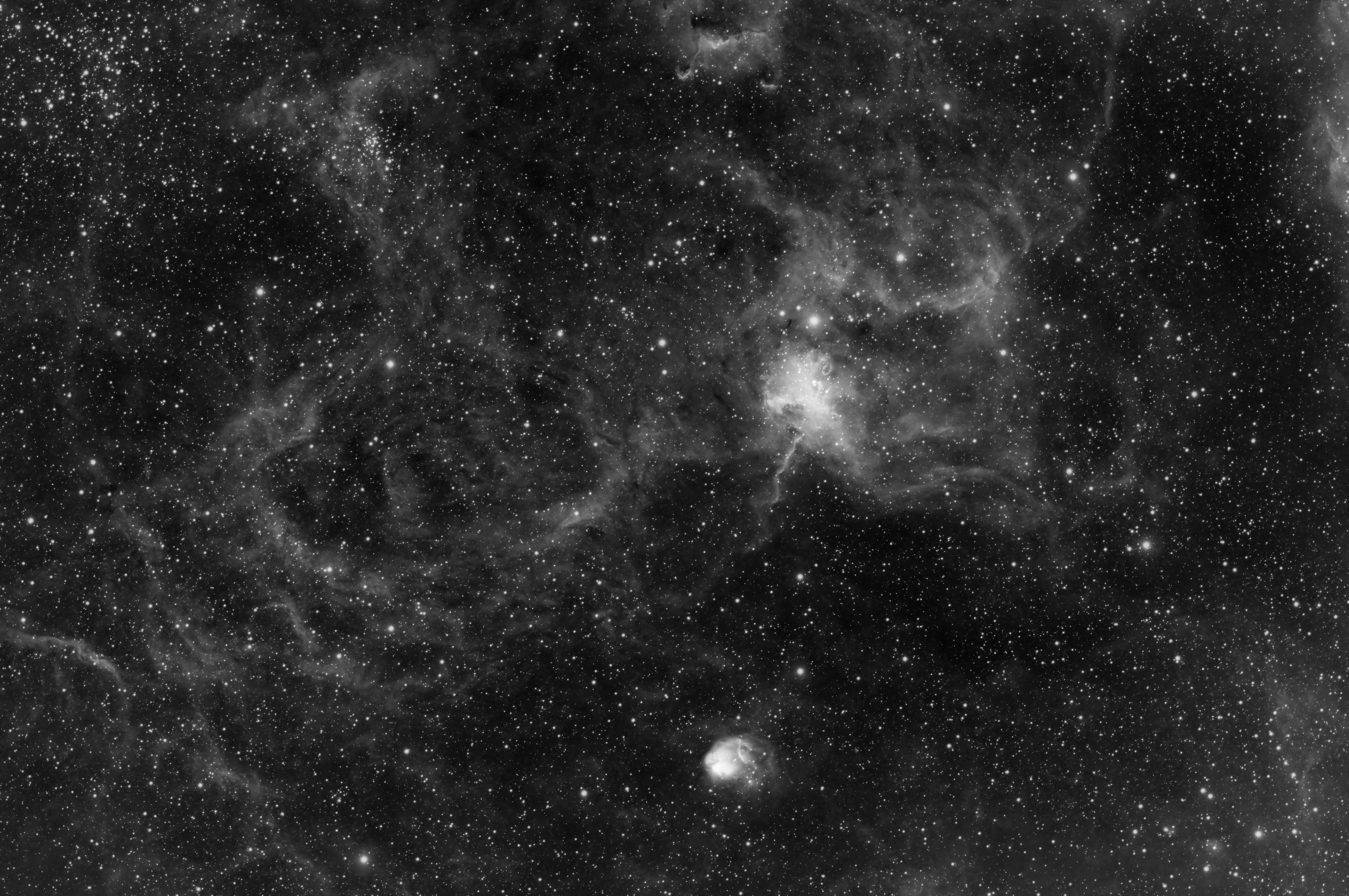


Comet Tsuchinshan-ATLAS, C/2023 A3 , Comet A3,

  A cosmic wanderer, Comet Tsuchinshan-Atlas or more commonly known as Comet A3 has traced its elliptical path through the solar system, a j...