Showing posts with label Canon EOS40D. Show all posts

Sunday, 27 February 2022

Evolution of my Astro Imaging

 I would say I have been electronic imaging since 2005 with my first Canon camera that was
purchased in 

2005 Canon 300d a 6.3mp. 

2007 updated to a Canon 40d.


2014 Starlight Express Sxvm25


2019 Zwo ASO 294Mc Pro


2021 ZWO ASI1600mm


Saturday, 25 April 2015

Star trails

Star trails from Saham Hills observatory


The last time I imaged star trails was with my old Olympus OM1 film camera back in Somerset.
I have seen a few really nice compositions on various Facebook pages using a free programme
http://www.startrails.de/html/software.html .A very simple programme to use. Take the images load into programme and select the trail type and go. In a short while you have a fantastic pic like this.
 
 The sequence is 150 x 40 second images from the Canon 40D and 18-85 IS USM lens @18mm Iso 400.
Capture started at 21.22 hence the deep blue sky. The bright star at bottom right is Vega rising. I am sure I will be posting many more of these before the year is out.


Thursday, 3 October 2013

New versus Old

I forgot I took these when setting up and testing the new scope and CCD. Approx 40 minutes exposure from each camera of the lovely M27

Canon to the left                                                                                                                           Starlight to the Right


Friday, 6 September 2013

M33 The Triangulum Galaxy.

 The weather recently has been quite good. Forecast was excellent and clear the whole night. No work either for me this week so I decided to go an all nighter. Happy that the mount was working fine, I decided that 10 minute exposures would be the order of play. My Eastern view is excellent and suffers no light pollution so should not be too detremental of the Canon 40D in noise. I managed to grab 220 minutes in total in 10 minute subs. As this is a test for the new set up I have yet to take 10 minute darks, so no darks subtraction. Stacked in DSS and processed in Imagesplus I am pleased with the result. Pic 2 is a reprocess by fellow Blogger Andrew via his pix insight software. Considerable difference in detail. I may just have to invest in. Just not sure if I have the time at present to learn a whole new processing pathway.


Sunday, 4 August 2013

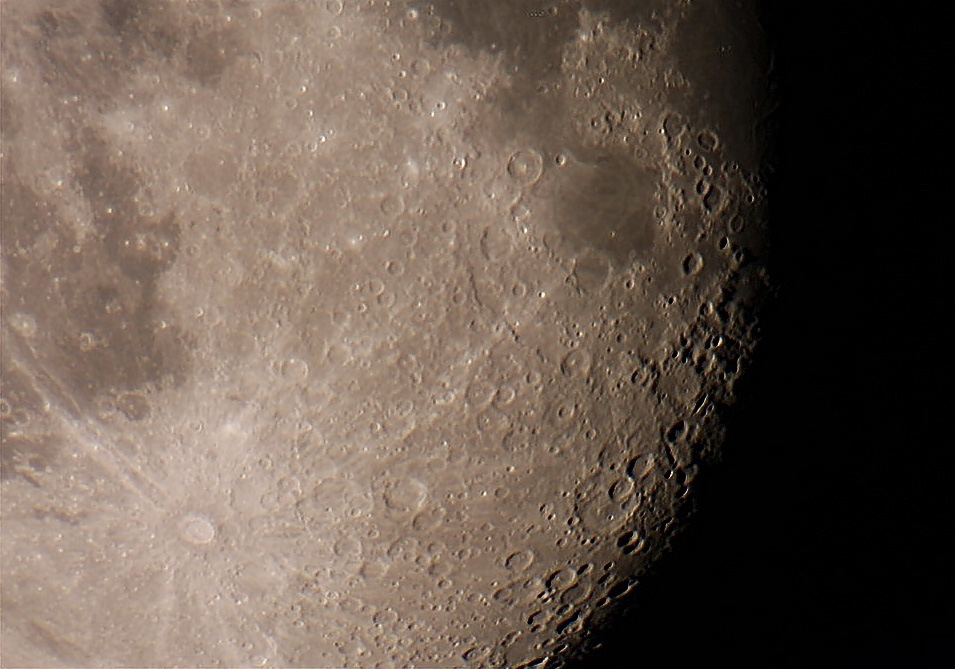
Tycho

Captured on the evening of the 25th July. I love tracing the ejecta rays from the 108 million year old Tycho. I get the impression of a near verticle impact from the ejecta dispersion that can be traced across every quadrant of the moon.

Monday, 15 July 2013

M 52 & a Bubble


Picture the scene, France was bathed in a period of mourning for
King Louis XV a struggling economy and battle scarred France
decended futher into dissaray from decades of war that was soon
to fall to the people in the French Revolution . Meanwhile French
astronomer and comet hunter Charles Messier had found another faint object to add to his expanding catalogue of (non cometary bodies), whilst observing a comet in the same region .Catalogued as galactic open star cluster (M52) Approx 5000 light years away and 35 million years old, this collection of approx 200 stars has shone for countless eons of time. You will also notice a bubble of glowing gas, at more than twice the distance of M52 this shockwave of expanding gas & dust was created and illuminated by the energetic radiation from a
massive star. This image was taken last night or should I say early this morning for what was an all nighter. The guiding worked well all night allowing for 5 minute sub frames to give me this 1hour 15 minute shot. Focus was a few microns off though.

Thursday, 14 March 2013

It's About Time.

Comet C/2001 L4 PANNSTARRS has finally graced our northern hemisphere skies. This evening for me was a little frustrating. Located below a new moon it should have been visible. Except there was a horizon of cloud that stayed put for the duration. It was good to see via facebook a couple of fellow bloggers and Breckland AS society members, Dr Dan Barnfield Bob catch a glimpse of the comet this evening.The skies however have cleared. The seeing not perfect but I have set the cameras in motion. Having done very little astronomy since christmas it feels good to get back to it. I had planned on a slight modification to my set up in which the 66mm guidescope would come off and used as a grab and go. My imaging scope would then be connected to an off axis guider and camera, thus lightening the load on my ageing mount. But unfortunatly the focusser just could not take the weight for the auto focus to work. So I have gave up on the idea and rebuilt the 66mm back on board. I have also increased the counterweight slightly and this seems to help with the guiding consistency. With this I wanted an easy target to test the system. I caught about 90 mins will process in the morning.

As promised from last night I managed to capture some photons of that were travelling through the darkness of space for 35 million years to arrive last night at my camera lens. This trio of galaxies all look slightly different as the galactic discs are tilted to different angles from our line of sight.The galaxy on the left is known as NGC 3628, seen edge on with obscuring dust lanes cutting across the plane of the galaxy. while the disks of M65(top) and M66 are both inclined enough to show off their spiral structure. There is evidence that all 3 galaxies have interacted with each other some 800 million years ago.

Friday, 2 November 2012

Moon Mosaic no2


Typical ! I have the week off for half term and I feel lousy. Hot & cold sweats, blocked then runny everything. Just stuffed up and a headache this morning. They kids have had a movie morning watching some Disney classics. While 2 computers processed a ton of frames. 24 images make up this wonderful moon mosaic. I used the same technique as described before using EOS live record. I kept the camera on the same plane as I recorded each AVI. My attempt was to capture the whole moon but looks like I missed a couple of sections. So here is a crop of the best part of the image. Stacked in Registax 6 and the same wavelet sharpening on each frame was used. Photoshop then used to align the frames. No colour correction or other processing used. I know it is not perfect as my 2x Barlow claims it ED but I always get colour fringing on one side of the image. Considering it is only a 90mm refractor. I am quite pleased with the result.

Monday, 1 October 2012

A billion Stars

Been a little busy recently, Going on holiday, Back to work, A set of nights, Sending eldest daughter to University, all plays havoc with the astronomy. I have been playing a bit with Maxim DL. I am trying to use the auto focus setup procedure and combine automation with exposure control. I still have a slight DEC drift and need to re centre the image by a few arc seconds every other exposure. So just trying to get everything sorted out. Andromeda was at a nice elevation so I thought I would have a little test.

This shot 2 Hour 13 Minute exposure in 3 & 5 minute subs. No dark frame subtraction, Flats or bias taken. Iso 1600. Canon 40D through my imaging set up. Comparing it to the others I have taken I think it is the best hands down. I would appreciate any feedback too!

My own criticism is that if I had taken a few short exposures I could tease out a little more detail in the core. Easily remedied as maxim has saved the camera rotation angel when I plate solved the image. So another visit sometime soon I hope. I might consider sending it to sky at night mag too.

Wednesday, 8 February 2012

Runaway Horses

I remembered I had about 35 minutes worth of data from the UHC filter. I have combined them to the original hour, I think the improvement is noticable.

Tuesday, 17 January 2012

Horsehead Nebula

Stargazing Live from my own back garden this evening. My telescope & camera pointing towards the heavens to image the amazing Horsehead Nebula.

The red glow originates from hydrogen gas predominantly behind the nebula, ionized by the nearby bright star Sigma Orionis. The darkness of the Horsehead is caused mostly by thick dust, although the lower part of the Horsehead's neck casts a shadow to the left. Streams of gas leaving the nebula are funneled by a strong magnetic field. Bright spots in the Horsehead Nebula's base are young stars just in the process of forming.
1 hour only of exposure Approx 40 mins @ Iso 3200 and 20 Mins @Iso 1600 using 2 minute guided sub frames. My collection of darks are proving useful with a dark frame subtraction. DDP and levels adjustment and aquisition provided from images plus and Deep sky stacker combining the frames.

Friday, 6 January 2012

M42


The last week or so has left us all a bit battered by the winds.
The moons phase equally annoying for a deep sky imager. I wanted to just test everything was still working as it has been over a month since rolling back the dome roof. Last year I was able to test my UHC filter on ngc7000 on a series with and without. So last night I pointed towards Orion and done a series of 3 minute images at Iso 800. I love the colour rendition that the filter gives. A more natural look from unfiltered. M42  I think. Just wish we were a few light years closer!!!!!!!

Tuesday, 4 January 2011

Partial Solar Eclipse

Good morning everyone. My last day before I return to taining. Haven't done a great deal of astronomy since November. I had the chance to go to our club observatory at Great Ellingham last night as we are hosting open evening's for Stargazing Live. A good turn out considering the cloud cover was 100%. Still visitors had the chance to see scopes set up on our astro pad and some visitors even bought their own scopes and asked for help in getting the best from them. A tour of the control room and gallery before we went upstairs to see the monster 20". Earlier that evening jupiter was visible so we had the webcam set up and showing a live view through a laptop. That was until the visitors and the clouds arrived. Anyway everyone I met was impressed with our set up and already looks like we may have a few new members from the first night.

I was tasked with a small errand this morningas Kate left for work. Looking east was again clouded out but I took the camera with me just in case of a break as it was already 08.30 as the partial eclipse was well under way. I had just returned and parked up when I saw a gap in the clouds. I dumped everything on the lawn and fired up the camera. Just enough time to take a couple of images before we were clouded out again.


Taken with the 40D Iso 100 1/160 sec for both images. Hope you like them

Saturday, 14 August 2010

Persied Meteor 2010

     We have spent the last few days down in Yeovil, Somerset visiting family far away from the clear skies of Norfolk.
     We all had a wonderful day at Longleat safari park too as I watched the skies clear above us on the drive back. The plan was to just sit the camera on the tripod and shoot from the back garden. A few test shots revealed a lovely orange sky. I decided there and then to get away. About 6 miles from Yeovil is a beautiful and reasonable dark site on top of Ham hill in Stoke Sub Hamden. I arrived at 11.30 pm to a car park full of meteor watchers. I found a quiet corner and started to shoot. We had an amazing view to the south Sagittarius was easily visible as the teapot sank below the hill and the milky way arched across the entire sky. Most of the cars disappeared about midnight and left me and another chap clicking away and chatting. We saw some amazing meteors that left a trails of smoke for sometimes 15 seconds after but annoyingly never in the direction of where our cameras we pointed. However I did capture this one flashing through Camelopardalis at 01:16:56 again leaving a trail of smoke behind it. I did capture about 30 others but none as bright as this one.

Cant decide if its worth sending to one of our publications.

Sunday, 1 August 2010

NGC 7000 With UHC Filter

Hi everyone,

I am enjoying my 3 weeks off 1 down 2 to go Daddy day care is fun!!(most of the time) although last night was the first night outside since last Saturday. First off I have solved the little mystery of the failure of guide camera and dew heaters. The power supply / charger for the power tank had broken. So each time I thought I was charging nothing happened and of course the voltage dropped below usable and caused equipment failure. All working fine now.

Went out at about 9.00 pm to test the bahtinov mask kindly supplied by fellow member and manufacturer of these fine items. Made to a professional standard with precise laser cutting of the material providing extremely sharp focus spikes to allow quick and easy focus. Less than 10 seconds I think. Please see Keiths page on my list of fellow bloggers and get ordering they are worth every reasonably priced penny.

This time I thought I would complete my little task of taking NGC7000 again this time with the UHC filter in place. I was very pleased with the result showing the true colour of the Hydrogen Alpha line emissions.

This stack is of 38 X 1 minute unguided subs with no dark calibration / flats or bias frames used.
Stacked in deep sky stacker and a DDP stretch in Images Plus. No additional colour enhacement but I will have a play and if its worthy of posting I will let you see in due course. Let me know what you think comments are always welcome.

Saturday, 5 June 2010

M81 & M82 2 Hours

Hi again all,
Had a great night of clear skies again last night so from midnight I captured another 1 hours worth of photons. Again we have 60 x 1 minute exposures unguided and a master produced. I then combined both masters and done a little cropping due to camera alignment. Had to remove as we had our daughters 8th birthday party to capture. I am preety amazed at the result stars image is a little smoother and stars rounder too?

Thursday, 3 June 2010

M81 & m82

Hi Everyone,
Had some good news on the work side of life. I will moving my shift pattern onto days by July. Finally I will become an astronomer again. Have a new nickname from the family too bless em I am now known as Astro Geek. On a week of rest this week cant get my sleep pattern right either probably due to an enormous wisdom tooth excavating through the side of my face. Good news is its coming out Monday morning after a 12 hour shift.

Enough of my woes. Here's the good stuff.

Went outside last night and the weather man said it was going to be clear so I believed him and rolled back the roof of the observatory and let the scopes equalize

I had a re balance and alignment done a month or so ago. I done a couple of test shots to focus etc. I set Images plus to 60 x 1 minute unguided exposures.

I lost a couple of shots over the course so here is a 58 minute taken in JPEG no flats no bias or darks as I had to bin them all due to the new field flattener.

My aim is to go out tonight and do another hours worth and see what that looks like when co added. So here is the first hours worth. Beware this could fall flat on its face and all I end up with is this image.

</

Friday, 16 April 2010

M51 Whirlpool Galaxy NGC 5194

After many hours of adjusting and checking the cameras are fixed correctly and square to the scope I have come to the conclusion that the generic Field flattener I had bought just doesn't work I know it was for a f5.5 to f6 scope and my scope is f6.7 but I lived in the vein hope that it wouldn't be that bad. Alas to no avail. Last week I put out a cry for help on UK Astro Ads and asked if anyone had a William Optics Mk3 field flattener which is dedicated for my scope. I had a reply from a really nice chap who said he had one, and a generic William Optics field flattener for refractors as well. He offered the mk 3 to me at a good price and offered to post both of them for me to test. I like so many others have had a few bad transactions on such sites so I as of course a little unsure when I clicked the pay pal button and duly paid up. A couple of days later a package arrives and you know that feeling you get in your stomach when you think things are about to go hideously wrong. I sat staring at the box while I drank my coffee and reluctantly opened it. What a surprise 2 immaculate field flatteners. Having hurdled our youngest happily playing on the carpet in front of me I grabbed the keys to my observatory and had a play. I attached my Canon T fitting to it and connected to scope focussed on a neighbours chimney and checked it out for defects. Last night we had a fantastic clear night despite the fear of a few hundred tonnes of Icelandic volcanic ash about to land on me I set about focusing using my live view and one of my fellow members who makes superb quality Batninov Masks see Keiths Astro over to your right. Now lets try this thing out. a quick 30 seconds to see if everything was there. I took 7 x 3 minute guided exposures and a few darks and started to stack. Here below is the summation of those Images of M51. Slightly over processed I know for a short duration image. BUT Astounded, Amazed, Totally shocked I have star shapes to the edge of the field I am so pleased to finally have an image that doesn't need 80% cropping. Now the bad news. I have had to dump my entire collection of Darks,Flats and Bias frames to start a new with the new Flattener. My Sincere thanks goes to Dr John and his faith and trust in mankind.(the flattener I didn't require now posted back)

Sunday, 27 September 2009

Andromeda Revisited

A revisit to the great Andromeda spiral galaxy on thursday took another 40 minutes worth of images including some 5 minute guided. About 60 minutes worth of darks subtracted aswell. Have had a play withe the processing to get a more pleasing colour. I dont think there was enough detail on shorter exposures on the previous image. Now i think it has become a great deal smoother. I do have a stock of flats and bias frames, so I may be back with another. I do have a few issues with coma however so I have cropped as best I can Let me know what you think.


Object: The Great Andromeda Galaxy
Type: Galaxy
Constellation: Andromeda
Date: 24th - 25th September 09 11.40 01.40am
Equipment: William Optics Megrez 90 Canon EOS 40D guided using 66mm William Optics refractor & Atik 16IC camera.
Subframes: 15 x 1 minute exposures at ISO1600, 4 x 5 minute ISO 1600 and 8 x 2 minute exposures approx 60 mins of darks subtracted
Stacked: by Deep Sky Stacker.
Processed: In Images Plus 3.75 with a DDP stretch.

Saturday, 30 May 2009

M27 The Dumbell Nebula


Object: Dumbbell Nebula M27
Type: Planetary Nebula
Constellation: Velpecula
Date: 30 May 09 01.30am
Equipment: William Optics Megrez 90 Canon EOS 40D guided usin 66mm William Optics refractor & Atik 16IC camera.
Subframes: 1 x 8 minute exposures at ISO800, 1 x 8 minute dark, Bias & light frame calibrated
Stacked: by Deep Sky Stacker.
Processed: In Images Plus 3.75 with a DDP stretch.

Notes: This is the first opportunity to guide using my new Atik 16IC camera. I was able to guide using what I estimate to be a 9th Mag star. I am seeing a much better signal to noiseratio by generating a longer exposure rather than 16 x 30 seconds. I look foward to future tests.

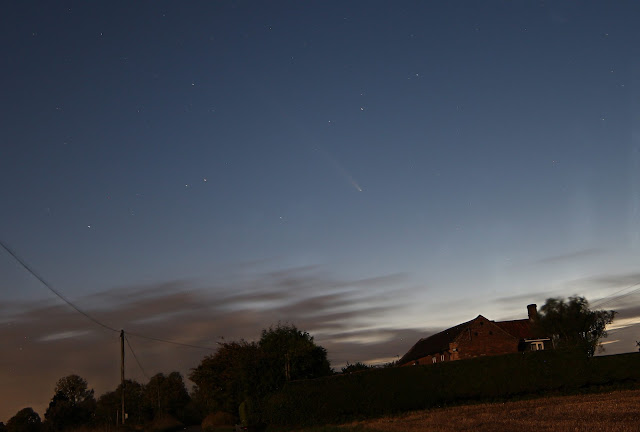
Comet Tsuchinshan-ATLAS, C/2023 A3 , Comet A3,

  A cosmic wanderer, Comet Tsuchinshan-Atlas or more commonly known as Comet A3 has traced its elliptical path through the solar system, a j...