Showing posts with label Open cluster. Show all posts

Friday, 14 January 2022

Rosette Nebula

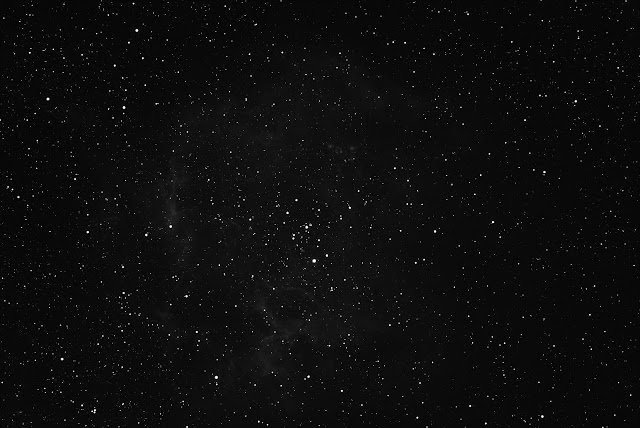
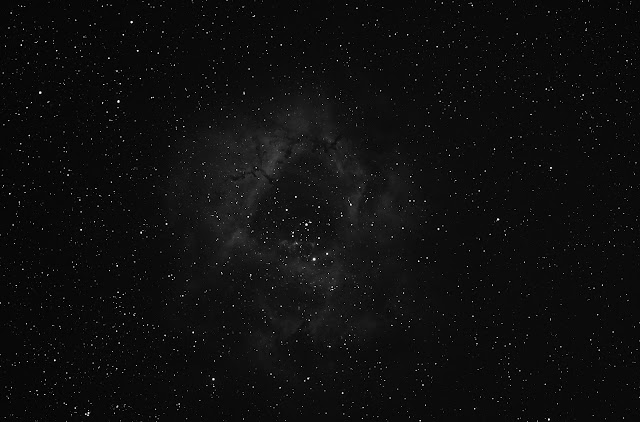
 An 85% waxing gibbous moon phase is certainly a distraction for astrophotographers looking for faint fuzzies. But what can we do (launch a virgin rocket at it).. Thank goodness for the Ha filter, Because of the brightness of the sky background I reduced the exposure time to two minute subs and captured 4 hours worth of data. Imaging with the incredible ZWO ASI 2600MM and the 36mm filter wheel. I invested  also in a set of Optolong narrowband filters. I was incredibly impressed with the L- Enhance and it's ability to keep halo's and star sizes to a minimum. So for me it was a no brainer to add these to the arsenal. Saying that their LRGB filter set were new and untested at the time of purchase so I opted for the ZWO filter set. I am happy with them so far. But as I said the Ha filter was deployed last night and with a image stretch and dark dust enhancement I have a really clean image. Desperate for for some Oiii & Sii now.

Right so update alert last night was a clear night so had the opportunity to shoot 2 hours each on Oiii & Sii.

Processed on my new laptop and wow it is fast. 

Registered aligned & stacked in Deep Sky Stacker.

Starnet++

Processed in photoshop with

HSO colour mapped & selective colour

Levels & Curves

Photokemi astro tools Space dust & Dark details medium

Topaz denoise.
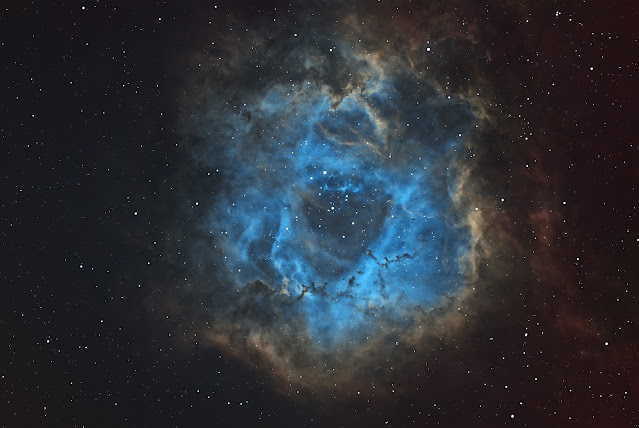


Ha

Oiii

Sii

Photo Details

  • Total Exposure: 9 Hours, 0 Minutes 120 x 2 Mins Ha , 30 x 3Mins Oiii, 30 x 3Mins Sii 
  • Image Acquisition: ZWO ASIair Pro
  • Camera Settings:  ZWO ASI2600mm pro Gain 100, 0°C
  • Accessories: ZWO 7 position Filter wheel
    •                Optolong narrowand filters 
    •                ZWO broadband filters
    •                ZWO EAF
  • Calibration Frames: No Calibration
  • Stacking and Processing: DeepSkyStacker, Adobe Photoshop 2020, 
  • Size: 2.26 x 1.38 deg 
  • Pixel Scale: 1.41 arcsec/pixel

Thursday, 23 August 2012

M103

M103 (Ngc581) is one of the more remote open clusters in Messier's catalog, at about 8,000 light years distant in one of the most recognised constellations of Cassiopeia the queen. Visible in my binoculars against a rich star field it was the last entry to his original catalogue without him actually observing it. Well Mr Messier I have seen it. and I have ticked it off my list. The bright star also visible at the top is Ruchbah or(δ) Delta Cassiopeiae  Cassiopeiae. See finder chart. To me this star is a little more interesting than the cluster. It is an eclipsing binary star system consisting of a pair of stars that orbit about each other over a period of 759 days.


The primary a white sub giant has a stellar classification of A5III-IV, with the luminosity class of IV indicating that it has exhausted the hydrogen at its core and has begun to evolve through the subgiant phase into a giant star. It has expanded to about 3.9 times the Sun's radius. It is moving through the Galaxy at a speed of 43.9 km/s relative to the Sun.

M39

The last week has been a little traumatic for the whole family, Our eldest daughter has been waiting to find out if she has the grades to get into Uni. A sigh of relief as she is awarded her primary place at Anglia Ruskin. Congratulations Jasmine. The Younger two have been driving us nuts as they are desperate to go on their sunny holiday and bored of being at home from school.

The RA drive on the mount was very tight and needed a strip down and rebuild, All went well until I ran a test on the guiding. What could be the matter here. PHD would not keep the guide star for more than a few seconds. Lets not panic yet I thought so I ran 60 x 30 second test shots. A nightmare. The subject has moved over a degree across the field of view. The only thing I could think of was the polar alignment. I do my polar alignment using the Kochab clock method. Always worked well for me!! As I looked through the finder the illuminated cross moved, damn, the whole finder had been knocked at some point and almost fell out the holder. Not a great deal more I can do tonight. Next day allowed to me to strip it all down and rebuild and align the polar finder. A chimney pot half a mile up the road stayed where it should be as the pole finder was tightened into position.

A new test on Scheat in Andromeda was perfect. 2 minutes, 5 minutes, 10 minutes was no issue at all.

M39 was the target of choice nearly above my head so I ran 30 x 2 minute guided exposures at 1600 ISO. Processed in Maxim DL & Photoshop.


Sunday, 31 August 2008

Double Cluster In perseus


Object: NGC884 & 889
Type: Open Clusters
Distance: 7300Light Years
Constellation: Perseus
Date: 30th August 08

Equipment: William Optics Megrez 90 Canon EOS 40DSubframes: 19 x 30 second exposures unguided at ISO1600Processed: No darks or flats were captured. Processed in Images Plus 2.0 with a Moderate non linear stretch or DDP.Notes: Well for a few hours last night it was clear. Transparency good So I rolled back the roof and took a few images.
Having problems with PHD it just wanders off after about 20 seconds

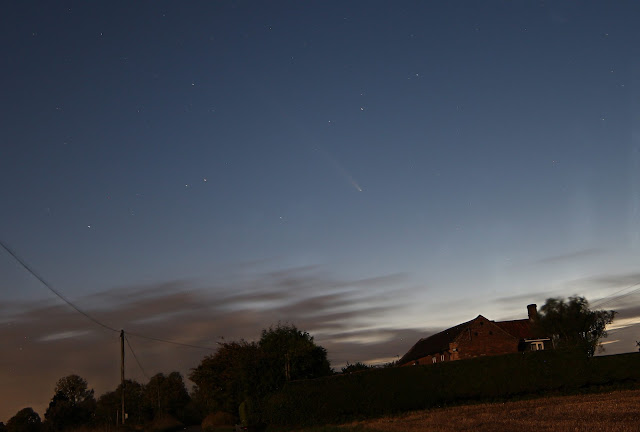
Comet Tsuchinshan-ATLAS, C/2023 A3 , Comet A3,

  A cosmic wanderer, Comet Tsuchinshan-Atlas or more commonly known as Comet A3 has traced its elliptical path through the solar system, a j...