Showing posts with label Comet. Show all posts

Sunday, 17 October 2021

67P/Churyumov–Gerasimenko

5 years ago now I witnessed one the most incredible feats of engineering skill man has created thus far, not happy with just dropping into orbit around Comet 67P but sending a lander onto the surface too. With gravity at 1/10000 that of earth Philae didn't quite manage to stay put when the cold gas thrusters and harpoon failed to operate. So it bounced twice and settled, wedged into the side of a hill. 


Beautiful imagery was captured and returned by the Rosetta spacecraft detailing the shape and structure. Resembling a peanut shell (image above courtesy of Rosetta) this 2 lobed comet has tumbled through the solar system for billions of years. 

I have been keeping an eye of it's location each night in the hope of a capture worthy of posting. But in typical UK weather the clouds rolled in after less than ten minutes of imaging time against the lovely backdrop of Messier 35.  My intent was an RGB image through filters and using the comet stack in DSS to keep both stars are comet a pinpoint. However plans were scuppered after 7 minutes through the red filter.


Just had a look back at my comet images and this one will be my 16th Comet imaged to date.

In no particular order we have:


All of my previous comet images can be found in the previous pages of my blog.


Sunday, 12 July 2020

Comet 2020/ F3 Neowise

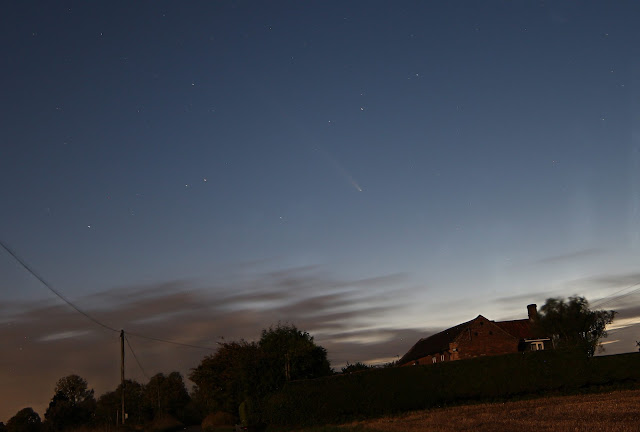
Imagine the year 4491. That's 2471 years from now. We certainly wont be here but comet 2020/F3 Neowise will be back. An absolutely beautiful sight visible to the naked eye. Unfortunately for me it is obscured by the houses opposite for a shot with the telescope. So a few images taken with the DSLR to show you.


Tuesday, 30 June 2020

C/2017 T2 Panstarrs

 When we think of comets we instinctively think of Halley's Comet that swings by once every 75 and a bit years. Halley's comet sweeps in from an orbit that takes it out to the planet Neptune and back. This little one  C/2017 T2 Panstarrs has a little longer journey to make of nearly half a million years. So truly a once In a lifetime look at this cosmic interloper.


Tuesday, 13 January 2015

Comet C/2014 Q2 Lovejoy animation

They say an image speaks a thousand words.
So for me an animation speakes a whole volume.
This will be the 3rd animation I have done that shows the movement
of a comet. This one is of course Comet C/2014 Q2 Lovejoy.


26 Frames of 2 minute exposures. Animation created in Maxim DL after a DDP stretch, & Crop in Imagesplus.
 
I hope we get a few more clear nights to have another go. Rapidly moving North also it has  moved over 10 degrees in 3 days since imaging on Saturday night.

Sunday, 11 January 2015

Comet C/2014 Q2 Lovejoy

Discovered on the 17th August by the renound Terry Lovejoy with a very modest set up 8 " Schmidt–Cassegrain telescope. C2014 Q2  was discovered at apparent magnitude 15 in the southern constellation of Puppis, from his observatory in Brisbane, Australia. This long period comet has arrived at an inclination of 80 degrees so we can be sure it originated from the Oort cloud. Orbital calculations show that this passage of the comet was 11,000 years. But our solar system have had a dramatic effect pulling on the comet and reduced it's next pass to 8,000 years.

 --------------------------------------------


We have had to wait until late December to get our first glimpse in the northern hemisphere. My first visual and 2nd "Lovejoy" comet was Tuesday 6th at the Ellingham observatory using the 20". The nucleus virtually filled the eyepice and was also a very pleasing sight in the binoculars. The recent high winds have slowed and the forecast for last night was to be clear. Dome open as early as possible allowing scopes to reach ambient temperture. CCD cooled to minus 27 degrees (outside temp 3degrees), scope pointed and centered on the trees across the road from me, awaiting it's rise above the treeline. First image captured at 18.29. A series of 23 x 2 minute exposures. Cropped and overprocessed to show the tail structure.

I have cropped further for the second image and produced an inverse or negative. To me this is more impressive as it clearly shows the tidal ribbons of dust. Images in late December showed some tail disconnection, powerful solar winds cause these disconnections and came sometimes rip a stream from the tail completely. Nothing visible here although the larger central portion appears to be snaking back nicely with the solar wind.


 --------------------------------------------


These images are the same series as above but processed a little differntly to focus on just the comet nucleus. Virtually no tail structure can be seen here but for me a more realistic and cleaner image of it's icy core. Iam also amazed at the colours. "The colour is likely due to the presence of two gases cyanogen (CN)2 and diatomic carbon (C2) which glow green when their molecules are ionised or excited.


"Ionisation causes electrons within the molecules to gain energy and when the electrons drop back down to their normal state, they give off light of a certain wavelength. For these molecules, they emit green light and since they are very strong emitters, their green colour dominates the comet."


Still wanting a little more, I gave the image an extreme crop on the nucleus and removed colour. What I cant tell is have I captured the nucleus shape or is this just pixel drift?. Tell me what you think. Your comment always welcomed.


----------------------------------


Wednesday, 1 October 2014

Comet C/2012 K1 (PANSTARRS)

Most of my viewers on the blog know that I post on facebook aswell under my own page and that of our society Breckland AS https://www.facebook.com/?ref=home#!/groups/176906152365752/. Please visit our page and join in with the many topics of discussion as well as viewing our wonderful collection of images, Taken by club members and their scopes.
 
I hope you enjoy what we have to offer.
 
 
Well it appears that I had stored some data for processing another day. I had done this in April and had taken a few images of Comet C/2012 K1 PanSTARRS. Take when the comet was approx 3 degrees from Alkaid. Just 8 x 5 minute exposures taken. No calibration frames used. Processed in Deep sky stacker using comet stack. processed twice to align background stars and once again on the comet. I have combined them in Photshop. Currently searching the disc drive for any other unused data.....
 

Wednesday, 20 August 2014

Another Once in a lifetime Comet. C/2014 E2 Jacques

We have been treated to a few bright comets over the last year and once again treated to another dance across the heavens. A possible collision event somewhere deep in the Oort cloud has sent another cosmic interloper to grace our skies. Comet C/2014 E2 Jacques is a long period comet of approx 30,000 years, so last seen 1200 generations ago when the Neanderthals and modern man were developing stone tools and art whilst enduring what was earths last last ice age.....
I too have endurred a few recent problems with the DDG focusser on the FLT110 scope and will need to be replaced for sure. So I have for the purpose of this comet removed the Starlight express and replaced it with the Canon 40D. Better for short exposures on what was the guide scope William optics GT81. Offering a nice 2.6 x 1.7 degree fov. The GT 81 boast a flat field lens which performed well on it's first test with the Canon. No coma issues at all.

So my aim was to:
Capture enough frames to put together an animation showing its motion.
Use Deep sky stacker software to Comet stack, Star stack and merge the two together.
The final result is noisy for two reasons capture was @Iso 1600 and there were no calibration frames used. (no time to acquire them) It is also a shame that 4 minute exposures was never going to be long enough to capture the Heart & soul nebula that it lies between in my image.

So first up the animation. 14 frames of 4 minute exposures separated by 1 minute intervals.
Next the comet stack from Deep sky stacker. Sigma clipped to remove most of the stars.
 
 
Final processed image of star field & comet.


I think I will also try the same process in maxim as the stars are not right. But for now it is another comet bagged & tagged.
 
That reminds me I will have to dig out some of my comet Hale Bopp photos and scan them in and post. Them were the days when comets had 2 tails you could see naked eye. We need another Hale Bopp.
 

Sunday, 1 December 2013

Comet Ison Animation

Before Comet Ison drove himself headlong to a fiery destruction. I captured these images on the morning of the 28th Oct. travveling at 115 thousand mph. 30x 2 minute exposures .

Sunday, 17 November 2013

Comet Fever

Comet fever is sweeping the globe, as we anticipate the arrival of comet Ison. I imaged Ison on the 13th at 05.00. I estimated the magnitude at approx 7.5 still just beyond visual limits. A few cloudy early mornings later it appears we have some excitement. As I write this there are posts on facebook claiming he is upto 5.5 and withing viusal limits. The dawn sky was lightening at pace as I tried 3 minute exposures with the Sxv M25. I also captured comet Lovejoy higher in the sky and captured earlier starting at 02.30. These images were produced by the comet stacking and star blurring in Deep Sky Stacker. A strange result with no elongated stars at all ??? I tried with the 3rd method of what would be double processing on the comet then the stars and recombining the to give a sharp core and stars image. This worked but I lost all the colour????. If you looka carefully there is some structure in the tail of Ison.
I wanted to post something from what was an all night session. I will have another go with them and also want to create an animation for them both too. Watch this space.

         Comet C/2012 S1) Ison                                                                                                                 Comet C/2013 R1) Lovejoy

Sunday, 5 May 2013

More comet PANSTARRS

A few wonderful clear nights last week has certainly inspired some of  the members of http://www.brecklandastro.org.uk/  including myself. With an unfortunate position of a neighbours rooftop I have to wait until midnight to get a glimpse of the now rapidly departing Comet PANSTARRS. Still sporting a lovely fan like tail again I have managed to collect an hours worth of images. I don't know if it's me or Deepsky stacker. I just cannot seem to get the nucleus right. HIP379 looks amazing with a Star Spikes Pro effect.

Saturday, 20 April 2013

Finally.......

The weather has been unkind, the neighbours wall and roof unmovable, these are just two of the annoyances to a backyard astronomer like myself. This is the first image I have taken of comet Pan Starrs. As it moves further north it also fades in brightness. With a wonderful fan like tail still a wonderful sight through a wide field scope like mine. It cleared the roof structure at around 11.00 pm and I set about with a few 1 minute frames to stack. I am pleased with the result. I was gutted that I missed the opportunity to capture it with the beautiful Andromeda galaxy. Unlike a couple of my fellow bloggers. Andrew for starters at  http://blog.andrewluck.me.uk/wp-content/uploads/2013/04/Final.jpg    Dr Dan's http://farawaythings.blogspot.co.uk/Fantastic result gents. I am a bit disappointed that there is no second point of interest in the image, on the other hand just happy to get a decent enough image to publish.

Thursday, 14 March 2013

It's About Time.

Comet C/2001 L4 PANNSTARRS has finally graced our northern hemisphere skies. This evening for me was a little frustrating. Located below a new moon it should have been visible. Except there was a horizon of cloud that stayed put for the duration. It was good to see via facebook a couple of fellow bloggers and Breckland AS society members, Dr Dan Barnfield Bob catch a glimpse of the comet this evening.The skies however have cleared. The seeing not perfect but I have set the cameras in motion. Having done very little astronomy since christmas it feels good to get back to it. I had planned on a slight modification to my set up in which the 66mm guidescope would come off and used as a grab and go. My imaging scope would then be connected to an off axis guider and camera, thus lightening the load on my ageing mount. But unfortunatly the focusser just could not take the weight for the auto focus to work. So I have gave up on the idea and rebuilt the 66mm back on board. I have also increased the counterweight slightly and this seems to help with the guiding consistency. With this I wanted an easy target to test the system. I caught about 90 mins will process in the morning.

As promised from last night I managed to capture some photons of that were travelling through the darkness of space for 35 million years to arrive last night at my camera lens. This trio of galaxies all look slightly different as the galactic discs are tilted to different angles from our line of sight.The galaxy on the left is known as NGC 3628, seen edge on with obscuring dust lanes cutting across the plane of the galaxy. while the disks of M65(top) and M66 are both inclined enough to show off their spiral structure. There is evidence that all 3 galaxies have interacted with each other some 800 million years ago.

Saturday, 13 October 2012

Comet 168P/ Hergenrother

 
Great news for keen comet observers, a well known periodic comet has suddenly gone into a substantial outburst and is now visible through backyard telescopes. 168P/ Hergenrother is a short period comet which visits the inner solar every 6.9 years. Normally the comet glows at a sorry magnitude 15 however something happened - perhaps a new dust jet - which caused the comet to brighten considerably, recent visual estimates place the comet between magnitude 10.2 and 10.5 putting the icy visitor within range of 6" aperture telescopes. Here is an animation I made from 60 x 1 minute exposures. Visible in the top corner of Pegasus at present and moving it's way through to Andromeda.

This is my Animation of 60 x 1 minute frames.


60 X 1 minute frames stacked in Deep Sky Stacker and a little DDP

Saturday, 10 March 2012

3rd Tail for Comet Garradd

I was looking at a Nasa pic of the day today and the wonderful image was of of the heavenly interloper Comet Garradd. The image was taken on Feb 24th http://apod.nasa.gov/apod/ap120303.html and shows a 2nd Ion tail. My image of the comet was taken on the 22nd Feb and my previous pic was a stacked image using deep sky stacker aligning on the comet and tracking the stars.I see no sign of a 3rd tail. I reprocessed stacking the comet only and allowed the stars to trail. To my amazement I could see the hint of a newly formed Ion tail. I have not seen the tail on images prior to this so I may have captured the first jets of plasma as they slam into the magnetic fields in the solar wind.

Thursday, 23 February 2012

Comet 2009 P1 Garradd

I had a great night Saturday night. Typical thought just had a week off for half term. and I have to return to work on Sunday so It's up at 6.00 ish. I finally rolled closed the roof at 02.30 and into bed by 02.45. I found it difficult to sleep as all I could see was the lovely comet Garradd. I swear I could almost see it moving in the eyepiece. It certainly did move over a period of an hour. I used Deep Sky Stacker to stack comet and stars. So there is a bit of noise present. None the less I just love the 2 tails. It was almost 3D looking at it through a 25mm 2" eyepiece on the 90mm refractor. So a stack of about 47 Minutes Iso1600. No dark calibration. Just a ddp stretch and a colour boost.

Saturday, 5 June 2010

Comet 2009 R1 McNaught

Congratulations go to Rob McNaught this is his 51st comet discovery during the course of the Siding Springs Survey. Expected to get another couple of magnitudes brighter by the end of the month just about when us Brits lose it.

I had a quick go the other morning around 2.45 when the moon was up and it had just risen over a neighbours rooftop. Knowing my luck the next week set of nights off I get will all be cloudy so get it while yuo can!!

Here is a stack of 6 x 30 second exposures at ISO400

Not an amazing pic but just glad to have seen it. Enjoy while you can.

Tuesday, 17 March 2009

Lulin Animation

Wow it worked I downloaded a simple AVI creation programme added the files and hey presto Comet Lulin zipping across our skies.
This small animation is from stacking 10 frames and repeated

Sunday, 1 March 2009

Comet Lulin (C/2007 N3)

Object: Comet Lulin (C/2007 N3)
Type: Comet
Constellation: Leo
Date: 1st March 09
Equipment: William Optics Megrez 90 Canon EOS 40D Subframes: 11 x 30 second exposures unguided at ISO1600
Processed: No darks or flats were captured. Processed in Images Plus 3.75 with a small non linear stretch or DDP
Having just given our newborn her midnight bottle and tucked her safely in her crib. I looked out the window.

Guess What I Saw ??
Finally we have had a few hours of clear sky and this was my first view of comet Lulin. I spent 15 minutes or so looking at it through my 26mm 2" meade eyepiece through the 90mm refractor. I couldnt see any colour as in the west south west direction is our local town of Watton (only 3 miles away) and a significant amount of skyglow was creeping higher and higher as the clouds and moisture content increased. .

As Lulin is composed of frozen ice, dust and gases. Cyanogen gas and diatomic carbon present in it, when irradiated by sunlight, make it appear green.

I quickly connected up the camera and for the first time used Images plus 3.75 DSLR control for a series of exposures. This image was taken between 1.50 am and About 2.15 am Several frames removed from stacking as cloud passed by. I stacked them to keep the stars at pinpoint so the comets nucleus looks a little elongated. I also used the windows picture viewer and flicked through all the frames at high speed and it was amazing to see how fast the comet is now now moving across the fixed background stars. If I can find a simple animation programme I will will make an animation of its motion.

I am amazed there was a secondary point of interest here. The tail of the comet has passed across 4 NGC galaxies marked on the frame. The faintest of which is mag 15.00 and I can just confirm its there. Not bad for 5 and a half minutes of exposure.

Not the best pic I have taken by far simply because of the sky quality and all I kept was 11 subs from the 30 or so I had taken, A fraction on the heavy side of processing to see the tail and those 4 galaxies.
For fear of no more clear nights I reflect on another beautiful looking comet and the thought of its journey and possible return in 50 million years time.
God speed comet Lulin.

Saturday, 31 January 2009

Comet Lulin (C/2007 N3)


What might be the best naked-eye comet of the year is approaching the Earth and growing brighter every day. It’s Comet Lulin, named for the Chinese observatory where it was discovered in 2007.

Comet Lulin currently is in the constellation of Virgo passing the star Spica in the next couple of days, rising about 1 a.m., but as we progress through February, the comet will move with pace into the constellations of Virgo and Leo and will rise at the much more reasonable hour of 7 p.m.

Perhaps the most interesting aspect of Comet Lulin is its unusual orbit around the sun. Although it orbits in nearly the same plane that the Earth does, it does so backwards. Earth and all of the major planets orbit the sun counterclockwise as viewed from above Earth’s North Pole, but Comet Lulin is going against the flow, moving around the sun in a clockwise direction. Because it is moving in the opposite direction that Earth moves, the two will pass each other at the breakneck speed of nearly 40 miles per second, or 140,000 miles per hour.

On the night of closest approach to Earth, Feb. 24, Comet Lulin will be moving at an astounding 5 degrees per day across our line of sight. Its motion against the background stars will be evident through a small telescope or even binoculars. The comet will pass 0.41 Astronomical Units from earth and reach its closest distance to Earth on February 24, about 14.5 times the distance between the Earth and the Moon.

Another fascinating aspect of Comet Lulin’s orbit is that it is parabolic rather than elliptical. That means that Comet Lulin doesn’t make regular, periodic visits to the inner solar system, but it is in an orbit so large that this might be the very first time it has passed through the inner solar system and felt the warmth of the sun on its solidly frozen ices. Consequently, predicting the behavior of this newcomer is speculative at best. So far, it has been at or slightly ahead of its theoretical brightness curve. If this trend continues, Comet Lulin is expected to reach fourth magnitude at its peak. That’s bright enough to be seen with the unaided eye from dark, rural locations.

A pair of ordinary binoculars always enhances your view of a comet, and on the night of closest approach, Feb. 24, Comet Lulin and the bright planet Saturn will be in the same binocular field of view, providing an unforgettable sight.

A soon as possible from my location attempts will be made to photograph this newcomer to our solar system.

Long Live Comet Lulin.

Comet Tsuchinshan-ATLAS, C/2023 A3 , Comet A3,

  A cosmic wanderer, Comet Tsuchinshan-Atlas or more commonly known as Comet A3 has traced its elliptical path through the solar system, a j...