Showing posts with label Globular Cluster. Show all posts

Monday, 29 May 2023

M10

Well a first for me I think in the last couple of years. 3 yes, three nights clear in a row and no work, so that means 3.00am finishes each night. Tonight would be night 4 but the forecast is for clouds. Oh well it was good while it lasted.

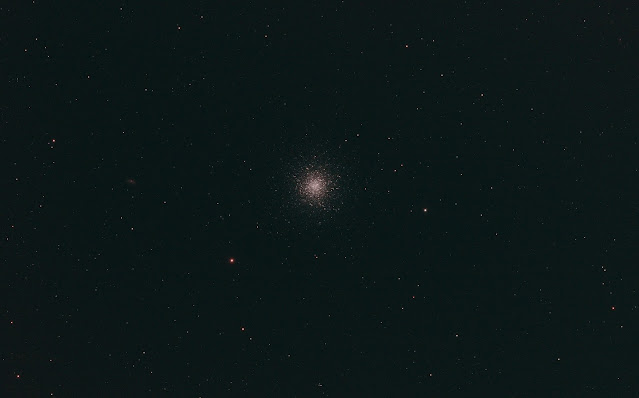
The plan to continue with the E nebula when it rises high enough so for now just 45 minutes 15x 60 sec RGB on M10. It will soon disappear into the tree so very limited time on target. I have a high fence around the house and a tree at due south so anything this low that rises is only visible for an hour or so.

Not a great result but happy I managed to capture it.


Tuesday, 23 May 2023

M12


Not a great deal has changed in the 259 years since its discovery by French astronomer Charles Messier, M12 is a densely packed cluster of hundreds of thousands of the galaxies very oldest stars estimated to be over 13 billion years old, bound by gravity this cluster is 75 light years in diameter or about 435 trillion miles in length in comparison that would be approx. 74,000 yes seventy four thousand times the size of our own solar system of planets.

It took the new horizons probe 9.5 years to get to Pluto so that would mean it would take another seven hundred thousand years before it arrives at the majestic M12.

This image is an RGB combination of 20 x 120 second exposures using all 3 filters so a total of 2 hours combined data, processed in PI.

Considering this for me is very low down and just above the fence line I am very pleased with the result.


Wednesday, 5 April 2023

M3

 First discovered in Dec 1764 by French astronomer Charles Messier, M3 is again a globular cluster with over 500,000 stars and an age of a mind blowing 11.4 Billion years old. Easily visible in binoculars or a telescope.


12 x 2 minute exposures in RGB channels combined in Pixinsight. Core Brightness reduction in Photoshop.

Tuesday, 4 April 2023

M53


M53 is one of about 250 globular clusters belonging to our Milky Way galaxy. At a distance of 60,000 light years, M53 is one of the more distant clusters. The globular contains many older red stars, but it also has a number of blue stars. Such young blue stars are fairly uncommon in globular clusters.

One atypical feature of this image is that I collected all of the sub exposures for this image when the Moon was89% full. Usually I don't photograph Broadband targets when the Moon is out, as the bright light from the Moon washes out the faint parts of most images. However, I was able to capture this image fairly well, because globular clusters consist entirely of stars. Almost all of the stars are individually brighter than the background light from the Moon.

Image capture was 12 x 3 minute exposures in the RGB filters and Pixinsight processed.


In the same field of view from the full frame NGC5053 is a much fainter cluster of stars a  little closer at 57,000 light years, very faint tidal streams suggest some interaction between the two in the past.


Saturday, 17 July 2021

M71 & M27

Last night was the second opportunity to capture some light with the new astro camera. Time for some tests after plenty of reading on the different and optimum settings for gain, exposure and time and balancing that with my scope size and focal length. So we have 2 images M71 & M27. M71 a wonderful globular cluster in Sagitta. Exposure time was 15 x 3 minute exposures with gain at 0 to take advantage of the full well depth 50ke and 16 bit. Readout noise is below detection when cooled to -15. I am happy to play for a few months in Mono before unleashing the filters. M27 was set to 5 minute exposures and here just six of them for 30 minutes of total exposure. A crop too of approx 400%


Saturday, 10 October 2020

M31 Globular Clusters Project

The Andromeda Galaxy (also known as M31 and NGC 224) is the nearest spiral galaxy to our own Milky Way galaxy. Its relatively early Hubble type (Sb) and bright absolute magnitude (-20) make it an important and unique source of information on galaxies of this nature. M31 forms an important testing ground for ideas about massive galaxies and about galaxy evolution, and is ripe for detailed astrophysical exploration. The purpose of this atlas is to make future exploration and exploitation of this galaxy easier by mapping out some of the thousands of objects of various kinds that have been identified in it and by giving photographic and photometric data that will aid in planning and understanding new rese
arch.

The National Geographic Society generously provided funds to support the preparation of the atlas and to help cover its publication costs. The Kitt Peak National Observatory provided the observing time at its 4-meter telescope, through an assignment to an ``M31 consortium.'' The National Science Foundation, through grant AST 76-17598, partially supported some of the research results that were by-products of the preparation of the atlas. And finally, the University of Washington Press has guided the preparation of the atlas and painstakingly produced it.

The original photographic plates for the project were taken in Oct 1974 with the newly installeNicholas U. Mayall Telescope


Below is the website to the source of my information

http://ned.ipac.caltech.edu/level5/ANDROMEDA_Atlas/frames.html

-----------------------------------

This project was inspired by a fantastic website by Steve Gottlieb who images globular clusters in nearby galaxies. Steve is a deep sky observer who enjoys the obscure and offbeat targets.

 https://www.astronomy-mall.com/Adventures.In.Deep.Space/gcextra.htm

                                                            -----------------------------------

39 Photographic plates were taken each of 25 minute exposure. Months of painstaking work was done to complete the Atlas and it's list of extragalactic clusters.


I unfortunately do not own anything in the order of the 4 metre Nicholas U Mayall just a modest 100mm refractor that's about 40 times smaller. I accept that a modern CMOS sensor is infinitely more sensitive today that a photographic emulsion. I spent about a week aligning the plates to mine and came up with an amazing 244 Globular clusters in M31 and it's satellite galaxies. It has been a fun project and I would encourage you all to have a go yourself. My Image below.


Friday, 18 September 2020

Andromeda Globular clusters.

 I stumbled across a great website by Steve Gottlieb https://www.astronomy-mall.com/Adventures.In.Deep.Space/gcextra.htm who has spend some time studying the globular clusters of M31. Several hundred were found categorised and published first by Edwin Hubble in 1932, As many as 509 globulars in M31 have been catalogued based on spectra plates taken at Mauna Kea with the 3.6 meter Canada-France-Hawaii telescope, (Crampton et al, 1985), although recent work indicates that some of these are faint background galaxies. In any case, the M31 globular cluster system does appear to be more numerous than our own galaxy by roughly a 2:1 ratio. This important article provides identifications, positions, magnitudes, colours and radii although no finder charts are given.

A few nights ago I was testing the ASIAIR Pro auto focus and aligned on The Andromeda Galaxy. An hour later I stacked an hours worth of data and stretched it. I was truly amazed I was able to resolve 2' clusters @>mag15. Resolving deeper & longer is a passion of mine and my project a few years ago labelled hundreds of PGC galaxies in the Coma Cluster, this intrigued me from the outset and I had to see how many I could find in M110 (NGC205)

It didn't take long to find them all.


My image is on the left. incredible detail for just 1 hour of exposure. Spectacular rounds stars with of .42 arc second guiding accuracy.


My next project during the new lockdown will be to catalogue the Globulars in M31. I have found quite a few already but it looks like it may take a while.

Monday, 1 June 2020

M13

A beautifully clear night on Saturday in Saham.  M13, a globular cluster composed of several hundred thousand stars tightly bound by gravity and at a ripe old age of 11.66 billion years old some of the oldest stars in the galaxy. I am getting used to the new set up now, better balance and thus better guiding numbers. RMS 0.4 for 30 1 minute exposures.


Thursday, 14 May 2015

M12 More than pleasing to the eye.

The globular clusters in the Milky Way are all estimated to be at least 10 billion years old and therefore contain some of the oldest stars in the galaxy. They contain an abundance of low-mass red stars and intermediate-mass yellow stars, but none greater than 0.8 solar masses. There are about 150 known globular clusters in the Milky Way. It is thought that globular clusters formed very early in the vast halo surrounding the nascent galaxy before it flattened to form the spiral disc. Star formation would have stopped in these clusters maybe 13 billion years ago, so only old stars are expected to be found there.

Described by Charles Messier as a nebula without stars, it's discovery almost 251 years ago this May 30th. M12 is fine example of a globular cluster, appearing to me visually in my 110mm as a compact dense core with a fainter outer shell. I have the luxury of shielding myself from extraneous light inside the observatory but I still like to cover my head with a dark towel and allow just the faint photons of light to touch the retinas. Somewhat smaller than M13 my eyes are drawn to the triangular shaped 3 stars to it's lower left resolving them to starlight points easily. I wanted to highlight that with this image taken Tuesday night with what was one of the best clear nights of the year. Just over 20 degrees above the horizon and tainted with the light from the nearby town of Watton. I limited exposures to 10 minutes and this was just about the limit as a gradient was becoming a problem. 2 Hours in total calibrated and stacked in Maxim and processed in Photoshop using several layers in an attempt to keep the core stellar like. My focus was a fraction off as 12th+ magnitude stars show a little blooming, noticable when stretched so I have sacrificed some of the background stars. Having never image M12 before I am pleased with the result.

Saturday, 24 May 2014

M13

A test of the set up was required. So I rebalanced and ran PHD of a target much lower in declination than M106. I wanted something bright and easy so M13 was an easy choice to make rising nicely in the North east. I ran the guide programme for 5 minutes with no issues. Fingers were crossed and I ran 5 x 20 minute exposures as a test run really. Calibrated in Maxim DL and processed in photoshop. All I done to process was levels and curves. No unsharp masks or colour correction. Very pleased the core of the structure was not overcooked. A close inspection of the image had shown a faint galaxy between M13 and NGC6207. Carte Du Ceil shows it to be a PGC (principle galaxy catalogue) designation PGC2085277 a mag16.15 galaxy some 2500 times further away than the galactic cluster M13. Delving deeper I found 31 in total as deep as 19.22. Some showing as a marginal brigtening of a pixel or 2 but still there. call up a 2 degree FOV in Carte du Ceil and see how many you can capture too. You may have to download a few extra catalogues though.

Monday, 15 July 2013

M 52 & a Bubble


Picture the scene, France was bathed in a period of mourning for
King Louis XV a struggling economy and battle scarred France
decended futher into dissaray from decades of war that was soon
to fall to the people in the French Revolution . Meanwhile French
astronomer and comet hunter Charles Messier had found another faint object to add to his expanding catalogue of (non cometary bodies), whilst observing a comet in the same region .Catalogued as galactic open star cluster (M52) Approx 5000 light years away and 35 million years old, this collection of approx 200 stars has shone for countless eons of time. You will also notice a bubble of glowing gas, at more than twice the distance of M52 this shockwave of expanding gas & dust was created and illuminated by the energetic radiation from a
massive star. This image was taken last night or should I say early this morning for what was an all nighter. The guiding worked well all night allowing for 5 minute sub frames to give me this 1hour 15 minute shot. Focus was a few microns off though.

Thursday, 26 July 2012

M2

M2 (NGC7089) is one of the largest globular clusters consisting of approximately 150,000 stars located within our galaxy at a distance of approximately 36,000 light years. Estimated to be 13 billion years old, almost as old as time itself. A lovely view at high power resolve the cluster into a swarm of bees. Even with my Megrez 90 I am pleased to resolve nearly all the way to what is a very dense core. Once again Iso 800 works well with the clusters and an hour of 2 minute guided exposures. A fantastic well illuminated wide field has not required a need for flats here.

Lonely among us.

Floating amongst a myriad of stars lost in time for 10 billion years,(a junior in globular standards) M71 will have spent eons watching the birth and growth of our galaxy looking down from it's vantage point outside the disk of the milky way 1200 light years away. To it's left lies the wonderfully coloured g Sagittae a red giant in it's twilight years some 640 times more luminous that our sun and 55 times more massive too.

Stacked in Maxim DL and processed in Photoshop this 1 hour exposure at Iso 800 has had no darks, flats, or Bias frames. A minimal DDP stretch. I find with globulars less is more with the processing. A pleasing result and very happy being being able to resolve stars to the core of M71

Thursday, 12 April 2012

An old favourite

After studying M13 through your telescope, imagine now the sky as from deep within the cluster. We would see uncountable numbers of blazing stars, many as bright or brighter than our naked eye planets. Inhabitants on a planet inside M13 would probably know nothing of the Galaxy and other galaxies, as their view would be completely blocked by the brilliance of their own skies. To them, the Great Cluster in Hercules would be "the Universe".

I wanted to try a few exposures at a low Iso and see how well the processing would keep noise to a minimum. The sky has remained very dark as the DDP stretch in Images Plus increased and teased out more detail. I wanted to capture more detail in the core, under saturating the chip at 400 ISO has worked well. Stacked in Deep Sky Stacker this is only 10 x 2 minute guided exposures. (This time I remembered to refocus after the alignment setup)

Monday, 26 March 2012

Galactic Globulars M3,M53

I cant believe the good run we have had over the last week five from five here in Sunny Norfolk. I am feeling a bit gutted too as I have missed Breckland Astronomical societies first star party & I have a week of night to do starting tonight so the skies are bound to get even better!!. I shouldn't complain either as I have addeed a handful of Pics to my own messier chart

Having bagged a few galaxies this week I turned my attention to the old and weary (globulars) that is....

M5 & M53 became the clusters of choice.  

                      M5

Astronomers like Messier, Kirch, Koehler & Bode all described their first observations of M5 back in the mid 1700's as a nebula without stars. It wasn't until 1783 when William & Caroline Herschel viewed through their 7  & 20 foots reflector. it was resolved into the myriad of stars we can capture today. Although Caroline still mistook it for a comet.

 M53 & Ngc 5053

M53 and NGC5053 are shown in this field. M53 is the bright globular cluster in the centre; NGC5053 is the dimmer globular cluster in the lower right. ngc5053 is about 53,500 light years distant from Earth which is close to the distance of M53. This puts both globular clusters relatively close to each other in space. I had made a slight miscalculation and thought I could not fit both in the same field of view. I only looked at the framing of M53 in my test image. I will have to have another go sometime framing them both appropriately.

Wednesday, 4 May 2011

M13

We have been graced recently with some great clear nights. 5 in a row at last count but tonight was the 1st without the wind. So on goes the canon. I have said now a couple of times this may be the last pic for a while as I am moving, but the clear skies just keep on coming!!!

Anyway onto the good stuff. This is a slightly cropped and DDP processed image of 20 x 300 second exposures at ISO400.

It never fails to amaze me the sensitivity of the cameras just seems to get better. We can now image detail in the nearby 12th mag ngc6207. No longer just a fuzzy blob next to it.

About 124 light years in diameter M13 contains a few hundred thousand stars.

Tuesday, 23 March 2010

M92, NGC6341


I dont really believe what I saw last night but from dusk till dawn we had a clear night temp hovered around +2. At around midnight i could see the old summer favourites coming into view. Dew heaters on and I focused on M92 somewhat overlooked because of its proximity to its big sister M13, I dont really know why because it's a wonderful sight in my 90mm.

At a distance of 26,000 light years only 900 Light years futher on than M13

16 variables have been discovered in this globular, 14 of which are of RR Lyrae type, while one of them is one of the very few eclipsing binaries in globular clusters.

Late last year I purchased one of the generic field flatteners. I have to say it doesnt work. will just have to save a few pennies for the Williams mk111 version.

Anyway Here is a cropped and stacked set of 76 unguided 30 second JPEGS Images giving a total of 38 Minutes. No darks of flats used.

It was just great to get outside and let some of the stresses of work float away

Monday, 12 May 2008

M13 The Great Hercules Cluster


Monday 5th May.


An historic day. My finished observatory has seen first light and to celebrate the event I pulled an all nighter ( well Very nearly).

The first target was M13 in the constelation in Hercules. I was initially happy to spend the evening just being able to achieve focus and get everything working. Having achieved this reasonably quickly I set about some imaging.

28 x 30 second unguided exposures using

Canon EOS300D / William Optics Megrez 90mm refractor / Processed Using Images Plus 2.0

I am very pleased with this first attempt.

Your comments are appreciated.


Thursday, 28 February 2008

Deep Sky M13

M13 The Great Hercules Globular Cluster.
This Image was Taken through The 10" Orion Optics reflector at principle focus with a Canon EOS300d DSLR. A stack of 6 x 30 Second exposures stacked in Images Plus V2
This as my first attempt a deep sky Imaging.

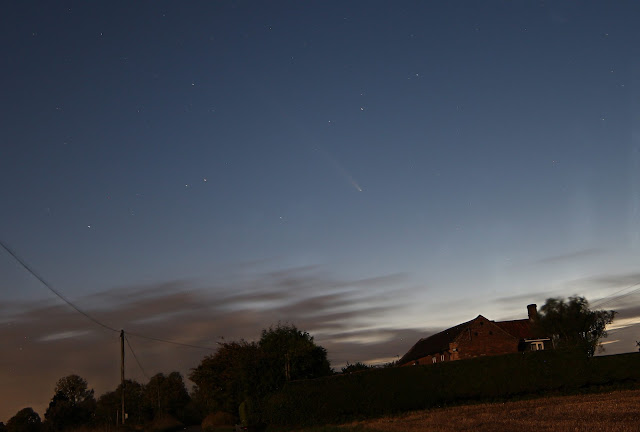
Comet Tsuchinshan-ATLAS, C/2023 A3 , Comet A3,

  A cosmic wanderer, Comet Tsuchinshan-Atlas or more commonly known as Comet A3 has traced its elliptical path through the solar system, a j...