One the most recognisable objects in the night sky is the
Pleidies or the 7 sisters. In Greek mythology they were the 7 daughters of the
Titan Atlas & and his wife Pleione. Legend says with the weight of the
world on Atlas’s shoulders he was unable to protect his daughters from the great
hunter Orion, so In order to save them Zeus transformed them into stars placed
them in the heavens away from Orion’s reach.
In reality the cluster contains more than three thousand
young hot stars all formed within the last 100 million years with only the
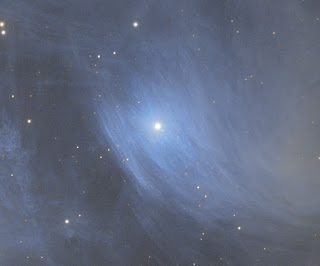
brightest visible to the naked eye. The blue nebula that is visible is a cloud
of dust these cosmic wanderers are just passing through. My image here was
captured over several recent clear nights and is a total of just over 3 hours through
my telescope.
20 x 3 minute exposures for each Red, Green & Blue ZWO filters, processed in Pixinsight using the new Blur Exterminator plug in.
The Merope Nebula is the brightest
reflection nebula in the Pleiades cluster.
It is also known as Tempel’s Nebula. It was discovered by the German astronomer
Wilhelm Tempel from Venice, Italy on October 19, 1859. Tempel used a 4-inch
refractor to observe the famous open cluster.
You
can also see here a small object about the 4.00 O'clock position. The nebula
contains a small bright knot, designated IC 349, that is located only 0.06
light years from Merope. The knot was
discovered by the American astronomer Edward Emerson Barnard in November 1890
and is also known as Barnard’s Merope Nebula. Barnard observed the knot using a
36-inch telescope at the Lick Observatory in California. IC 349 is about half
an arc minute wide. It is the brightest part of the Merope Nebula because it
lies so close to the central star. A recent capture from Hubble shows the knot
being destroyed by 11km per second stellar winds.