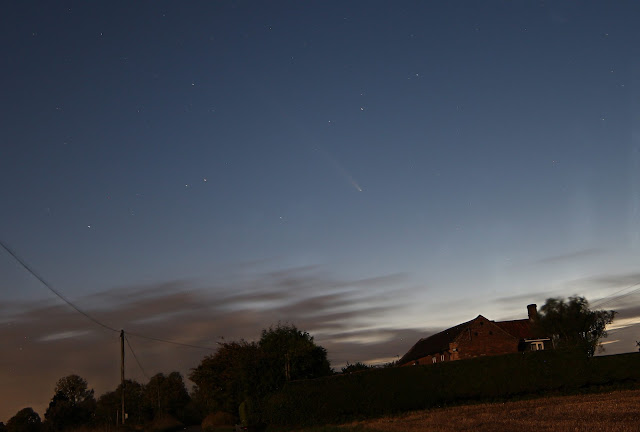
As mentioned previously there was a bright moon not far away at the time of capture.
I am happy with the dusty stuff captured. One thing I have noticed Blogspot appears to brighten the images a fraction from my original.

 Right so here we have a cropped image of the pair. There was a serious hot pixel problem which pixinsight gave a good attempt to remove despite no dark frame intergration. Andrew has followed a standard workflow to enhance the master frame. The real skill is knowing how much stretch, Tweaking, adjustment to make before thee next tool is used. I have tried with the same master. Not quite the same result. I also post on my facebook page and the Breckland AS page too https://www.facebook.com/?ref=home#!/groups/176906152365752/ like and join the page to follow all my frinds images.
 get such detail from the core. Testament to the
  SXVm25c too. I would like to test the Canon 40d on the same subject to do a comparison in the depth of detail captured. Please ignore the hot pixels. I am still struggling to remove them despite now having the darks. I mentioned earlier that I was trying to get to grips with the preprocessing script. It / I have an issue with my flat fields. It will not accept there is a signal there and refuses to combine them to a master. I have now managed to create a flat manually. Next issue I have come across occurs with the light frames in the preprocessing script it debayers ok and now cannot locate any stars in the frame. I have tested the whole process using Maxim and everything combines with no issues.
 I would consider myself a patient / tolerenat person god know I need to be in my line of work. But I am just so frustrated with it. I feel at the moment somewhat demoralised by the lack of consistent workflow guides and explanations given on various web pages. I seem to get problems in every step or script I try. Very pleased again with the detail in and around the core. Don't get me wrong it is an amazing piece of software. I am sure there are many who are in the same boat as me. I would like to hear from anyone who is? By now I was desperate to combine those new light frames giving me a total of 5 hours of light. I ran the whole set through Maxim and the flats really make a difference from the vignetting I could see on the 3 hour master. I have yet to play with it using the pixinsight processes but I will not be defeated and will post an update. Watch this space..........I have never using the old set up been capable of 5 hours worth of usable data. Even the smallest of stars are perfect. Sorry for banging on about it but this has really impressed me and I think given me a platform to produce some future stunning images. So in conclusion I am down, but certainly not out, the Jury is out and a verdict no yet reached. How many days of the trial left ?????
 The new set up is better than I would have hoped. Shame the skies have not been so cooperative. However last friday was beautifully clear. I wanted to capture and old favourite a target I was familiar with to put the scope & camera to the test. Guiding was absolutely flawless, sub pixel guiding for ever 3 hours. Captured in 5 minute subs these are the hugely cropped images of M81 & M82 processed in pixinsight by fellow blogger Andrew. It was amazing to see the workflow used by Andrew to pull out the detail in the pair of galaxies. I have also darkened the sky background.
 I have a small issue with hot pixels which will be addressed, but I just wanted to get some photons on that CCD. I also have a William Optics 50 mm finder scope which other astrophotographers have used their guider. I think I will have a go and use the GT81 with the 40D Canon. I hope you liking the first results.


A cosmic wanderer, Comet Tsuchinshan-Atlas or more commonly known as Comet A3 has traced its elliptical path through the solar system, a j...