Showing posts with label Hubble Palette. Show all posts

Monday, 10 April 2023

Spider Nebula (update)

Started in December last year with some lovely 5h 50m of Ha data, I have managed to capture some Oiii & Sii data as well during January. 4 hours from each filter will give me a total of 11hrs 50 minutes to produce an SHO image. A JPEG of each processed image. Looking at them now I have done a star reduction on the Ha.

Ha


Oiii

Sii

Combined data 


Also a starless version just because I love the way it looks.


Photo Details

  • Total Exposure:  11 Hours, 50 Minutes ( 46 x 300 sec Ha, 48 x 300 sec Oii, 48 x 300 sec Oiii Frames)
  • Telescope: Skywatcher Esprit ED100
  • Image Acquisition: ZWO ASIair Pro
  • Camera Settings:  ZWO ASI2600mm pro Gain 100, 0°C
  • Accessories: ZWO 7 position Filter wheel
    •                Optolong narrowand filters 
    •                ZWO EAF
  • Calibration Frames: Darks, Flats calibrated.
  • Stacking and Processing: Pixinsight & touch ups in Photoshop. 
  • Size: 2.26 x 1.38 deg 
  • Pixel Scale: 1.41 arcsec/pixel

Friday, 30 December 2022

Spider Nebula

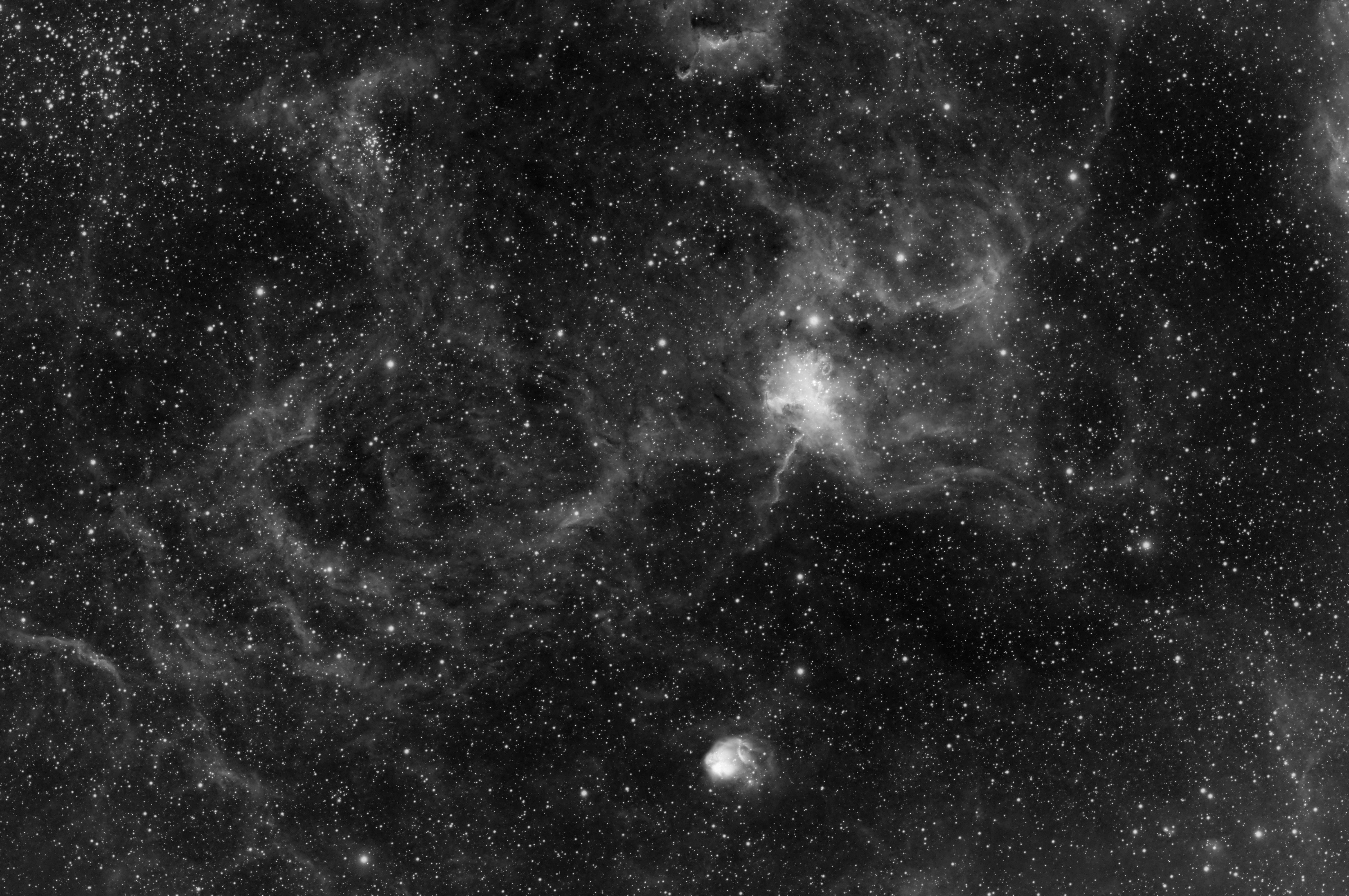
I have a few targets in the constellation of Auriga that I continue to look at capturing, some of which  were captured last winter, seems like a long time since I captured IC405 & 410 now, I should have a re process using what I have learnt over this last year from Pixinsight...But as for last night I managed 3hrs 50 mins of Ha data on  IC417 the Spider Nebula. I plan on an SHO image using 5 hours from each filter. As a start we have here an ASI air quick stack and screen stretch of the ha data. Looks lovely on the tablet but just a little processing via Pixinsight I have some lovely clean data and some lovely details too.

1. ASI AIR PRO stack & screen stretch.


2. Pixinsight process.

Using full calibration, Darks, Flats, Dark flats using WBPP script, 2 x Drizzle,
Automatic background subtraction, Blur Exterminator, Noise Exterminator, Histogram Transformation, Starnett++ Curves Transformation & PixelMath to re add the stars at 75%.

The are some interesting objects here in amongst the clouds of ionised hydrogen gas. We will start with 

IC 417 just left of centre of the image (also known as Sh2-234) is an emission nebula of almost 100 light-years across, located some 10,000 light-years away from Earth in the constellation of Auriga (the Charioteer). It is often referred to as the Spider Nebula and in that case its prey is a nearby (above) emission nebula called the Fly (NGC 1931).The nebula contains a young open cluster of about 40 stars, and is energized by its hot, massive blue stars which are still embedded in glowing hydrogen gas.


In the bottom right hand corner is the Charles Messier famed M38 open cluster a much closer 3480 light years and to it's left NGC1912 starfish cluster.

 3. Starless


I really love a starless image you can really explore the Ha regions here.

There will be a great deal more to add to this post as time moves into 2023, there will be at least 5 hours of Ha, Oiii & Sii data to create a SHO palette image. 

Malcolm. aka The Astrogeek
Tuesday, 31 August 2021

Sunday, 29 August 2021

Ngc 7000 Narrowband.

 The Curse of the new gear strikes again.

Yes the weather has not played ball for the last couple of weeks lending credence to the curse of the new gear for us astronomers. I am desperate and stupidly excited to create my first "Hubble Palette" style image using the Optolong Narrowband 36mm filters in the ZWO filter wheel. I did manage to get the filters installed with no issues and had to wait a week to test. All filters are parfocal and using the ZWO EAF "auto focusser" all gave pinpoints stars within 10 focus steps. Sometimes seeing can set the focus point with a difference of up to 30 steps so very happy with that. I first tested the Ha filter on NGC7000 and here is a stack of 12 x 5 minute exposures.

Hydrogen Alpha 7nm Optolong Filter. 12 x 5 minutes

I have imaged this target many times in the past and I am stunned at the quality with a 1 hour stack.

I have had to wait a while longer to image the OIII and S2 filters. 

OIII 7nm Oxygen III Optolong Filter. 18 x 10 Minutes


Sulphur 2 7nm Optolong Filter 18 x 10 Minutes


All Combined in the Hubble Palette RGB image.


Comet Tsuchinshan-ATLAS, C/2023 A3 , Comet A3,

  A cosmic wanderer, Comet Tsuchinshan-Atlas or more commonly known as Comet A3 has traced its elliptical path through the solar system, a j...