Showing posts with label Images Plus. Show all posts

Wednesday, 17 October 2012

California nebula

As promised I have had another go at the huge NGC1499. I sometimes wonder how something as huge as this never made the messier catalogue.
I have managed and hour and a half this time and think I have a much smoother result.
45 x 2 minute guided exposures at ISO 1600. No darks , flats or bias frames added , subtracted or divided. I just love the new JMI focusser. so simple and quick to auto focus. I have had a long day at work today. Just can't think of anything else to add. Goodnight all....

Thursday, 12 April 2012

An old favourite

After studying M13 through your telescope, imagine now the sky as from deep within the cluster. We would see uncountable numbers of blazing stars, many as bright or brighter than our naked eye planets. Inhabitants on a planet inside M13 would probably know nothing of the Galaxy and other galaxies, as their view would be completely blocked by the brilliance of their own skies. To them, the Great Cluster in Hercules would be "the Universe".

I wanted to try a few exposures at a low Iso and see how well the processing would keep noise to a minimum. The sky has remained very dark as the DDP stretch in Images Plus increased and teased out more detail. I wanted to capture more detail in the core, under saturating the chip at 400 ISO has worked well. Stacked in Deep Sky Stacker this is only 10 x 2 minute guided exposures. (This time I remembered to refocus after the alignment setup)

Tuesday, 17 January 2012

Horsehead Nebula

Stargazing Live from my own back garden this evening. My telescope & camera pointing towards the heavens to image the amazing Horsehead Nebula.

The red glow originates from hydrogen gas predominantly behind the nebula, ionized by the nearby bright star Sigma Orionis. The darkness of the Horsehead is caused mostly by thick dust, although the lower part of the Horsehead's neck casts a shadow to the left. Streams of gas leaving the nebula are funneled by a strong magnetic field. Bright spots in the Horsehead Nebula's base are young stars just in the process of forming.
1 hour only of exposure Approx 40 mins @ Iso 3200 and 20 Mins @Iso 1600 using 2 minute guided sub frames. My collection of darks are proving useful with a dark frame subtraction. DDP and levels adjustment and aquisition provided from images plus and Deep sky stacker combining the frames.

Saturday, 5 June 2010

M81 & M82 2 Hours

Hi again all,
Had a great night of clear skies again last night so from midnight I captured another 1 hours worth of photons. Again we have 60 x 1 minute exposures unguided and a master produced. I then combined both masters and done a little cropping due to camera alignment. Had to remove as we had our daughters 8th birthday party to capture. I am preety amazed at the result stars image is a little smoother and stars rounder too?

Sunday, 1 March 2009

Comet Lulin (C/2007 N3)

Object: Comet Lulin (C/2007 N3)
Type: Comet
Constellation: Leo
Date: 1st March 09
Equipment: William Optics Megrez 90 Canon EOS 40D Subframes: 11 x 30 second exposures unguided at ISO1600
Processed: No darks or flats were captured. Processed in Images Plus 3.75 with a small non linear stretch or DDP
Having just given our newborn her midnight bottle and tucked her safely in her crib. I looked out the window.

Guess What I Saw ??
Finally we have had a few hours of clear sky and this was my first view of comet Lulin. I spent 15 minutes or so looking at it through my 26mm 2" meade eyepiece through the 90mm refractor. I couldnt see any colour as in the west south west direction is our local town of Watton (only 3 miles away) and a significant amount of skyglow was creeping higher and higher as the clouds and moisture content increased. .

As Lulin is composed of frozen ice, dust and gases. Cyanogen gas and diatomic carbon present in it, when irradiated by sunlight, make it appear green.

I quickly connected up the camera and for the first time used Images plus 3.75 DSLR control for a series of exposures. This image was taken between 1.50 am and About 2.15 am Several frames removed from stacking as cloud passed by. I stacked them to keep the stars at pinpoint so the comets nucleus looks a little elongated. I also used the windows picture viewer and flicked through all the frames at high speed and it was amazing to see how fast the comet is now now moving across the fixed background stars. If I can find a simple animation programme I will will make an animation of its motion.

I am amazed there was a secondary point of interest here. The tail of the comet has passed across 4 NGC galaxies marked on the frame. The faintest of which is mag 15.00 and I can just confirm its there. Not bad for 5 and a half minutes of exposure.

Not the best pic I have taken by far simply because of the sky quality and all I kept was 11 subs from the 30 or so I had taken, A fraction on the heavy side of processing to see the tail and those 4 galaxies.
For fear of no more clear nights I reflect on another beautiful looking comet and the thought of its journey and possible return in 50 million years time.
God speed comet Lulin.

Saturday, 14 February 2009

M42 & NGC1977 Over Processed

This image is the same as the one below but i used some very aggressive processing using images plus 2.5. I have done this to see what info I could tease out from the stacked master image. Personally I like to keep the images clean with realistic dark backgrounds so if anything I am happy to under process to get a more pleasing result. I am certainly no expert in imaging but I enjoy the challenge of having a go.


So what did I do.

well within images plus there is a video file with a set of typical preset adjustments for a M42 found in the file named "deep sky image set" you can copy and paste these settings upon your own image , the processes include Pixel Maths, Digital Development, Brightness & levels, Saturation & brightness.

I wouldnt be happy with this as a final result but what amazes me is that the information is there. I love the way the running man leaps from his own nebula and M42,s wings completely encirle and join hands. No colour adjustments were made & I love to see the true colours shine through.
Please your comments are welcomed what do you think

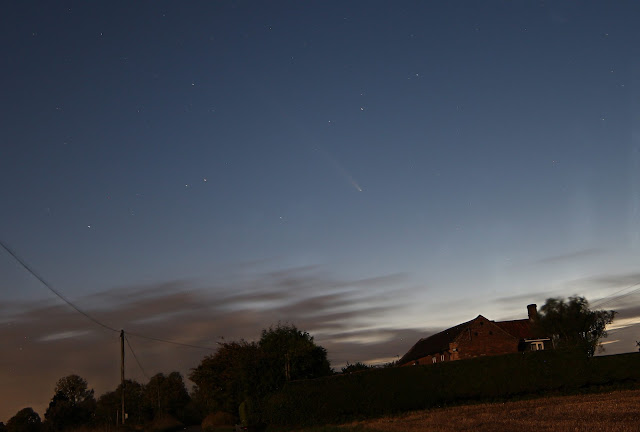
Comet Tsuchinshan-ATLAS, C/2023 A3 , Comet A3,

  A cosmic wanderer, Comet Tsuchinshan-Atlas or more commonly known as Comet A3 has traced its elliptical path through the solar system, a j...