The Great Orion Nebula has always been a firm favourite to view visually or to image. I was lucky enough to view the trapezium through the clubs 20 reflector. A beautiful sight in a quality eyepiece. I also had some fun imaging it too. Not a very favorably placed object for my backyard with the fence and a number of electricity cables stretching across from The South to the North East. So an imaging run consist of a lot of rejected frames with wires.
Friday, 20 January 2023
M42 The Great Orion Nebula
Sunday, 14 March 2021
M42 The Orion Nebula
A last look at the Great Orion Nebula for a few months. Unfortunately for me it disappears behind the front of the house about an hour past the meridian so a very limited window of capture now in March.
Anyway a short capture of 20 x 180 and 20 x 30 seconds images taken with the ASI294mc pro on the ED100 via the ASI AIR Pro. Calibrated and stacked in Deep sky stacker and processed in Photoshop. I am always amazed how smooth the result is and even with a huge crop on the Trapezium the resulting image is incredibly clean. One confession to make though for the pixel peepers, the 4 stars of the Trapezium have been made round removing slight halos from processing.
Monday, 29 December 2014
First post for a long while, Last one of the year.
Due to illness this has been my first post for a few months now. It was great to go out to my observatory and dust off the cobwebs and roll back the roof. I am lucky in that once I have powered & set up approx 10 minutes I can then control all my imaging from the comfort of inside the house. No more endless hours in the cold. Through the 35 years or so I have been an astronomer I feel i have earned & done my time in the cold. I was surprised that everything was working well. I decided an easy target to get me back into the swing. Due to the moon's presence I limited the exposures to 5 minutes. A total of 2 hours 20 minutes has given me this result. I also took a number of 10 second exposures, so the final result was not to over expose the core. Taken through the William Optics GT81. No calibration frames used. Just processed in Photoshop. I hope to return with longer exposures to capture the outer shell of gas. Looking forward to posting pics of Comet Lovejoy too soon.Sunday, 17 November 2013
Flat field issues solved
This process was done late evening after returning from the observatory at Great Ellingham. I wanted to give it a test run on a subject until the rise of the comets. I ended with a nice result from 12 x 10 minute exposures on the enigmatic M42. A DDP stretch and saturation gave a good sharp result with lovely structure to the wisps of nebolosity. Guiding was sub pixel accurate.
Friday, 6 January 2012
M42
The last week or so has left us all a bit battered by the winds.
The moons phase equally annoying for a deep sky imager. I wanted to just test everything was still working as it has been over a month since rolling back the dome roof. Last year I was able to test my UHC filter on ngc7000 on a series with and without. So last night I pointed towards Orion and done a series of 3 minute images at Iso 800. I love the colour rendition that the filter gives. A more natural look from unfiltered. M42 I think. Just wish we were a few light years closer!!!!!!!
Saturday, 14 February 2009
M42 & NGC1977 Over Processed
Wednesday, 4 February 2009
M42 The Great Orion Nebula

What an amazing night transparency excelent apart from the 62% moon in the way.
I thought I would have another go at M42. I wasnt happy with the previous posted image, well that was really just a test to get the PHD to work ( still no luck ). Apologies for slightly elongated stars.
Object: M42
Type: Reflection & Emission Nebula 1270 Light Years Distant.
Constellation: Orion
Date: 24th January 09
Equipment: William Optics Megrez 90 Canon EOS 40D
Subframes: 30 x 30 second exposures unguided at ISO800 and
Processed: 10 x 30 sec darks were captured & subtracted. Stacked using Deep Sky Stacker,
Processed in Images Plus 2.0 with a DDP stretch. 10 Iterations on a adaptive Richardson Lucy deconvolution filter.
Notes: This cropped Image was taken under a 62% illuminated moon.
Any exposure over 30 seconds was badly washed with moonlight so I kept it to that and the result is excellent. I also used Deep Sky Stacker programme for the calibration and stacking it was very easy to use and a great deal quicker than manual registration of each image. I used med fine quality JPEG as I have a small problem when I ask it to use RAW even with an empty card the camera says it is full and will not take an image.
Sunday, 25 January 2009
M42 The Great Orion Nebula

Equipment: William Optics Megrez 90 Canon EOS 40D
Subframes: 4 x 30 second exposures unguided at ISO800 and
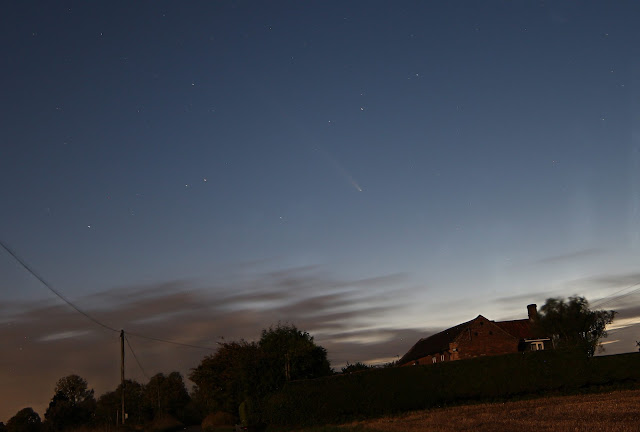
Comet Tsuchinshan-ATLAS, C/2023 A3 , Comet A3,
A cosmic wanderer, Comet Tsuchinshan-Atlas or more commonly known as Comet A3 has traced its elliptical path through the solar system, a j...
-
ASTRONOMER: When you rearrange the letters: MOON STARER Does anyone know any more that are astro related??
-
A cosmic wanderer, Comet Tsuchinshan-Atlas or more commonly known as Comet A3 has traced its elliptical path through the solar system, a j...