Showing posts with label Comet C/2007 N3 Lulin. Show all posts
Showing posts with label Comet C/2007 N3 Lulin. Show all posts
Wednesday, 18 March 2009

Tuesday, 17 March 2009
Lulin Animation
Wow it worked I downloaded a simple AVI creation programme added the files and hey presto Comet Lulin zipping across our skies.
This small animation is from stacking 10 frames and repeated
This small animation is from stacking 10 frames and repeated
Sunday, 1 March 2009
Comet Lulin (C/2007 N3)
Object: Comet Lulin (C/2007 N3)
Type: Comet
Constellation: Leo
Date: 1st March 09
Equipment: William Optics Megrez 90 Canon EOS 40D Subframes: 11 x 30 second exposures unguided at ISO1600
Processed: No darks or flats were captured. Processed in Images Plus 3.75 with a small non linear stretch or DDP
 Having just given our newborn her midnight bottle and tucked her safely in her crib. I looked out the window.
As Lulin is composed of frozen ice, dust and gases. Cyanogen gas and diatomic carbon present in it, when irradiated by sunlight, make it appear green.
I quickly connected up the camera and for the first time used Images plus 3.75 DSLR control for a series of exposures. This image was taken between 1.50 am and About 2.15 am Several frames removed from stacking as cloud passed by. I stacked them to keep the stars at pinpoint so the comets nucleus looks a little elongated. I also used the windows picture viewer and flicked through all the frames at high speed and it was amazing to see how fast the comet is now now moving across the fixed background stars. If I can find a simple animation programme I will will make an animation of its motion.
I am amazed there was a secondary point of interest here. The tail of the comet has passed across 4 NGC galaxies marked on the frame. The faintest of which is mag 15.00 and I can just confirm its there. Not bad for 5 and a half minutes of exposure.
Not the best pic I have taken by far simply because of the sky quality and all I kept was 11 subs from the 30 or so I had taken, A fraction on the heavy side of processing to see the tail and those 4 galaxies.
For fear of no more clear nights I reflect on another beautiful looking comet and the thought of its journey and possible return in 50 million years time.
God speed comet Lulin.
Type: Comet
Constellation: Leo
Date: 1st March 09
Equipment: William Optics Megrez 90 Canon EOS 40D Subframes: 11 x 30 second exposures unguided at ISO1600
Processed: No darks or flats were captured. Processed in Images Plus 3.75 with a small non linear stretch or DDP
 Having just given our newborn her midnight bottle and tucked her safely in her crib. I looked out the window.
Guess What I Saw ??
Finally we have had a few hours of clear sky and this was my first view of comet Lulin. I spent 15 minutes or so looking at it through my 26mm 2" meade eyepiece through the 90mm refractor. I couldnt see any colour as in the west south west direction is our local town of Watton (only 3 miles away) and a significant amount of skyglow was creeping higher and higher as the clouds and moisture content increased. .As Lulin is composed of frozen ice, dust and gases. Cyanogen gas and diatomic carbon present in it, when irradiated by sunlight, make it appear green.
I quickly connected up the camera and for the first time used Images plus 3.75 DSLR control for a series of exposures. This image was taken between 1.50 am and About 2.15 am Several frames removed from stacking as cloud passed by. I stacked them to keep the stars at pinpoint so the comets nucleus looks a little elongated. I also used the windows picture viewer and flicked through all the frames at high speed and it was amazing to see how fast the comet is now now moving across the fixed background stars. If I can find a simple animation programme I will will make an animation of its motion.
I am amazed there was a secondary point of interest here. The tail of the comet has passed across 4 NGC galaxies marked on the frame. The faintest of which is mag 15.00 and I can just confirm its there. Not bad for 5 and a half minutes of exposure.
Not the best pic I have taken by far simply because of the sky quality and all I kept was 11 subs from the 30 or so I had taken, A fraction on the heavy side of processing to see the tail and those 4 galaxies.
For fear of no more clear nights I reflect on another beautiful looking comet and the thought of its journey and possible return in 50 million years time.
God speed comet Lulin.
Saturday, 31 January 2009
Comet Lulin (C/2007 N3)

What might be the best naked-eye comet of the year is approaching the Earth and growing brighter every day. It’s Comet Lulin, named for the Chinese observatory where it was discovered in 2007.
Comet Lulin currently is in the constellation of Virgo passing the star Spica in the next couple of days, rising about 1 a.m., but as we progress through February, the comet will move with pace into the constellations of Virgo and Leo and will rise at the much more reasonable hour of 7 p.m.
Comet Lulin currently is in the constellation of Virgo passing the star Spica in the next couple of days, rising about 1 a.m., but as we progress through February, the comet will move with pace into the constellations of Virgo and Leo and will rise at the much more reasonable hour of 7 p.m.
Perhaps the most interesting aspect of Comet Lulin is its unusual orbit around the sun. Although it orbits in nearly the same plane that the Earth does, it does so backwards. Earth and all of the major planets orbit the sun counterclockwise as viewed from above Earth’s North Pole, but Comet Lulin is going against the flow, moving around the sun in a clockwise direction. Because it is moving in the opposite direction that Earth moves, the two will pass each other at the breakneck speed of nearly 40 miles per second, or 140,000 miles per hour.
On the night of closest approach to Earth, Feb. 24, Comet Lulin will be moving at an astounding 5 degrees per day across our line of sight. Its motion against the background stars will be evident through a small telescope or even binoculars. The comet will pass 0.41 Astronomical Units from earth and reach its closest distance to Earth on February 24, about 14.5 times the distance between the Earth and the Moon.
Another fascinating aspect of Comet Lulin’s orbit is that it is parabolic rather than elliptical. That means that Comet Lulin doesn’t make regular, periodic visits to the inner solar system, but it is in an orbit so large that this might be the very first time it has passed through the inner solar system and felt the warmth of the sun on its solidly frozen ices. Consequently, predicting the behavior of this newcomer is speculative at best. So far, it has been at or slightly ahead of its theoretical brightness curve. If this trend continues, Comet Lulin is expected to reach fourth magnitude at its peak. That’s bright enough to be seen with the unaided eye from dark, rural locations.
A pair of ordinary binoculars always enhances your view of a comet, and on the night of closest approach, Feb. 24, Comet Lulin and the bright planet Saturn will be in the same binocular field of view, providing an unforgettable sight.
A soon as possible from my location attempts will be made to photograph this newcomer to our solar system.
Long Live Comet Lulin.
Subscribe to:
Posts (Atom)
Comet Tsuchinshan-ATLAS, C/2023 A3 , Comet A3,
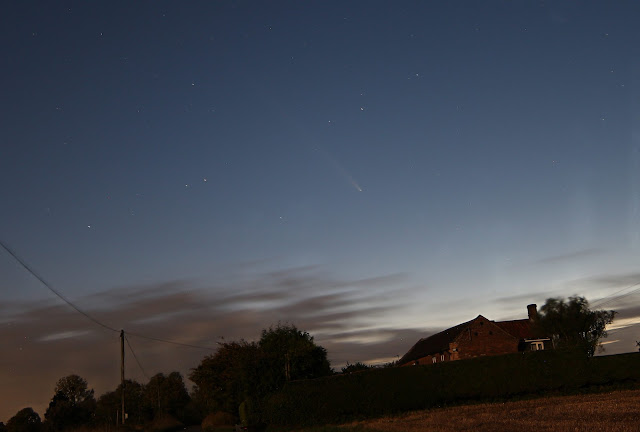
A cosmic wanderer, Comet Tsuchinshan-Atlas or more commonly known as Comet A3 has traced its elliptical path through the solar system, a j...
-
ASTRONOMER: When you rearrange the letters: MOON STARER Does anyone know any more that are astro related??
-
 My previous post of M97 & M108 required further inspection as I could see numerous faint fuzzies about 20 in all. I have highlighted the...