Showing posts with label Pixinsight. Show all posts

Monday, 29 May 2023

M10

Well a first for me I think in the last couple of years. 3 yes, three nights clear in a row and no work, so that means 3.00am finishes each night. Tonight would be night 4 but the forecast is for clouds. Oh well it was good while it lasted.

The plan to continue with the E nebula when it rises high enough so for now just 45 minutes 15x 60 sec RGB on M10. It will soon disappear into the tree so very limited time on target. I have a high fence around the house and a tree at due south so anything this low that rises is only visible for an hour or so.

Not a great result but happy I managed to capture it.


Saturday, 7 January 2023

Melotte 15

The full moon interferes with imaging the very faint objects so I have been reprocessing some data captured from early last year. These two images lie within the centre of the Heart Nebula. The first is Melotte-15 is the star cluster at the heart of the Heart Nebula. It is an association of very young hot blue supergiant stars that are only 1.5 million years old. Fierce stellar winds from this cluster have blown the enormous bubble within the parent nebula that is the heart nebula. Image 2. The winds have sculpted the dust clouds within which other stars are forming into interesting columns and shapes.


Sunday, 1 January 2023

The Tadpoles SHO processed

About 9 hours of data used to create the HSO version of the IC 410 nebula.

This was a project started lst year with just some Ha data.

48 x 5Min subs Ha
30 x 5Min subs for Oiii & Sii
Plan mode on the AIR incorporating the EAF during acquisition has produced an incredible set of sub frames. Processed in Pixinsight.

Full calibration using WBPP script. DBE, and Linear fit to the Oiii channel, Channel Combination, Generalised Hyperbolic stretch, Correct Magenta Stars, Starnett++Generalised Hyperbolic stretch, Curves, Blur Exterminator, Noise Exterminator, Colour Mask, Convolution, LRGB Combination to add Luminance, Curves, Colour Masks,

I would love to do a video on the processing, but just not that confident in front of the camera.

Anyway the final results are as follows.


A crop of the Tadpoles.


Go on the a little more cropping.


Thursday, 22 December 2022

M45


One the most recognisable objects in the night sky is the Pleidies or the 7 sisters. In Greek mythology they were the 7 daughters of the Titan Atlas & and his wife Pleione. Legend says with the weight of the world on Atlas’s shoulders he was unable to protect his daughters from the great hunter Orion, so In order to save them Zeus transformed them into stars placed them in the heavens away from Orion’s reach.

In reality the cluster contains more than three thousand young hot stars all formed within the last 100 million years with only the brightest visible to the naked eye. The blue nebula that is visible is a cloud of dust these cosmic wanderers are just passing through. My image here was captured over several recent clear nights and is a total of just over 3 hours through my telescope.

20 x 3 minute exposures for each Red, Green & Blue ZWO filters, processed in Pixinsight using the new Blur Exterminator plug in.


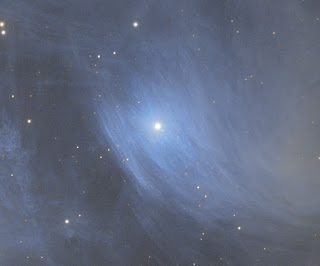
The Merope Nebula is the brightest reflection nebula in the Pleiades cluster. It is also known as Tempel’s Nebula. It was discovered by the German astronomer Wilhelm Tempel from Venice, Italy on October 19, 1859. Tempel used a 4-inch refractor to observe the famous open cluster.


You can also see here a small object about the 4.00 O'clock position. The nebula contains a small bright knot, designated IC 349, that is located only 0.06 light years from Merope. The knot was discovered by the American astronomer Edward Emerson Barnard in November 1890 and is also known as Barnard’s Merope Nebula. Barnard observed the knot using a 36-inch telescope at the Lick Observatory in California. IC 349 is about half an arc minute wide. It is the brightest part of the Merope Nebula because it lies so close to the central star. A recent capture from Hubble shows the knot being destroyed by 11km per second stellar winds.


Saturday, 12 November 2022

Sadr in Ha

Captured over 2 nights a day before and a day after the full moom. I wanted to test out the mosaic feature in the latest V2 update to the ASIair pro. A simple and easy feature to use. select you target of choice, set 2x2 / 3x3 ect for framing of the mosaic, export as a plan. Set plan with the filter, number of images and duration. Done. Result is 24 x 5 minute Ha exposures in a 2 x 2 pane mosaic with a 25% overlap. Processed with pixinsight, calibrated and Histogram transormation stretch and EZ de noise. 2 verions one with and one without stars.

Saturday, 19 October 2013

Pixinsight Processing.

I don't mind admitting that Pixinsight is a difficult programme to get to grips with. I am currently running the 45 day trial. I am struggling with the preprocessing script. I have taken a series of 5 minute subs on M81,M82 over several nights. I made a small error and did not plate solve correctly and the 2nd night was not framed quite the same. As it happens that was the least of my worries. The first attempt was jus light frames only. Darks, Flats & Bias frames captured on night two. These images are from just those light frames processed by Andrew Luck at our Great Ellingham observatory. Andrew's skill in using Pixinsight is obvious to see, with the stunning wide field vistas he is producing. Please take a look at what his QHY9 is capturing at  http://blog.andrewluck.me.uk./ .
I had preprocessed with Image Calibration and Image Intergration to obtain a 3 hour exposure. I was amazed at how tight the stars were even when cropping. The new Ioptron IEQ 45 mount is astounding in it's guiding capabilities. I have a pic of a lovely even graph. (but I cannot find it)

Right so here we have a cropped image of the pair. There was a serious hot pixel problem which pixinsight gave a good attempt to remove despite no dark frame intergration. Andrew has followed a standard workflow to enhance the master frame. The real skill is knowing how much stretch, Tweaking, adjustment to make before thee next tool is used. I have tried with the same master. Not quite the same result. I also post on my facebook page and the Breckland AS page too https://www.facebook.com/?ref=home#!/groups/176906152365752/ like and join the page to follow all my frinds images.
The processing of the M82 Galaxy was a real treat to watch as it emerged from the hidden data.
I hope you agree a fantastic piece of processing to
get such detail from the core. Testament to the
SXVm25c too. I would like to test the Canon 40d on the same subject to do a comparison in the depth of detail captured. Please ignore the hot pixels. I am still struggling to remove them despite now having the darks. I mentioned earlier that I was trying to get to grips with the preprocessing script. It / I have an issue with my flat fields. It will not accept there is a signal there and refuses to combine them to a master. I have now managed to create a flat manually. Next issue I have come across occurs with the light frames in the preprocessing script it debayers ok and now cannot locate any stars in the frame. I have tested the whole process using Maxim and everything combines with no issues.
 I would consider myself a patient / tolerenat person god know I need to be in my line of work. But I am just so frustrated with it. I feel at the moment somewhat demoralised by the lack of consistent workflow guides and explanations given on various web pages. I seem to get problems in every step or script I try. Very pleased again with the detail in and around the core. Don't get me wrong it is an amazing piece of software. I am sure there are many who are in the same boat as me. I would like to hear from anyone who is? By now I was desperate to combine those new light frames giving me a total of 5 hours of light. I ran the whole set through Maxim and the flats really make a difference from the vignetting I could see on the 3 hour master. I have yet to play with it using the pixinsight processes but I will not be defeated and will post an update. Watch this space..........I have never using the old set up been capable of 5 hours worth of usable data. Even the smallest of stars are perfect. Sorry for banging on about it but this has really impressed me and I think given me a platform to produce some future stunning images. So in conclusion I am down, but certainly not out, the Jury is out and a verdict no yet reached. How many days of the trial left ?????


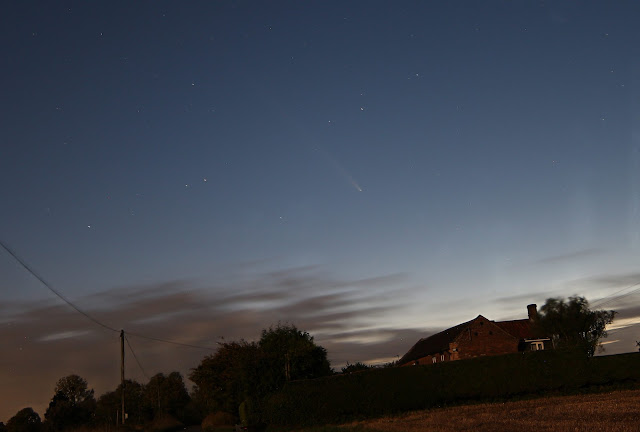
Comet Tsuchinshan-ATLAS, C/2023 A3 , Comet A3,

  A cosmic wanderer, Comet Tsuchinshan-Atlas or more commonly known as Comet A3 has traced its elliptical path through the solar system, a j...