Showing posts with label M53. Show all posts

Tuesday, 4 April 2023

M53


M53 is one of about 250 globular clusters belonging to our Milky Way galaxy. At a distance of 60,000 light years, M53 is one of the more distant clusters. The globular contains many older red stars, but it also has a number of blue stars. Such young blue stars are fairly uncommon in globular clusters.

One atypical feature of this image is that I collected all of the sub exposures for this image when the Moon was89% full. Usually I don't photograph Broadband targets when the Moon is out, as the bright light from the Moon washes out the faint parts of most images. However, I was able to capture this image fairly well, because globular clusters consist entirely of stars. Almost all of the stars are individually brighter than the background light from the Moon.

Image capture was 12 x 3 minute exposures in the RGB filters and Pixinsight processed.


In the same field of view from the full frame NGC5053 is a much fainter cluster of stars a  little closer at 57,000 light years, very faint tidal streams suggest some interaction between the two in the past.




Monday, 26 March 2012

Galactic Globulars M3,M53

I cant believe the good run we have had over the last week five from five here in Sunny Norfolk. I am feeling a bit gutted too as I have missed Breckland Astronomical societies first star party & I have a week of night to do starting tonight so the skies are bound to get even better!!. I shouldn't complain either as I have addeed a handful of Pics to my own messier chart

Having bagged a few galaxies this week I turned my attention to the old and weary (globulars) that is....

M5 & M53 became the clusters of choice.  

                      M5

Astronomers like Messier, Kirch, Koehler & Bode all described their first observations of M5 back in the mid 1700's as a nebula without stars. It wasn't until 1783 when William & Caroline Herschel viewed through their 7  & 20 foots reflector. it was resolved into the myriad of stars we can capture today. Although Caroline still mistook it for a comet.

 M53 & Ngc 5053

M53 and NGC5053 are shown in this field. M53 is the bright globular cluster in the centre; NGC5053 is the dimmer globular cluster in the lower right. ngc5053 is about 53,500 light years distant from Earth which is close to the distance of M53. This puts both globular clusters relatively close to each other in space. I had made a slight miscalculation and thought I could not fit both in the same field of view. I only looked at the framing of M53 in my test image. I will have to have another go sometime framing them both appropriately.

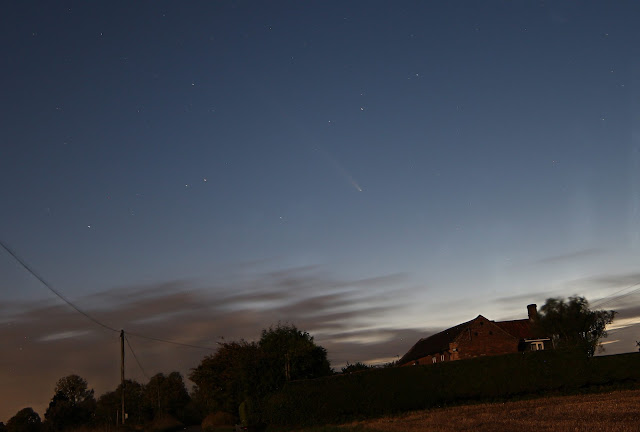
Comet Tsuchinshan-ATLAS, C/2023 A3 , Comet A3,

  A cosmic wanderer, Comet Tsuchinshan-Atlas or more commonly known as Comet A3 has traced its elliptical path through the solar system, a j...