Showing posts with label Cygnus. Show all posts

Sunday, 18 December 2022

Tuesday, 31 August 2021

Thursday, 3 September 2020

Veil Nebula

Giant stars are notorious for loosing their mass in the form of a super Nova The source of the Veil remnant was a star that exploded around 7500 years ago, Covering a huge area of sky appox. 36 times the area of the full moon. 

The Eastern Veil below is just a small section of the entire complex with a multitude of it's own nicknames like the Bat Nebula or Network Nebula.


The Western Veil is I think much more photogenic piece of the galactic puzzle commonly known as the Witches broom, Filaments of Hydrogen, Oxygen and Sulphur radiate light at different wavelengths and stretch across the sky in a twisted dance,


Monday, 29 June 2020

Pelican Nebula/ North American Nebula

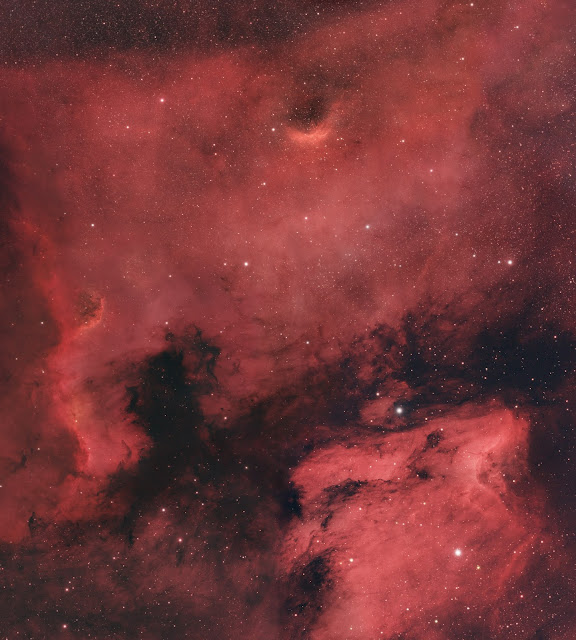
A favourite summer target has always been the Pelican Nebula IC5070. A wonderful target for us astrophotographers. As technology improves it forces us back for longer exposure, improved guiding building mosaics. But the one thing we always seek is a better image smoother, sharper better contrast. Looking at back at my early images through the DSLR's it's hard to believe we were happy with them. Always seeking those small improvements to create the perfect image.

New and old

Old and new


A mosaic of just 3 images has created this image. My first real attempt at bringing multiple long exposures into one. A total of approx 12 hours in total captured over a couple of weeks.


Tuesday, 26 May 2020

The Crescent Nebula.


The Crescent Nebula (also known as NGC 6888Caldwell 27Sharpless 105) is an emission nebula in the constellation Cygnus, about 5000 light-years away. It was discovered by Friedrich Wilhelm Herschel in 1792. It is formed by the fast stellar wind from the Wolf-Rayet star WR 136 (HD 192163) colliding with and energizing the slower moving wind ejected by the star when it became a red giant around 250,000 to 400,000 years ago. The result of the collision is a shell and two shock waves, one moving outward and one moving inward. The inward moving shock wave heats the stellar wind to X-ray-emitting temperatures.

Captured with the new ZWO ASI294MC Pro and Esprit ED100 and controlled via the ASI air pro. An amazing piece of kit, Those of you who are thinking about one to use with their ZWO cameras and many DSLR's I cannot put into words as well as a cut and paste. Coped from the website from Widescreen-Centre where Simon & Julian have been amazing with my questions and ultimate order from them, throughout their service, advice and professionalism has been superb.

ZWO ASIair PRO Smart WIFI Accessory for Portable Astro Photography with ZWO ASI Cameras and dSLRs

NEW FEATURES OF THE ASIAIR PRO


PRO SOFTWARE FEATURES

The new Asiair Pro comes with amazing new features such as Live Stacking, Automated Meridian Flip and more!
The Asiair app is compatible with iOS, iPadOS and Android, plus through emulator software you can run it on Apple laptops or computers as well.

IMPROVED STORAGE

A 32GB TF card provides 20GB free space for the user, plus the included 64GB U-Disk (USB memory) provides additional storage. If necessary, further storage can be added by user provided external storage.

POWER OUTPUTS / INPUTS

DC 12V@5A (Min voltage is 11.5V; Max supported current is 6A).
4 output ports; 12V input is recommended, but do not to exceed a total of 6A on all ports, as too high current will cause overheat problem.
The voltage and current of power outputs are 12V@3A.
The port type for the power outputs is 2.1*5.5mm center positive.

IMPROVED MOUNTING

ZWO redesigned the case for easier and more stable mounting by using the dovetail bar on your scope or a clamp.

NEW CNC-MACHINED ALU CASE

A beautifully designed and machined CNC case contains the new electronics. Aluminium is excellent for dissipating heat, whilst there is almost no effect on the WIFI signal.

So after that I am sure you have convinced yourself that is an amazing bit of kit. 

33x 5 minute guided exposures using the Optolong Lenhace narrowband filter has brought out details never capture previously by me. Stacked in Deep sky stacker and processed in Photoshop. 

Saturday, 20 July 2013

Summer Triangle

High above us in July we can see 3 of the brightest stars in the summer sky. They form an astronomical "asterim" ( an imaginary) triangle that cuts into the soft glow of the milky way.The closest of the three is Altair 16 light years away and 10 times as bright as our Sun. Secondly is Vega 25 light years away and featured in the Jodie Foster film "Contact" as a possible source of
intelligent life. Our final giant is Deneb. It appears only slightly dimmer than the other two but fires up at a massive 70,000 times brighter than the sun and a mind
blowing 1550 light years or 26 times the distance of Vega. As you are aware this composite of of course not to scale.

Monday, 15 July 2013

Ngc 6888 The Crescent Nebula

Some targets just need a little more than a DSLR can deliver. I think the crescent nebula is one of them. Last year I tried this target, never published the image because I was not happy with the result.
Despite the guiding working well and subs of 5 minutes I am still not entirely happy with the amount of data collected. There is some indication of some tenuous nebulosity surrounding the nebula.

Alberio


In the heart of the summer triangle floating in the sea of stars from ourown milky way's spiral arm lies Albireo . A close binary star system resolved here
and appears to make the star egg shaped. At approx 430 light years away. Visually
this yellow star has a wonderful companion that is a striking Blue. This 50 minute exposure
has drowned the faint colour away. Sorry!!
Perhaps a bit more aggressive processing will bring out some colour.

Thursday, 23 August 2012

M39

The last week has been a little traumatic for the whole family, Our eldest daughter has been waiting to find out if she has the grades to get into Uni. A sigh of relief as she is awarded her primary place at Anglia Ruskin. Congratulations Jasmine. The Younger two have been driving us nuts as they are desperate to go on their sunny holiday and bored of being at home from school.

The RA drive on the mount was very tight and needed a strip down and rebuild, All went well until I ran a test on the guiding. What could be the matter here. PHD would not keep the guide star for more than a few seconds. Lets not panic yet I thought so I ran 60 x 30 second test shots. A nightmare. The subject has moved over a degree across the field of view. The only thing I could think of was the polar alignment. I do my polar alignment using the Kochab clock method. Always worked well for me!! As I looked through the finder the illuminated cross moved, damn, the whole finder had been knocked at some point and almost fell out the holder. Not a great deal more I can do tonight. Next day allowed to me to strip it all down and rebuild and align the polar finder. A chimney pot half a mile up the road stayed where it should be as the pole finder was tightened into position.

A new test on Scheat in Andromeda was perfect. 2 minutes, 5 minutes, 10 minutes was no issue at all.

M39 was the target of choice nearly above my head so I ran 30 x 2 minute guided exposures at 1600 ISO. Processed in Maxim DL & Photoshop.


Friday, 27 July 2012

The Western Veil NGC 6960

     I have just had a thought as I sit here typing. How about bringing one of the names of the veil upto modern day times. Known as the witches broom. I will change it to Harry's Nimbus 3000. Good old Harry Potter.

      Not having a modified Canon I have limited sensitivity to the faint nebulosity that the western Veil displays. A revisit for sure with the UHC filter attatched. Last night was certainly the poorest night of the last 4 with a high dew point moisture was dripping from the outside of the dome.
Iso 1600 with 58 minutes of data has at least captured the wave like shape behind the naked eye star 52 Cygni.

Saturday, 30 June 2012

IC 5070 The pelican

Just off the ease coast of florida in NGC7000 The North American Nebula lies the strange, wierd, call it what you will, Pelican Nebula. Good job there is no flamingo nebula (I have a thing about flamingos dont even ask)
Located in the same arm our ouf galaxy (Orion arm) approx 2000 light years away, A flood of ultraviolet radiation is being released from massive stars hidden behind the thick dust permeating the region. The intense radiation is wrecking having on the local environment. The radiation ionizes parts of the molecular cloud while eroding and evaporating other areas within the cloud. Portions of the molecular cloud consisting of higher density matter resist ionization and survive as long pillars of dust and gas thus creating the shape we see today.
This is a somewhat adhoc shot. The wind was a tad furious around the dome but it was at least clear. I had set the Iso to 3200 to see what I could pick up for another imaging run when I caught a glimpse of the Pelican. I set up for 30 x 2minute exposures and went back inside the house. I never expected a great deal because of the wind. Having binned 10 shots I processed the remainder. I small DDP stretch and a pretty star spike later, no darks,flats ect gave me this image. If you remember last year I took a shot of the North American in both UHC filtered and unfiltered and what a dramatic difference. http://www.malcsastro.blogspot.co.uk/2010/08/ngc-7000-with-uhc-filter.html My intention is to do the same again. WATCH THIS SPACE.

Thursday, 21 June 2012

Cocoon Nebula Wide Field

Having spent a night last week imaging some delight from the south. Upon processing the smallest stars appeared as donut shaped. My focus was off my 100th of a mm test images looked ok but it wasn't until they were stacked and processed you could see there was a problem. So last night was really just a test to try and put in place a good focussing technique. I started with Ï€2cyg a 4.4 mag star less than 3° from my target. I use my bahtinov mask to achieve a near perfect focus. I then switch to Imagesplus and fine tune using the FWHM process. Overall I was pretty happy with what was done. Time was now gone 1.00am and work loomed for the next day. So I ran a 30 x 1 minute exposure at Iso1600. Deleted 2 subs and stacked a series of 28 frames to give me this shot. High in the North east under a very poor sky. I will endeavour to have another go later this year when positioned in the west and a good dark sky.

Sunday, 18 July 2010

Ngc 7000 North American Nebula

I have a couple of weeks holiday at the moment and Saturday was the first night with a decent clear stable sky. Powered up everything to find the red dot finder battery flat. (oops that was me) the Atik guide camera stopped working. Unable to download an image??? and the dew heaters stopped working just a yellow light .Great night this is going to be. Done a quick 2 star alignment and had a quick look at a few deep sky delights via the Canon. Started with some favourites to ease my pain like M27 and M71. Took a slow slew over to M11 and M26 found a couple of lovely ngc open clusters. Then headed towards M16 damn just obscured by the roof of the observatory. Not a good time of night to see it for me. So I headed back to Cygnus and had a good look at Everybody's favourite Alberio. finally moved across to The North American Nebula. I took about 10 minutes worth of data a month or so ago done a quick process to it and nothing highly dissapointed with the lack of colour. So I set up a quick run of 20 x 5 minute exposures, as I have no guiding capability tonight, and done a little deep sky stack on them. No lats or darks and I even took them in JPEG I know stop swearing at me. I didnt really have any intention of doing anything with them after last time so wasnt really expecting a great deal. Any way enough rambling from me here are a couple of pics. i think I like the negative better very pleased with the accuracy of the mount giving round stars. and a good flat field. Enjoy


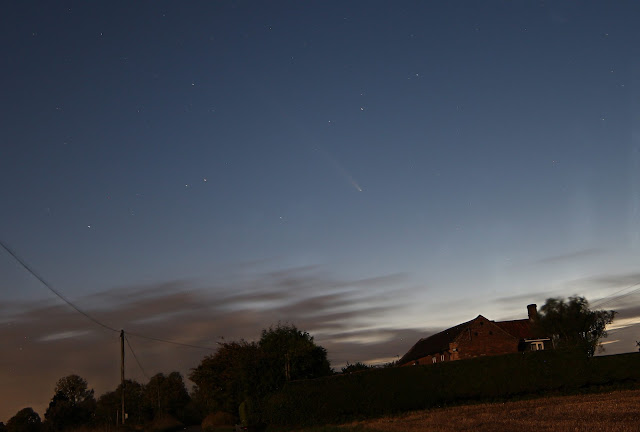
Comet Tsuchinshan-ATLAS, C/2023 A3 , Comet A3,

  A cosmic wanderer, Comet Tsuchinshan-Atlas or more commonly known as Comet A3 has traced its elliptical path through the solar system, a j...