Showing posts with label autostakkert. Show all posts

Thursday, 23 March 2023

Another month goes by

So another month goes by and just one night for me of clear sky for some imaging, the current project is M96 and associated galaxies in the field of view, more on that to follow. But for now a full moon passes and a new moon offers fleeting new views. I say new views as a new neighbour a few doors down the road has cut down a a large number of trees from his back garden offering me a long missed sight of setting the new moon and Venus. Whilst dodging clouds I managed a few video captures and after a run through Autostakkert and Registax for Wavelet processing.  

This image is a composite of 2 images both the best 100 frames from a 500 frame AVI at the 1080 resolution from the ASIair Pro video capture.

Reducing the resolution does increase the frame rate but on a camera that is a full res 6 frames a second I am not expecting amazing results from a 2 minute capture. But here we go a couple of images of some lovely craters. 

Patavius is the large crater here at a 177 km in diameter and a depth of 3.4km. The multiple central peaks extend nearly 2km high.

I also had a few minutes to capture a quick video of Venus flickering like a jewel as it dropped into the trees. Stellarium shows a just under 80% disc illumination. My image shows the same. Not bad for about 100 frames stacked.


Monday, 27 February 2023

Well If it is there I might as well take a picture of it.

 Well it is here again above us for another week or so rising right between all these faint galaxies that need imaging. So I might as well take a few pics of it. 

My ZWO ASI 2600mm is not a planetary camera it records an not very impressive 6 frames per second however a couple of minutes of capture and a quick Autostakkert later. The ASIair software allows captures at various resolutions from 1920 all the way down to 240. I have attempted a couple of captures at this setting but the images are so pixelated it is not worth displaying. Working at a longer focal length now I need to capture a 2 pane mosaic to capture the full lunation.


Mare Serenitatis or the “Sea of Serenity” is a lunar Mare. A Mare is a large Basalt plain formed by ancient asteroid impacts on the far side of the moon that have triggered volcanic eruptions on the opposite near side some 3 billion years ago. The word Maria is latin for sea as to early astronomers these dark areas look like seas.

Ancient asteroid impacts on the far side of the moon nearly 4 billion years sent shockwaves through the moon causing volcanic eruptions on the opposite side or the nearside leaving huge Basalt lava basins. Known today as Mare these darker plains looked just like seas to the ancient astronomers and so they now bear their Latin name of Mare. Mare Serenitatis or the “Sea of Serenity” has not changed for billions of years. It has a diameter of 674km and has plenty of features. First we have the crater Posidonius a 95km impact crater located at the north east in this view. The rim of the crater is very shallow a clear indication of its age as it was filled by lava flows giving it almost an appearance of being slowly washed away. Just south of the centre we have a much smaller 16km impact crater called Bessell, circular in shape is an indicator of an impact from directly above as opposed to at an oblique angle creating ejecta in the surround area. The mountain range running north to south at the left edge is part of the Appenine range running nearly 600 km in length. Finally we have the locations of the landing sites of Apollo 15 & 17.


The top most crater of three central craters in the picture below. is Theophilus together with Cyrillus and Catharina they form a prominent group of craters. Theophilus rim rises about 4200m above its floor. It was created in the Eratosthenian period, so it is pretty old. Its central mountain is 1400m high and has four summits. Both Cyrillus and Catharina are much older craters – it can be easily seen how these craters overlap each other.


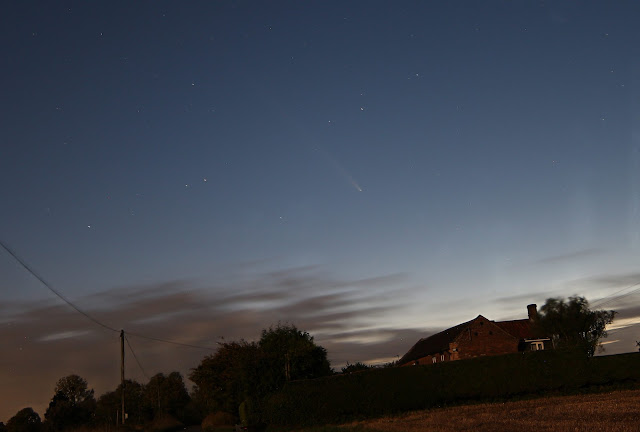
Comet Tsuchinshan-ATLAS, C/2023 A3 , Comet A3,

  A cosmic wanderer, Comet Tsuchinshan-Atlas or more commonly known as Comet A3 has traced its elliptical path through the solar system, a j...