Showing posts with label Ha filter. Show all posts

Wednesday, 2 August 2023

Elephants Trunk Nebula

So it is a school night but while the skies remain clear I will start with a couple of hours of new target data on the Elephants trunk Nebula. 3 minute subs using the Optolong narrowband filters starting with Ha. A great night of data capture using the ASI air pro I managed to capture 71 x 180 second exposures resulting in just over three and a half hours. As normal a 3 minute stretched sub is noisy but with a promising amount of data.
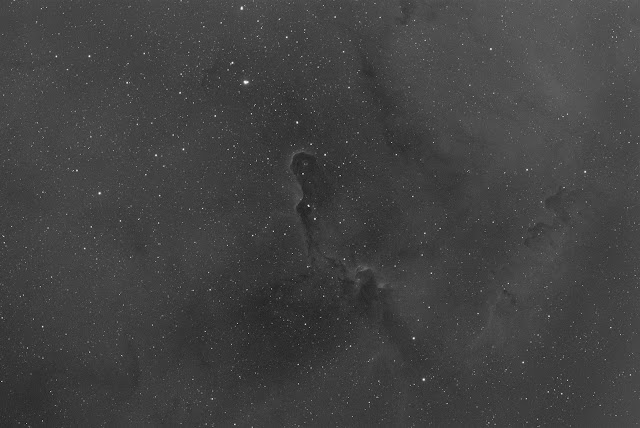
No processing here other than a histogram stretch.

WBPP is an incredible script that combines all the sub frames with calibration frames and does an amazing job. This is the combined efforts of those 71 frames. I have also included the starless image.


I am posting these about a month after processing, it would appear there is a brightness difference between the two. 

Update Aug 2nd. The weather has been awful for the whole of the UK and I have not completed any further progress on this project. If this keeps weather keeps up I will crack on and finish it next spring..... Further updates to follow.


Monday, 29 May 2023

Pillars of creation

Holy smokes, sometimes you just need to stop in your tracks and just behold the beauty, majesty and enormity of space. M16, The Eagle Nebula or more commonly known as "The Pillars of Creation" is probably the most iconic and well known images of deep space and the legacy of the Hubble space telescope. First captured by Hubble back in 1995. The "Pillars of Creation" is a star forming cloud of Hydrogen gas 90 trillion kilometers wide. The tiny section in the centre of my image resemble fingers, stalagmites of condensing clouds of Hydrogen gas and dust forever reaching into the darkness, lying deep within and not visible to conventional cameras are eggs or incubators of newly formed stars ready for birth in a few hundred million years.

The Black & White images here are my own from my 130mm telescope and cooled camera capturing light at the frequency of 656.21nm or the wavelength Hydrogen Alpha.


An ever increasing zoom into my image reveals the Pillars in all their glory. 
Seven hours of data capture this incredible region.


Finally I get to compare my image to the most celebrated of Hubble's images. With Hubble's final cost of around $10 billion and my modest set up around a million times less I don't think I have done a bad job.


NASA, ESA, and the Hubble Heritage Team (STScI/AURA) - http://hubblesite.org/image/3471/news_release/2015-01

Monday, 2 January 2023

Shiney bright thing

 My scope is only 550mm focal length so not designed for lunar imaging. Also my camera is not a planetary camera imaging at just 6 frames a second. So no chance really of capturing good seeing. So the next 3 images are captured with the ASIAir pro. AVI processed in the software and the final jpegs are not huge in size. 


Comet Tsuchinshan-ATLAS, C/2023 A3 , Comet A3,

  A cosmic wanderer, Comet Tsuchinshan-Atlas or more commonly known as Comet A3 has traced its elliptical path through the solar system, a j...