Showing posts with label LRGB. Show all posts

Sunday, 26 February 2023

Messier 63

Over recent weeks I have been looking at NINA, a freeware program for the control of our telescopes and connected equipment. I have watched lots of YouTube videos and felt I would give it a try. A very complex programme capable of lots of fantastic features, too many to list off the top of my head, all backed up by a large community of users and a host of additional plugins to create a truly customisable experience. Perhaps it is my impatience speaking here as I am now the proud owner of the new Altair 130 EDT scope and the need for collecting some photons is perhaps leading my frustrations. 

I have been now the user of the ASIair pro for several years and have been more than pleased with it's simplicity and ease of use. A clean user interface and an uncomplicated processes leads to the quick set up and start of imaging. So I thought a new challenge was needed....

When building the observatory I ran a powered USB extension into the house as well as a wired internet to allow the flexibility of future connectivity for wired and wireless To set NINA up I rerouted all data cables via my new powered USB hub and through to the extension cable to inside. Connectivity to NINA was simple opening up EQ Mod and PHD2 all stable with no dropouts to the laptop. Using the sky atlas selecting a target was easy and sending it to the framing tool prepares you for the imaging process. From there is where I found some issues, I ran the Hocus focus plugin a number of times but struggled to achieve focus using a number of filters. Making numerous adjustments to the focus steps in the attempt to replicate the demonstrated parabolic curve. Mine looked more like a top hat with odd dips and jumps. I am sure it is just settings but the frustrations exist that following the videos made no difference I just could not replicate anything resembling a good focus. It has also been a long while since I used PHD 2 and encountered similar issues with guiding calibration and not enough star movements. Aghhhhhh. I don't think it helps that I also feel awful, a really bad cough and cold. So for now I have reconnected everything back to the ASIAir, programmed an autorun sequence on M63, Auto focus has achieved and guiding is currently running at .45 RMS Perfectly acceptable. So for tonight anyway I will enjoy the clear sky and continue with this short run of subs. As of this minute I am at 26 from 40 x 5 minutes frames in LRGB. 

The following night was not so great with 95% humidity. So I have ended up with 19 x 5 minute subs in RGB, the Luminance data was for me too blown out so not used.

The Sunflower Galaxy, also known as Messier 63 or M63 and designated as NGC 5055 in the New General Catalogue, is a spiral galaxy located in the northern constellation Canes Venatici. It lies roughly 37 million light years from Earth and has an apparent magnitude of 9.3.

The galaxy is enormous in size, with an apparent size of 12′.6 × 7′.2. This makes it roughly the same size as the Milky Way galaxy, and it has a mass 140 billion times that of the Sun. It is also believed to have a supermassive black hole with a mass of up to 30 million Suns.


There are a number of fainter PGC galaxies here most of which are a hundred times or more further away. A Pixinsight annotation shows their locations.


Tuesday, 14 February 2023

A new beginning.

It is with a heavy heart I say goodbye to my trusted Esprit ED100, my workhorse for the last couple of years. I do know though it has gone to a good home, Living it's life now on the Kent coast to a lovely chap called Tony who came up this morning with his wife to view and make a purchase. I hope they enjoyed their time here and after seeing my advert on UK astrobuyandsell. I hope the scope gives him the same enjoyment as it has done for me for many years to come.

So for me an unexpected deal has presented itself. My good friend Richard from our society has made a life changing decision and emigrated to Brazil. I happened to mention a few weeks ago I was looking to upgrade to a longer focal length, with that was the offer of his Altair Astro 130EDT triplet refractor. A fantastic scope that has given Richard some wonderful images. Richard was kind enough to offer me the scope to try as I was unsure if it would fit inside my modest dome. My initial set up left me disappointed as there was not a great deal of room as the scope moved around with USB cables brushing the walls, so from there I initially said thanks but no thanks. I think the plan for him was to make a quick sale on UK astrobuyandsell as he did not want to take the scope with him. So I took the plunge and said yes I will have it and make it fit. I have spent the last few days positioning the scope in the rings and finally achieved great balance with a little more headroom than before. So I think this will work well for me.

Side by side they are worlds apart in size. When I built the observatory at the time I never thought any upgrade would be this big. I imagined a 115mm would suffice.


It fits.


Luckily for me too there was a couple of hours reasonably clear before the fog and cloud ruined the remainder of the evening. I opted for a target that was past the meridian and nice and high over the house so M1 the Crab nebula was my first light target.

All I could manage was 5 x 5 minutes in RGB using the ZWO filters. A rough and quick process in Pixinsight with no calibration frames and what is a huge crop. I am very pleased and happy with this initial first light image of 724mm focal length. Initial results in guiding also good with an average RMS of just over .6

The Astrogeek is one happy chappy.


Sunday, 16 October 2022

Dark Shark Nebula

This is my first attempt at capturing a dark nebula, and the Dark Shark or Howling Wolf as it is sometimes called became my target of choice because of it's beautiful variation of colored stars and it's uncanny resemblance to a hungry shark. Known to be an incredibly difficult object to image I was needing moonless skies. This was imaged over 2 nights with a total intergration time of 7.5 hours through Red, Green & Blue filters This image shows the Dark Shark, a complex of several objects in Cepheus, located around 650 light years from us, and about 15 light years from snout to tail. The brownish portion is part of a large molecular cloud thought to be glowing dust powered by high-energy starlight. LDN 1235 is the dark spot in the shark’s head. vdB (Van den Bergh catalogue) 149 and 150 are the two blue reflection nebulae at the top and bottom of the shark’s neck. Both these beautiful reflection nebula shine with the color of very hot B8IV stars within these parts of the nebula.
Imaging details * Oct 2nd / 15th 2022 * Norfolk, UK (Bortle 6) * Telescope: Skywatcher Esprit ED100 * Camera: ZWO ASI 2600MM-PRO * Filter: ZWO RGB * Mount: Skywatcher EQ6R Pro * Guide: Altair 60mm; ZWO ASI 120MM Mini * Control: ASIAIPRo, ZWO EAF * Software: PixInsight, Photoshop * 50 x 180 seconds RGB Total integration time:7.5 hours

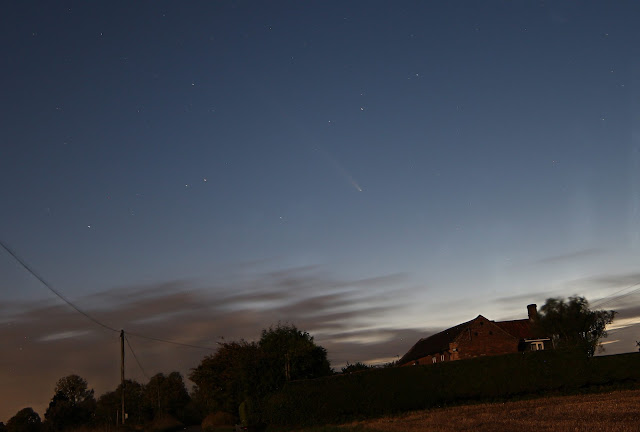
Comet Tsuchinshan-ATLAS, C/2023 A3 , Comet A3,

  A cosmic wanderer, Comet Tsuchinshan-Atlas or more commonly known as Comet A3 has traced its elliptical path through the solar system, a j...