Showing posts with label Tadpoles. Show all posts

Sunday, 1 January 2023

The Tadpoles SHO processed

About 9 hours of data used to create the HSO version of the IC 410 nebula.

This was a project started lst year with just some Ha data.

48 x 5Min subs Ha
30 x 5Min subs for Oiii & Sii
Plan mode on the AIR incorporating the EAF during acquisition has produced an incredible set of sub frames. Processed in Pixinsight.

Full calibration using WBPP script. DBE, and Linear fit to the Oiii channel, Channel Combination, Generalised Hyperbolic stretch, Correct Magenta Stars, Starnett++Generalised Hyperbolic stretch, Curves, Blur Exterminator, Noise Exterminator, Colour Mask, Convolution, LRGB Combination to add Luminance, Curves, Colour Masks,

I would love to do a video on the processing, but just not that confident in front of the camera.

Anyway the final results are as follows.


A crop of the Tadpoles.


Go on the a little more cropping.


Saturday, 11 December 2021

IC410 The Tadpoles.


As I may have mentioned before on my facebook page and even on here too the last 5 plus weeks of weather have been truly awful. However, 2 nights from Friday last week have been cold and clear but somewhat spoilt by the approaching full moon. So the filter wheel has rotated to the HA filter and the start of 2 projects IC410 & IC405 are born.

IC410 is a dusty emission nebula located in the constellation of Auriga at about 12.000 light years from Earth. It is part of a larger star forming region that also contains the Flaming Star Nebula (IC405). The gas structures in this picture are lit by the radiation from the open star cluster Ngc1893 that lies in the center of the nebula. This star cluster is about 4 million years old, but in astronomical terms it is still very young, with hot, massive stars. Just right of the star cluster two more dense structures are visible. Affectionately known as The Tadpoles these two structures are approximately 10 light years long these are similar to the famous Pillars of Creation and they are composed of dust and gas leftover from the formation of the star cluster and are very likely to give birth to more stars in the future. As can be seen in the image, these structures point away from the center of the nebula. This is because of the stellar winds and radiation pressure from the stars in NGC 1893. The really do look like they are trying to get back to the centre.


    25x 5 minute Ha subframes.

    Tadpoles crop
    Looking a little closer they really do look like tadpoles.

Lets hope for a few more hours of data to complete a Hubble Palette image.
Watch this space:

Image Details

  • Total Exposure:  2 Hours, 5 Minutes ( 25 Frames) x 5 Mins Ha (10/12/21)
  • Image Acquisition: ZWO ASIair Pro
  • Camera Settings:  ZWO ASI2600mm pro Gain 100, 0°C
  • Accessories: ZWO 7 position Filter wheel
    •                Optolong narrowand filters 
    •                ZWO broadband filters
    •                ZWO EAF
  • Calibration Frames: No Calibration
  • Stacking and Calibration: DeepSkyStacker
  • Processing: Adobe Photoshop 2020, 
  • Size: 2.26 x 1.38 deg 
  • Pixel Scale: 1.41 arcsec/pixel

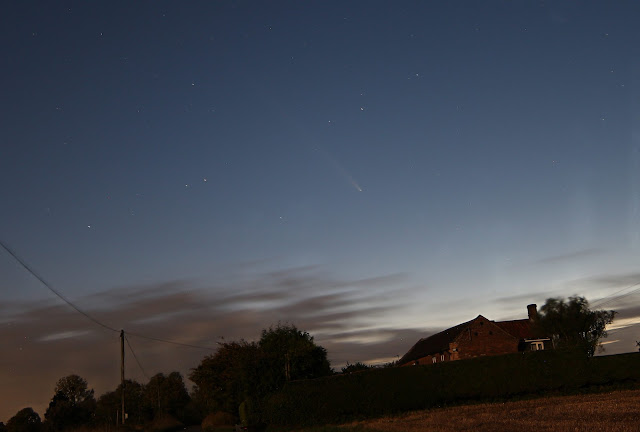
Comet Tsuchinshan-ATLAS, C/2023 A3 , Comet A3,

  A cosmic wanderer, Comet Tsuchinshan-Atlas or more commonly known as Comet A3 has traced its elliptical path through the solar system, a j...