Showing posts with label NGC 3628. Show all posts

Thursday, 1 April 2021

Leo Triplet

 I swear it is only ever clear the night of and after a full moon. Just my luck really, We have not had any decent nights for a while it seems, I wanted to get out and do something. I bought from                 U.K. Astronomy Buy & Sell (astrobuysell.com) a new Optolong  L Pro filter a light pollution filter that is more and more needed even in my rural location. Optolong LPS filter L-Pro for deep sky nebula consteallation photography-Optolong Optics Co.,Ltd

My only real unobstructed view is to the East and is the town of Watton is just 3 miles as the crow flies so the glow of the town radiates into view and the filter is needed. So my first test was the beautiful Leo triplet of galaxies. This image was taken over two nights using the filter and worked well I think. Only a very small gradient was noticed after some aggressive processing which was easily removed. I am quite happy with this image after some really poor seeing and the guiding on the first night never achieving better than 1.2 arc sec (usual average is 0.75.

59 x 5 minute sub exposures controlled with the ASIair pro2, stacked in Deep sky stacker and processed in Photoshop.


This trio is now accepted as part of the M96 group of galaxies and then part of an even larger group still.  I think to the accepted idea is also that M66 is a disturbed Barred Spiral. The front arm certainly looks like it has seen tidal interaction by a passer by whilst the rear arm looks somewhat undisturbed.


Thursday, 4 April 2013

Leo Triplet.

I had aquired just over an hour of data as I mentioned that I had imaged the Leo triplet before the supernova was found. . I had found on the portable hard drive another 90 minutes worth of sub frames imaged last year. So I thought I would combine them and see what the result was. It doesn't matter how many times you say it more "data more detail". Processed with images plus with a ddp stretch and a gradient removal in CS4 I am quite pleased with the improvement. 2 hours 23 Minutes at Iso1600.

Thursday, 14 March 2013

It's About Time.

Comet C/2001 L4 PANNSTARRS has finally graced our northern hemisphere skies. This evening for me was a little frustrating. Located below a new moon it should have been visible. Except there was a horizon of cloud that stayed put for the duration. It was good to see via facebook a couple of fellow bloggers and Breckland AS society members, Dr Dan ,  Barnfield Bob catch a glimpse of the comet this evening.The skies however have cleared. The seeing not perfect but I have set the cameras in motion. Having done very little astronomy since christmas it feels good to get back to it. I had planned on a slight modification to my set up in which the 66mm guidescope would come off and used as a grab and go. My imaging scope would then be connected to an off axis guider and camera, thus lightening the load on my ageing mount. But unfortunatly the focusser just could not take the weight for the auto focus to work. So I have gave up on the idea and rebuilt the 66mm back on board. I have also increased the counterweight slightly and this seems to help with the guiding consistency. With this I wanted an easy target to test the system. I caught about 90 mins will process in the morning.

As promised from last night I managed to capture some photons of that were travelling through the darkness of space for 35 million years to arrive last night at my camera lens. This trio of galaxies all look slightly different as the galactic discs are tilted to different angles from our line of sight.The galaxy on the left is known as NGC 3628, seen edge on with obscuring dust lanes cutting across the plane of the galaxy. while the disks of M65(top) and M66 are both inclined enough to show off their spiral structure. There is evidence that all 3 galaxies have interacted with each other some 800 million years ago.

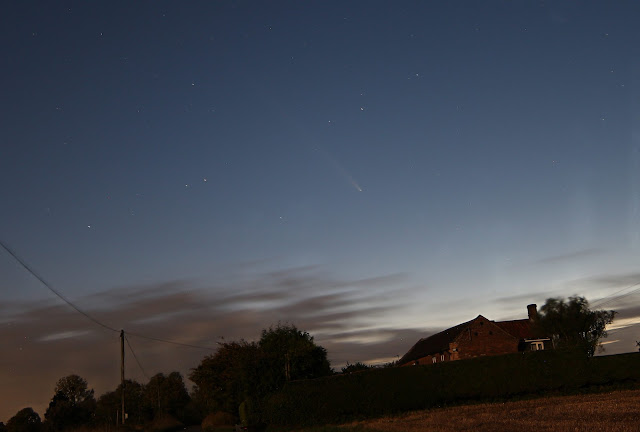
Comet Tsuchinshan-ATLAS, C/2023 A3 , Comet A3,

  A cosmic wanderer, Comet Tsuchinshan-Atlas or more commonly known as Comet A3 has traced its elliptical path through the solar system, a j...