Showing posts with label NGC 5904. Show all posts

Sunday, 16 April 2023

M5

A reprocess of the M5 data using drizzle, still unsure if I am happy with the difference.


Discovered in 1702, M5 by German astronomer Gottfried Kirch whilst observing a comet, M5 is very nearly a naked eye object, I cannot confess to observing it naked eye myself but visually through a telescope a stunning object. Though the camera even more spectacular resolving stars all the way to the core. Combined as a RGB image displays a wealth bright colourful stars. M5 contains a large number of Cepheid variable stars that have allowed astronomers to accurately to 24,500 light years.


  • Total Exposure:  1 Hour, 30 Minutes ( 30 x 60 sec in the R,G & B filters)
  • Telescope: Altair Astro EDT130 Triplet.
  • Image Acquisition: ZWO ASIair Pro
  • Camera Settings:  ZWO ASI2600mm pro Gain 100, 0°C
  • Accessories: ZWO 7 position Filter wheel
    •                ZWO Broadband filters 
    •                ZWO EAF
  • Calibration Frames: Darks, Flats calibrated.
  • Stacking and Processing: Pixinsight & touch ups in Photoshop. 
  • Size: 44 x 33 arc minutes
  • Pixel Scale: 1.05 arcsec/pixel

Monday, 26 March 2012

Galactic Globulars M3,M53

I cant believe the good run we have had over the last week five from five here in Sunny Norfolk. I am feeling a bit gutted too as I have missed Breckland Astronomical societies first star party & I have a week of night to do starting tonight so the skies are bound to get even better!!. I shouldn't complain either as I have addeed a handful of Pics to my own messier chart

Having bagged a few galaxies this week I turned my attention to the old and weary (globulars) that is....

M5 & M53 became the clusters of choice.  

                      M5

Astronomers like Messier, Kirch, Koehler & Bode all described their first observations of M5 back in the mid 1700's as a nebula without stars. It wasn't until 1783 when William & Caroline Herschel viewed through their 7  & 20 foots reflector. it was resolved into the myriad of stars we can capture today. Although Caroline still mistook it for a comet.

 M53 & Ngc 5053

M53 and NGC5053 are shown in this field. M53 is the bright globular cluster in the centre; NGC5053 is the dimmer globular cluster in the lower right. ngc5053 is about 53,500 light years distant from Earth which is close to the distance of M53. This puts both globular clusters relatively close to each other in space. I had made a slight miscalculation and thought I could not fit both in the same field of view. I only looked at the framing of M53 in my test image. I will have to have another go sometime framing them both appropriately.

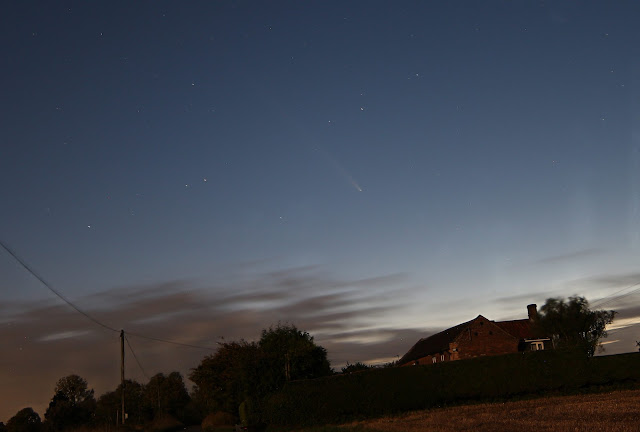
Comet Tsuchinshan-ATLAS, C/2023 A3 , Comet A3,

  A cosmic wanderer, Comet Tsuchinshan-Atlas or more commonly known as Comet A3 has traced its elliptical path through the solar system, a j...