Showing posts with label NGC 1499. Show all posts

Thursday, 21 December 2023

California Nebula

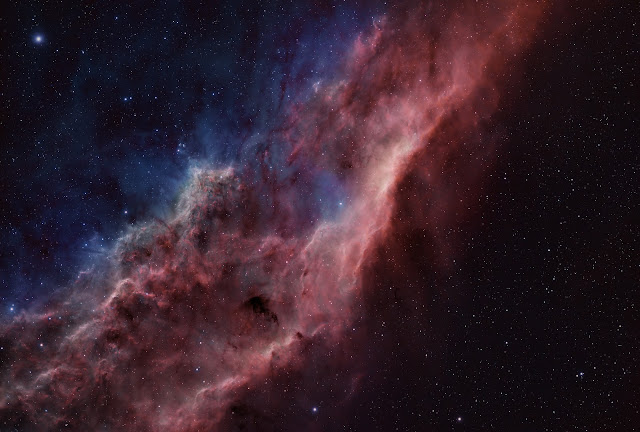
 NGC1499 The California Nebula.


Discovered in 1889 The California Nebula is an emission nebula in the constellation of Perseus, currently visible high in the winter night sky. So named because of its shape, reminiscent of the outline of the US State of California on a map.

The nebula itself stretches over 100 light years with my image showing about 70% of the total area. The Nebula is formed of gases that are ionized and made fluorescent by high-energy ultraviolet photons emitted from a young, hot, blue star.. The massive star in question, Menkib (Xi Persei), located top left in my image is one of the hottest stars visible to the unaided eye. It shines at magnitude 4.04 from a distance of about 1,200 light years. Menkib is a blue giant star with a mass 26 – 36 times that of the Sun and has expanded to 14 times the size. The star outshines our own by a colossal 263,000 (two hundred and sixty-three thousand) times. It also rotates exceptionally fast, with a projected rotational velocity of 220 km/s. The star’s estimated age is only 7 million years. Having evolved quickly due to its high mass, it will likely meet its fiery end as a supernova in the next million years.

The Nebula is huge several times the size of a full moon but nearly impossible to see visually but this long exposure imaged over several nights captures exquisite details from my backyard observatory.


Thursday, 1 April 2021

California Nebula

 A rework of a previous capture. Using the new to me Arcsinh Photoshop curves processing. A piece of software designed for PIXinsight. Can be found here. Photoshop Colour Preserving Stretch (markshelley.co.uk) Along with a fantastic explanation and several You tube videos showing it's use. A great one from Astro Ed (1) Astrophotography: The ABSOLUTE BEST way to STRETCH your Astro Image data in Photoshop [PS]! - YouTube demonstrates some new techniques for the teasing of data from images, especially keeping those stars small too. I used two itterations and combined it with a Starnet++ frame. Not the cleanest of data but great fun to play with. 


Wednesday, 24 June 2020

A night of two targets

The California Nebula 

The California Nebula  NGC1499 is an emission nebula located in the constellation of Perseus located along the Orion arm of our galaxy roughly 1000 light years away. Energetic particles exciting gas are creating a huge nebula, all created by that little blue fellow just below the centre of the image. I say little Menkib is actually about 20 times more massive than our sun and burns hotter than 25,000 degrees.  Captured with the Optolong L-Enhance 2" filter perfect for those faint Ha regions.


The Iris Nebula 

The Iris Nebula NGC7023 a faint reflection nebula. Dust & gas illuminated by the bright star in the middle of the nebula. Filter removed for this one and refocussed m anually via the ASIAIR pro and my Bhatinov mask. Just a couple of hours of 3 minutes sub frames for this one.


Thursday, 2 January 2014

Imaging the Califoria Nebula @f7

Whilst waiting for the Rosette to be clear of a tree the other night I had a play and took 3x 20 minute exposures of the California nebula. I have imaged this object before with the old set up imaging at @4.96 focal length of 446mm I was achieving a lovely wide field image encompassing the whole of the nebula. The new system is not as fast with the FLT110. Even with the dedicated TMB field flattener there is no reduction in the focal lenth so I now image at f7 at 770mm. So I just wanted to post 2 pics from the old system to the new. I had initial concerns over exposure length with the increase in focal ratio but my concerns were soon dissipated with the sensitivity of the new camera. I will of course need to mosaic a few of the larger targets. I cant wait to post some results.

 
Addendum
I have been learning a few new processing techniques Below is an update to the above to include a selective unsharp mask anda high pass filter. An amazing difference for 1 hours worth of exposure.


Wednesday, 17 October 2012

California nebula

As promised I have had another go at the huge NGC1499. I sometimes wonder how something as huge as this never made the messier catalogue.
I have managed and hour and a half this time and think I have a much smoother result.
45 x 2 minute guided exposures at ISO 1600. No darks , flats or bias frames added , subtracted or divided. I just love the new JMI focusser. so simple and quick to auto focus. I have had a long day at work today. Just can't think of anything else to add. Goodnight all....

Saturday, 13 October 2012

CHIPS

I am sure many people will remember the American tv programme CHIPS. Based on the Californian highway patrol motorcycle cops. Well I thought it was a good title for a post ha ha!!

Having spent most of the session imaging the wonderful Comet Hergenrother. I wanted to just have my first go at the huge California nebula NGC 1499 before closing up.

This image is very noisy as only 22 minutes were captured at ISO 1600. My 40D is unmodded so I was pleasantly surprised with the amount of red light captured. Also worth a session with the UHC filter too.  A target with good altitude for UK observers so I will definately revisit with some long exposure. Keep looking for the latest pics. I cant wait to see a difference. I was so pleased last year when I images the horsehead for the first time. A very smooth image with some fine detail was the result. shortcut to it here https://blogger.googleusercontent.com/img/b/R29vZ2xl/AVvXsEj5yUWG_b1MxqxKDpW1QfgK_NzPd_lrb4CaWiP1EfBa5ZZtaZeviBYKpWyLSVKw7iQYsQxIasCqc2FXrTZ6BsGgUveIJPOeBUciUfAI7PRGSUcWhsEgWVfbKdhMmTa1KpEn1gFWagxKv0Q/s1600/flame+horse+weirdcropped.jpg


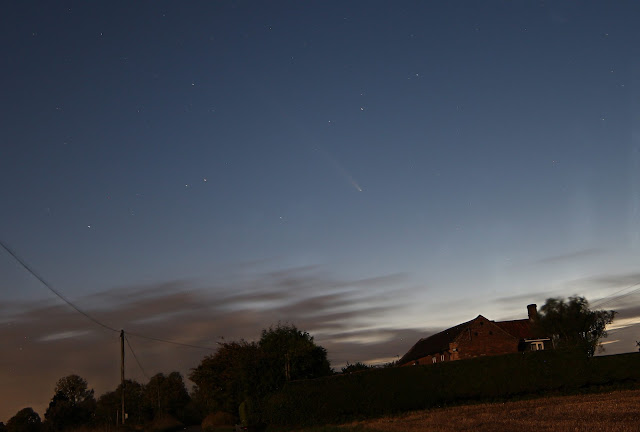
Comet Tsuchinshan-ATLAS, C/2023 A3 , Comet A3,

  A cosmic wanderer, Comet Tsuchinshan-Atlas or more commonly known as Comet A3 has traced its elliptical path through the solar system, a j...