Showing posts with label Galaxy. Show all posts

Thursday, 30 September 2021

M31

Almost a year ago was my M31 Globular clusters project. A fantastic project capturing a staggering 244 globular clusters associated with M31.

A year has passed and another M31 image is forthcoming. This time captured in HaRGB with my newish Mono camera, filter wheel and filters.

All of course captured with the ZWO ASI Air pro, a wonderful little device that has seen countless updated that include plan mode now. This allows an imaging run of multiple targets during a night. It allowed me on this occasion to run an imaging session on M31 swapping over filters and running the autofocus routine after each swap. It ran flawlessly.

So we have a basic stretch on each of the filters and a final combination giving a total of 4 hours, 1 hour on each filter.

Red


Green


Blue


Ha

4 hour Combination HaRGB

Crop


Overall I am very pleased with the image despite no calibration frames used at all here.


Wednesday, 12 May 2021

M97 & M108 The Whale & The Surfboard.


The owl and the surfboard. I have previously mentioned the astronomical names of objects often resemble what they look like. Two prime examples are M97 the Owl Nebula & M108 the Surfboard Galaxy. The Owl is a planetary nebula, (not a planet) but the violent death of an exploding star, ejecting shells of gas & material into space, Still expanding some 8000 years later at 35km per second, can you see the owls eyes? M108 the Surfboard Galaxy lies some 2000 times more distant at 26 Million light years. Another example of a Galaxy viewed edge on from our perspective and uncannily resembling a surfboard.


Thursday, 1 April 2021

Leo Triplet

 I swear it is only ever clear the night of and after a full moon. Just my luck really, We have not had any decent nights for a while it seems, I wanted to get out and do something. I bought from                 U.K. Astronomy Buy & Sell (astrobuysell.com) a new Optolong  L Pro filter a light pollution filter that is more and more needed even in my rural location. Optolong LPS filter L-Pro for deep sky nebula consteallation photography-Optolong Optics Co.,Ltd

My only real unobstructed view is to the East and is the town of Watton is just 3 miles as the crow flies so the glow of the town radiates into view and the filter is needed. So my first test was the beautiful Leo triplet of galaxies. This image was taken over two nights using the filter and worked well I think. Only a very small gradient was noticed after some aggressive processing which was easily removed. I am quite happy with this image after some really poor seeing and the guiding on the first night never achieving better than 1.2 arc sec (usual average is 0.75.

59 x 5 minute sub exposures controlled with the ASIair pro2, stacked in Deep sky stacker and processed in Photoshop.


This trio is now accepted as part of the M96 group of galaxies and then part of an even larger group still.  I think to the accepted idea is also that M66 is a disturbed Barred Spiral. The front arm certainly looks like it has seen tidal interaction by a passer by whilst the rear arm looks somewhat undisturbed.


Saturday, 10 October 2020

M31 Globular Clusters Project

The Andromeda Galaxy (also known as M31 and NGC 224) is the nearest spiral galaxy to our own Milky Way galaxy. Its relatively early Hubble type (Sb) and bright absolute magnitude (-20) make it an important and unique source of information on galaxies of this nature. M31 forms an important testing ground for ideas about massive galaxies and about galaxy evolution, and is ripe for detailed astrophysical exploration. The purpose of this atlas is to make future exploration and exploitation of this galaxy easier by mapping out some of the thousands of objects of various kinds that have been identified in it and by giving photographic and photometric data that will aid in planning and understanding new rese
arch.

The National Geographic Society generously provided funds to support the preparation of the atlas and to help cover its publication costs. The Kitt Peak National Observatory provided the observing time at its 4-meter telescope, through an assignment to an ``M31 consortium.'' The National Science Foundation, through grant AST 76-17598, partially supported some of the research results that were by-products of the preparation of the atlas. And finally, the University of Washington Press has guided the preparation of the atlas and painstakingly produced it.

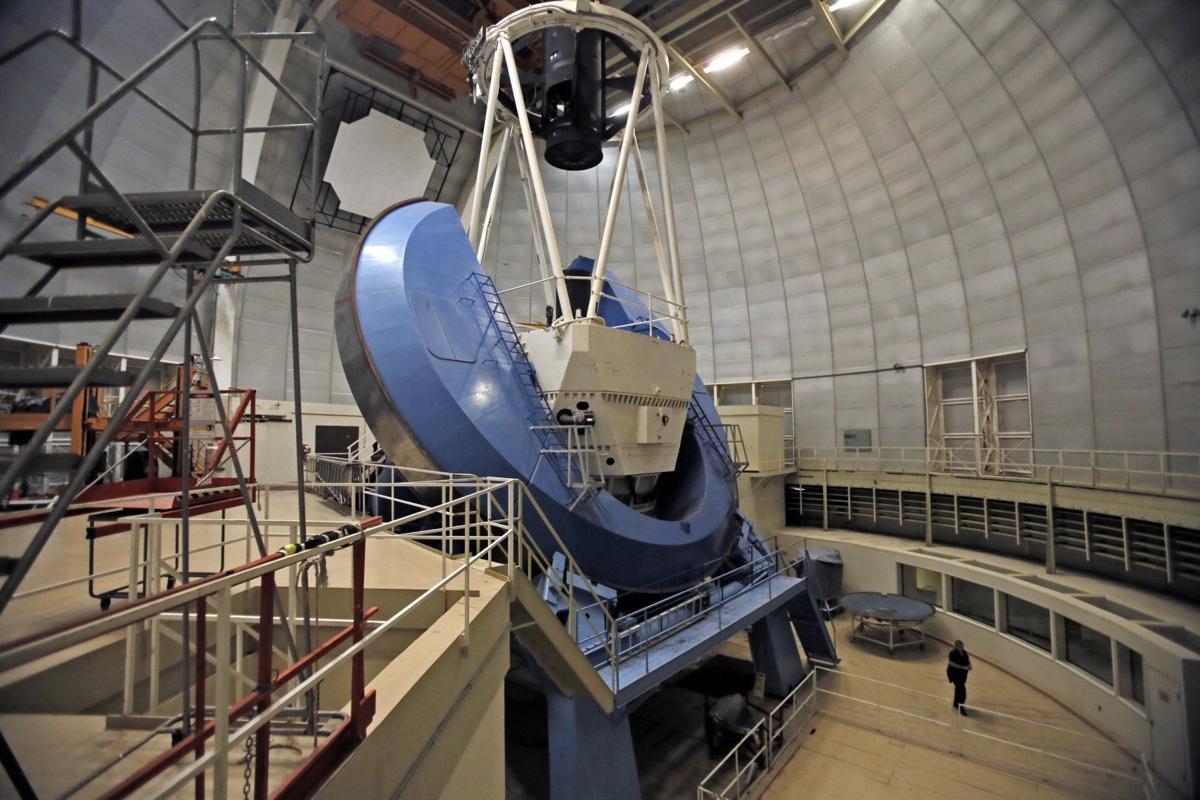
The original photographic plates for the project were taken in Oct 1974 with the newly installeNicholas U. Mayall Telescope


Below is the website to the source of my information

http://ned.ipac.caltech.edu/level5/ANDROMEDA_Atlas/frames.html

-----------------------------------

This project was inspired by a fantastic website by Steve Gottlieb who images globular clusters in nearby galaxies. Steve is a deep sky observer who enjoys the obscure and offbeat targets.

 https://www.astronomy-mall.com/Adventures.In.Deep.Space/gcextra.htm

                                                            -----------------------------------

39 Photographic plates were taken each of 25 minute exposure. Months of painstaking work was done to complete the Atlas and it's list of extragalactic clusters.


I unfortunately do not own anything in the order of the 4 metre Nicholas U Mayall just a modest 100mm refractor that's about 40 times smaller. I accept that a modern CMOS sensor is infinitely more sensitive today that a photographic emulsion. I spent about a week aligning the plates to mine and came up with an amazing 244 Globular clusters in M31 and it's satellite galaxies. It has been a fun project and I would encourage you all to have a go yourself. My Image below.


Friday, 18 September 2020

Andromeda Globular clusters.

 I stumbled across a great website by Steve Gottlieb https://www.astronomy-mall.com/Adventures.In.Deep.Space/gcextra.htm who has spend some time studying the globular clusters of M31. Several hundred were found categorised and published first by Edwin Hubble in 1932, As many as 509 globulars in M31 have been catalogued based on spectra plates taken at Mauna Kea with the 3.6 meter Canada-France-Hawaii telescope, (Crampton et al, 1985), although recent work indicates that some of these are faint background galaxies. In any case, the M31 globular cluster system does appear to be more numerous than our own galaxy by roughly a 2:1 ratio. This important article provides identifications, positions, magnitudes, colours and radii although no finder charts are given.

A few nights ago I was testing the ASIAIR Pro auto focus and aligned on The Andromeda Galaxy. An hour later I stacked an hours worth of data and stretched it. I was truly amazed I was able to resolve 2' clusters @>mag15. Resolving deeper & longer is a passion of mine and my project a few years ago labelled hundreds of PGC galaxies in the Coma Cluster, this intrigued me from the outset and I had to see how many I could find in M110 (NGC205)

It didn't take long to find them all.


My image is on the left. incredible detail for just 1 hour of exposure. Spectacular rounds stars with of .42 arc second guiding accuracy.


My next project during the new lockdown will be to catalogue the Globulars in M31. I have found quite a few already but it looks like it may take a while.

Saturday, 22 March 2014

M101 Galaxy

The Pinwheel Galaxy, M101, NGC 4547 was discovered in 1781. The observation was subsequently passed onto Messier who confirmed it's position and was one of his final additions to the catalogue. Estimated to be approx 70% larger than our own galaxy at a distance of 21 Million light years. I am happy with this capture of 3 hours 20 minutes in 20 minute sub exposures. calibrated in Maxim DL and processed in photoshop. Ha regions can be seen and I am very pleased with the detail all the way to the core of this beautiful showpiece galaxy.
 

Friday, 24 January 2014

Supernova 2014J

Sometimes the luck just holds. Well this time anyway. If you wander back through my blog or find my post on M95 april 2012. The avid nova watchers will remember the eruption in M95 sn2012aw. This happened just as I started at work a set of nights. We only do 2 sets a year and could not believe my misfortune in having to work when the skies were clear. Now go back a little futher to sept 2011 and sn 2011fe in M101. We were about to move and I had dismantled the observatory in preparation.

But not this time fellow bloggers. I had imaged m82 back in Oct testing out my new kit (left pic) and the wow amazing sn 2014J captured just last night 1 day after it's discovery. I am sure at this moment they are searching through Hubble archives to find the progenitor. We know already it is a type 1a and a few theories exist as to the fate of this white dwarf star.

Anyway here is my pic.

I am trying to do a blink comparison aswell. I will post it if I manage it. Any advice would be appreciated.

Sunday, 3 November 2013

5 hours processed M81,M82

I am getting to grips with the Starlight Express camera from using the DSLR. This is the first time I have captured 5 hours worth of data. Registered in Maxim DL and processed in Images plus. (Pixinsight trial ended the other day). I know I will revit the processing workflow for this one but here it is at present.


Saturday, 19 October 2013

Pixinsight Processing.

I don't mind admitting that Pixinsight is a difficult programme to get to grips with. I am currently running the 45 day trial. I am struggling with the preprocessing script. I have taken a series of 5 minute subs on M81,M82 over several nights. I made a small error and did not plate solve correctly and the 2nd night was not framed quite the same. As it happens that was the least of my worries. The first attempt was jus light frames only. Darks, Flats & Bias frames captured on night two. These images are from just those light frames processed by Andrew Luck at our Great Ellingham observatory. Andrew's skill in using Pixinsight is obvious to see, with the stunning wide field vistas he is producing. Please take a look at what his QHY9 is capturing at  http://blog.andrewluck.me.uk./ .
I had preprocessed with Image Calibration and Image Intergration to obtain a 3 hour exposure. I was amazed at how tight the stars were even when cropping. The new Ioptron IEQ 45 mount is astounding in it's guiding capabilities. I have a pic of a lovely even graph. (but I cannot find it)

Right so here we have a cropped image of the pair. There was a serious hot pixel problem which pixinsight gave a good attempt to remove despite no dark frame intergration. Andrew has followed a standard workflow to enhance the master frame. The real skill is knowing how much stretch, Tweaking, adjustment to make before thee next tool is used. I have tried with the same master. Not quite the same result. I also post on my facebook page and the Breckland AS page too https://www.facebook.com/?ref=home#!/groups/176906152365752/ like and join the page to follow all my frinds images.
The processing of the M82 Galaxy was a real treat to watch as it emerged from the hidden data.
I hope you agree a fantastic piece of processing to
get such detail from the core. Testament to the
SXVm25c too. I would like to test the Canon 40d on the same subject to do a comparison in the depth of detail captured. Please ignore the hot pixels. I am still struggling to remove them despite now having the darks. I mentioned earlier that I was trying to get to grips with the preprocessing script. It / I have an issue with my flat fields. It will not accept there is a signal there and refuses to combine them to a master. I have now managed to create a flat manually. Next issue I have come across occurs with the light frames in the preprocessing script it debayers ok and now cannot locate any stars in the frame. I have tested the whole process using Maxim and everything combines with no issues.
 I would consider myself a patient / tolerenat person god know I need to be in my line of work. But I am just so frustrated with it. I feel at the moment somewhat demoralised by the lack of consistent workflow guides and explanations given on various web pages. I seem to get problems in every step or script I try. Very pleased again with the detail in and around the core. Don't get me wrong it is an amazing piece of software. I am sure there are many who are in the same boat as me. I would like to hear from anyone who is? By now I was desperate to combine those new light frames giving me a total of 5 hours of light. I ran the whole set through Maxim and the flats really make a difference from the vignetting I could see on the 3 hour master. I have yet to play with it using the pixinsight processes but I will not be defeated and will post an update. Watch this space..........I have never using the old set up been capable of 5 hours worth of usable data. Even the smallest of stars are perfect. Sorry for banging on about it but this has really impressed me and I think given me a platform to produce some future stunning images. So in conclusion I am down, but certainly not out, the Jury is out and a verdict no yet reached. How many days of the trial left ?????


Thursday, 3 October 2013

Old favourites

The new set up is better than I would have hoped. Shame the skies have not been so cooperative. However last friday was beautifully clear. I wanted to capture and old favourite a target I was familiar with to put the scope & camera to the test. Guiding was absolutely flawless, sub pixel guiding for ever 3 hours. Captured in 5 minute subs these are the hugely cropped images of M81 & M82 processed in pixinsight by fellow blogger Andrew. It was amazing to see the workflow used by Andrew to pull out the detail in the pair of galaxies. I have also darkened the sky background.


I have a small issue with hot pixels which will be addressed, but I just wanted to get some photons on that CCD. I also have a William Optics 50 mm finder scope which other astrophotographers have used their guider. I think I will have a go and use the GT81 with the 40D Canon. I hope you liking the first results.

Sunday, 5 May 2013

The Magnificent M87

A behemoth in galaxy terms M87 or Virgo 1 is a target that a DSLR does not take full advantage of. Especially an imaging set up for wide field. A super giant elliptical that is almost  with no dust lanes. A much deeper exposure is required to capture the plasma flow from the galaxies active nucleus.Although it does look like I have captured the inner part closest to the core.What do you think?. Sporting a super massive black hole some 6.6 billion solar masses & larger than our sun -Pluto orbit,it churns out enough X rays, Gamma rays, Radio waves to keep the professional astronomers and orbiting telescopes busy for decades to come.
Just 46 minutes worth of data here. I had problems with the guiding and rejected more than half of the 2 minute guided frames. Darks subtracted and a gradient removal.

The Needle Galaxy

Known as the Needle Galaxy for its narrow profile, viewed edge on it is probably the most spectacular edge on Galaxy I have seen. I had look visually before I connected the Canon up. A central bulge was very noticeable and the arms just visible in my 90mm. I would love a look soon through our societies 20" http://www.brecklandastro.org.uk/ 
For set up and framing of an image I usually set the camera to 3200 Iso to capture a faint fuzzy,  When I programmed the imaging run I set the Iso to 3200. I have never used such a high setting on a long run of images before. I tried it on M42 but was not happy with the noise and never published the image. I have no stock of 3200 darks either so I thought the run would be a waste of time. Needless to say I was pleasantly surprised with the result. As I mentioned no darks, flats bias frames used. A fine gradient removal was used to even out the image. A visible central bulge and a dust lane gives me the result I was hoping for.

Thursday, 4 April 2013

Leo Triplet.

I had aquired just over an hour of data as I mentioned that I had imaged the Leo triplet before the supernova was found. . I had found on the portable hard drive another 90 minutes worth of sub frames imaged last year. So I thought I would combine them and see what the result was. It doesn't matter how many times you say it more "data more detail". Processed with images plus with a ddp stretch and a gradient removal in CS4 I am quite pleased with the improvement. 2 hours 23 Minutes at Iso1600.

Wednesday, 3 April 2013

Sn2013am

A type II supernova was discovered on 21st March in a galaxy far far away. About 35 Million light years away in M65. Image 1 shows the pic I took just a few days before core collapse. Pic 2 was I took last night showing the cataclysmic collapse and explosion of a star maybe 40 times larger than our own sun. Dust in the galaxy has obscured some of the light from reaching us and it is not as bright as predicted. Just so you can really get a grip on reality here this happened 35 million years ago.
 
This as I mentioned in a previous post is my second Supernova imaged.

Tuesday, 2 April 2013

M99, M100

Saturday night was a moonless clear night and at that point I was unaware of a new supernova in the galaxy M65. My scope was trained a few degrees away into Coma and caught a wide field image of M99(below) & M100(right) Both on average 55 Million light years away. I was testing the setup on 5 minute subs. Unfortunatly I have no stock of 300 second dark frames so the final wide field wasn't upto my usual standards. So rather than waste it I have cropped them and here they are. Please note M100 was very close to the edge of the frame. Stars are not perfect.

Monday, 1 October 2012

A billion Stars

Been a little busy recently, Going on holiday, Back to work, A set of nights, Sending eldest daughter to University, all plays havoc with the astronomy. I have been playing a bit with Maxim DL. I am trying to use the auto focus setup procedure and combine automation with exposure control. I still have a slight DEC drift and need to re centre the image by a few arc seconds every other exposure. So just trying to get everything sorted out. Andromeda was at a nice elevation so I thought I would have a little test.

This shot 2 Hour 13 Minute exposure in 3 & 5 minute subs. No dark frame subtraction, Flats or bias taken. Iso 1600. Canon 40D through my imaging set up. Comparing it to the others I have taken I think it is the best hands down. I would appreciate any feedback too!

My own criticism is that if I had taken a few short exposures I could tease out a little more detail in the core. Easily remedied as maxim has saved the camera rotation angel when I plate solved the image. So another visit sometime soon I hope. I might consider sending it to sky at night mag too.

Friday, 18 May 2012

M63 Sunflower Galaxy

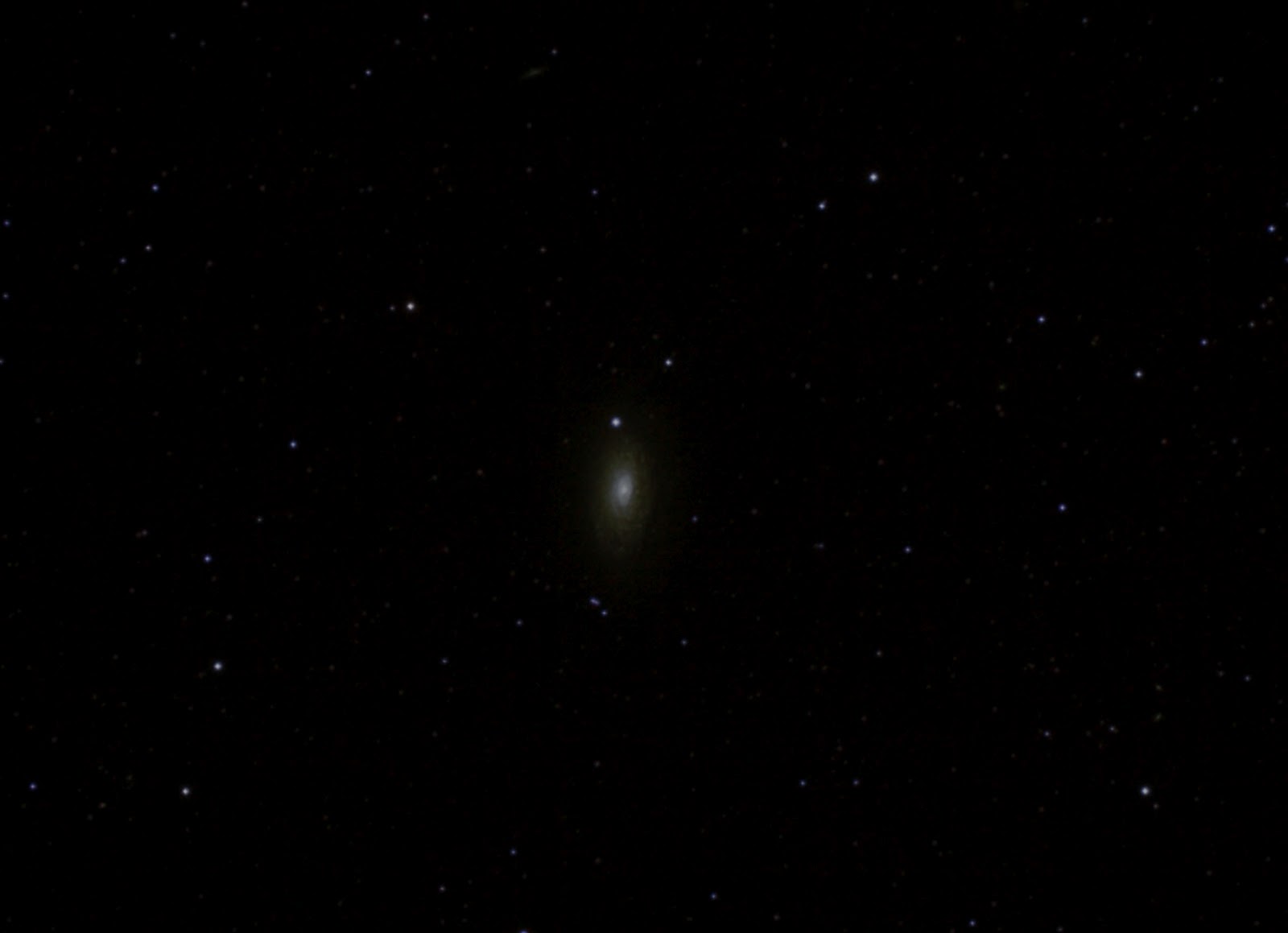
The first clear night in 5 weeks. I was desperate to get out and roll back the roof. M63 was my target. A central disk surrounded by a wealth of short spiral arm segments. A cropped 30 x 2 minute guided exposures at Iso 800. I am not really happy with the image. Sky quality was not amazing. I was just glad it was clear. I think a revisit will be required soon!

Monday, 2 April 2012

If it wasn't for bad luck

       I would have no luck at all. Is how the saying goes. Mystic Malc predicted a couple of weeks ago that we would indeed have a good week of clear skies last week. So we did, BUT I was not going to see any of them. Last monday to this Sunday inclusive was my first set of  nights on the night shift this year. Here continueth the run of bad luck.
      So if we skip back to last May I dismantled my observatory and packed everything away while we moved and of course missed Sn2011dh in M51 last June. Whilst I was building the new observatory last September I missed sn2011fe in M101.
      On the 23rd of Feb this year I imaged a wide field inc M95

and of course saw no Supernova See pic.Tonight is my first night at home again and guess what the clouds have rolled in. Am I destined to miss every Supernova.


To continue the run of misfortune. Last night 10/4/12 saw a reasonably clear. Google said the clear sky wouldn't last so I hastily set up and focussed on a set up star. Here in is where the problem lies M95 was a good 60 degrees across the sky and I completly forgot to refocus. Looks like a tenth of a mm out. But the good news is I have managed to get my first image of the sn2012aw.

Friday, 23 March 2012

Sombrero M104

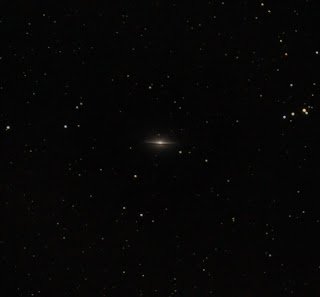
I have never imaged the Sombrero galaxy before. I was still quite low in the sky early Thurday morning I could only manage 13 Minutes before the realisation that I had work the next day. I will revisit and give a great deal more scope time on this wonderful galaxy. Anyway here is a cropped image just to say I have bagged another one.  Adios Muchacho's.

M101

M101 is relatively large 70% larger in comparison to our own galaxy. Lying approx 21 Million light years away. With over 3000 HII regions the galaxy is undergoing massive star formation.
My Image Is just 36 minutes composed of 12 x 3 minute unguided exposures at Iso 1600. Time was approaching 1.00am and some light cloud was approaching. I am always amazed at how much detail is captured on such a short lenth of exposure. I cant wait to get more!

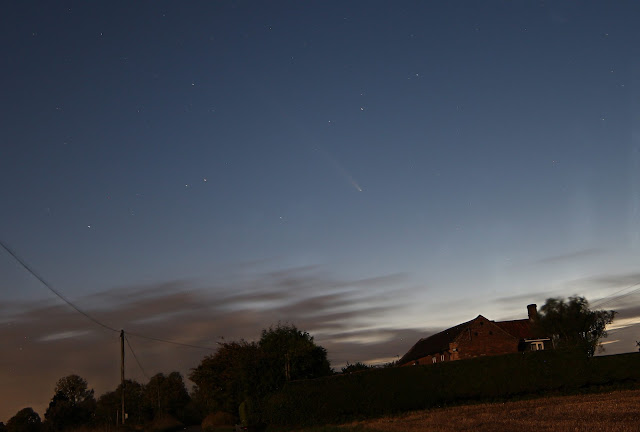
Comet Tsuchinshan-ATLAS, C/2023 A3 , Comet A3,

  A cosmic wanderer, Comet Tsuchinshan-Atlas or more commonly known as Comet A3 has traced its elliptical path through the solar system, a j...