Showing posts with label Ursa Major. Show all posts

Saturday, 12 June 2021

M101 The Whirlpool Galaxy

I dread galaxy season fearing I can never do it justice using a 100mm F5.5 refractor. However come summer I am never too disappointed and the collection of targets from the spring skies, This particular night a couple of months ago now I remember the east / southern  sky was very patchy and galaxies there were going to be a challenge, so I aimed near vertical and collected 295 minutes of light on M101. Definitely under processed as there is a lot more faint structure to tease out. 


I used my goto astro survey software Cartes du Ceil and fund several dozen 21st Mag galaxies. NGc5474 does not look to shabby either.

Wednesday, 12 May 2021

M97 & M108 The Whale & The Surfboard.


The owl and the surfboard. I have previously mentioned the astronomical names of objects often resemble what they look like. Two prime examples are M97 the Owl Nebula & M108 the Surfboard Galaxy. The Owl is a planetary nebula, (not a planet) but the violent death of an exploding star, ejecting shells of gas & material into space, Still expanding some 8000 years later at 35km per second, can you see the owls eyes? M108 the Surfboard Galaxy lies some 2000 times more distant at 26 Million light years. Another example of a Galaxy viewed edge on from our perspective and uncannily resembling a surfboard.


Thursday, 21 May 2020

M81 & M82


I have set the scope up and all is working well, One piece however was sent incorrectly, a critical piece to the optical train, Sky-Watcher manufacture a dedicated field flattener for the ED100. Unfortunately the one sent was for the Equinox 100 refractor. 


5 Hours total integration time in 3 minute sub frames calibrated and integrated in Deep SkyStacker. A very smooth result showing incredible detail in Ha from the cigar starburst galaxy. Estimated to be 100 times more luminous than our own Milky Way. 

It's incredible amount of star birth is though to have started with interaction with M81 in the distant past. 


_______________________


Who remembers the type1a supernova observed in 2014. I was lucky enough to capture it. I believe also it was the closest type 1a recorder in the last 40 years.


                      _______________________


Tuesday, 8 April 2014

Deep, Deep,Very Deep

My previous post of M97 & M108 required further inspection as I could see numerous faint fuzzies about 20 in all. I have highlighted the brightest in boxes and spent a great deal of time finding a desiganation for them. trawling through known to me and some obscure catalogues like MCG Morphological catalogue of galaxies, Holmber galaxies and the VV catalogue Vorontsov Velyanimov of interacting galaxies.

I was amazed to find a remote galaxy a bright one at that mag 14.6 named
MCG+09-19-018 A galaxy with active galactic nucleus, With a redshift of z=0.03475
we are Looking back time: 467 million light years a new record in distance capture for me.
Position confirmed again by Cartes du Ceil.
My image framed nicely with the glorius M108 shows this rather bright galaxy.
 
---------------------------------------------------------------------
Just when I thought it could not get any better.
 SDSSCGB 24289.1 breaks my distance record with a whopping 2.02 Billion light years. I can safely say that is the first time I have broken the billion light year barrier.
I have framed this small fuzzy against the Owl nebula. Position confirmed again by CDC


----------------------------------------------------------------------------
The best was yet to come.
 
 but my greatest surprise was a 20th mag capture of a distant, sorry I mean VERY VERY VERY distant quasar [VV2006] J111005.6+553532 confirmed in position by Carte du Ceil. This is certainly a record for me that will last a while capturing a z=3.54642 Redshift Quasar an incredible 11.9 Billion yes you read it correctly 11.9 Billion light years away. That equates without a great deal of maths, the light from the earliest universe when it was just 1.7 billion years old. To say I am stunned is an understatement. Framed again against M108 who seems to just get bigger. Is the faintest couple of pixels I have ever captured. No enhancement of this image exept levels & curves in Photoshop.


----------------------------------------------------------------------
I am just wondering what I can do next to top this.


Wednesday, 2 April 2014

M97 & M108

 First of all this will be my 200th post and I just want to thank all those who are new and regular visitors to my blog.

               Despite being circumpolar for us in the UK and visually through the scope an easily detectable pair I have never imaged The very photogenic pair of M108 & M97.
We will start with M108 (Ngc3556). It seems At 46 million light years away, There is a lot going on with this Barred spiral galaxy.  Viewed nearly edge on from our perspective. Close examintion shows expanding shells of hydrogen gas giving rise to many star forming regions. Chandra X ray observatory also detects a number of X ray sources hinting of an intermediate sized black hole in the galaxies heart.
 
Moving now 10,000 times closer we move within our own galaxy to the aptly named OWL nebula on M97 (Ngc3587) Discovered in 1781 early drawings were likened to an owl and known as that since then. A wonderful example of a planetary nebula, An expanding shell of material thrown off from a dying star around 8000 years ago. The progenitor star is around 14th magnitude and easily visible in my 2 hour capture.
Unfortunatly there seems to be a little interference from the nearby star Merak producing some definatly unwated light rays across the image. Other than that I quite like it .......Twit Twooo........

Saturday, 22 March 2014

M101 Galaxy

The Pinwheel Galaxy, M101, NGC 4547 was discovered in 1781. The observation was subsequently passed onto Messier who confirmed it's position and was one of his final additions to the catalogue. Estimated to be approx 70% larger than our own galaxy at a distance of 21 Million light years. I am happy with this capture of 3 hours 20 minutes in 20 minute sub exposures. calibrated in Maxim DL and processed in photoshop. Ha regions can be seen and I am very pleased with the detail all the way to the core of this beautiful showpiece galaxy.
 

Friday, 14 February 2014

A duo of galaxies & a supernova

Still shining bright supernova 2014j looks amazing.

Weather forecast for the next week or so pretty shocking again. I would love to capture it 1 more time as it fades into the background. I am very happy with the depth of detail captured.

Sunday, 26 January 2014

M82 Nova Wide field.

For 2 nights in a row we have been treated to clear skies. I have treated my camera again to the amazing supernova in the nearby galaxy of M82. I wanted a wide field shot of the area. Here is the result of 2 hours of exposure in 10 minute sub frames.

 
I am very happy with the dust lanes in M81. Dark dust visible circling the galaxy core.
 
Unfortunatly astronomy for the next week will take a back seat. I am working a set of nights from Monday bad timing with the moon out of the way.


Friday, 24 January 2014

Supernova 2014J

Sometimes the luck just holds. Well this time anyway. If you wander back through my blog or find my post on M95 april 2012. The avid nova watchers will remember the eruption in M95 sn2012aw. This happened just as I started at work a set of nights. We only do 2 sets a year and could not believe my misfortune in having to work when the skies were clear. Now go back a little futher to sept 2011 and sn 2011fe in M101. We were about to move and I had dismantled the observatory in preparation.

But not this time fellow bloggers. I had imaged m82 back in Oct testing out my new kit (left pic) and the wow amazing sn 2014J captured just last night 1 day after it's discovery. I am sure at this moment they are searching through Hubble archives to find the progenitor. We know already it is a type 1a and a few theories exist as to the fate of this white dwarf star.

Anyway here is my pic.

I am trying to do a blink comparison aswell. I will post it if I manage it. Any advice would be appreciated.

Sunday, 3 November 2013

5 hours processed M81,M82

I am getting to grips with the Starlight Express camera from using the DSLR. This is the first time I have captured 5 hours worth of data. Registered in Maxim DL and processed in Images plus. (Pixinsight trial ended the other day). I know I will revit the processing workflow for this one but here it is at present.


Saturday, 19 October 2013

Pixinsight Processing.

I don't mind admitting that Pixinsight is a difficult programme to get to grips with. I am currently running the 45 day trial. I am struggling with the preprocessing script. I have taken a series of 5 minute subs on M81,M82 over several nights. I made a small error and did not plate solve correctly and the 2nd night was not framed quite the same. As it happens that was the least of my worries. The first attempt was jus light frames only. Darks, Flats & Bias frames captured on night two. These images are from just those light frames processed by Andrew Luck at our Great Ellingham observatory. Andrew's skill in using Pixinsight is obvious to see, with the stunning wide field vistas he is producing. Please take a look at what his QHY9 is capturing at  http://blog.andrewluck.me.uk./ .
I had preprocessed with Image Calibration and Image Intergration to obtain a 3 hour exposure. I was amazed at how tight the stars were even when cropping. The new Ioptron IEQ 45 mount is astounding in it's guiding capabilities. I have a pic of a lovely even graph. (but I cannot find it)

Right so here we have a cropped image of the pair. There was a serious hot pixel problem which pixinsight gave a good attempt to remove despite no dark frame intergration. Andrew has followed a standard workflow to enhance the master frame. The real skill is knowing how much stretch, Tweaking, adjustment to make before thee next tool is used. I have tried with the same master. Not quite the same result. I also post on my facebook page and the Breckland AS page too https://www.facebook.com/?ref=home#!/groups/176906152365752/ like and join the page to follow all my frinds images.
The processing of the M82 Galaxy was a real treat to watch as it emerged from the hidden data.
I hope you agree a fantastic piece of processing to
get such detail from the core. Testament to the
SXVm25c too. I would like to test the Canon 40d on the same subject to do a comparison in the depth of detail captured. Please ignore the hot pixels. I am still struggling to remove them despite now having the darks. I mentioned earlier that I was trying to get to grips with the preprocessing script. It / I have an issue with my flat fields. It will not accept there is a signal there and refuses to combine them to a master. I have now managed to create a flat manually. Next issue I have come across occurs with the light frames in the preprocessing script it debayers ok and now cannot locate any stars in the frame. I have tested the whole process using Maxim and everything combines with no issues.
 I would consider myself a patient / tolerenat person god know I need to be in my line of work. But I am just so frustrated with it. I feel at the moment somewhat demoralised by the lack of consistent workflow guides and explanations given on various web pages. I seem to get problems in every step or script I try. Very pleased again with the detail in and around the core. Don't get me wrong it is an amazing piece of software. I am sure there are many who are in the same boat as me. I would like to hear from anyone who is? By now I was desperate to combine those new light frames giving me a total of 5 hours of light. I ran the whole set through Maxim and the flats really make a difference from the vignetting I could see on the 3 hour master. I have yet to play with it using the pixinsight processes but I will not be defeated and will post an update. Watch this space..........I have never using the old set up been capable of 5 hours worth of usable data. Even the smallest of stars are perfect. Sorry for banging on about it but this has really impressed me and I think given me a platform to produce some future stunning images. So in conclusion I am down, but certainly not out, the Jury is out and a verdict no yet reached. How many days of the trial left ?????


Thursday, 3 October 2013

Old favourites

The new set up is better than I would have hoped. Shame the skies have not been so cooperative. However last friday was beautifully clear. I wanted to capture and old favourite a target I was familiar with to put the scope & camera to the test. Guiding was absolutely flawless, sub pixel guiding for ever 3 hours. Captured in 5 minute subs these are the hugely cropped images of M81 & M82 processed in pixinsight by fellow blogger Andrew. It was amazing to see the workflow used by Andrew to pull out the detail in the pair of galaxies. I have also darkened the sky background.


I have a small issue with hot pixels which will be addressed, but I just wanted to get some photons on that CCD. I also have a William Optics 50 mm finder scope which other astrophotographers have used their guider. I think I will have a go and use the GT81 with the 40D Canon. I hope you liking the first results.

Friday, 23 March 2012

M101

M101 is relatively large 70% larger in comparison to our own galaxy. Lying approx 21 Million light years away. With over 3000 HII regions the galaxy is undergoing massive star formation.
My Image Is just 36 minutes composed of 12 x 3 minute unguided exposures at Iso 1600. Time was approaching 1.00am and some light cloud was approaching. I am always amazed at how much detail is captured on such a short lenth of exposure. I cant wait to get more!

Saturday, 5 June 2010

M81 & M82 Again


I never get bored of these beautiful galaxies nestling themselves about 12 million light years away M81's (ngc 3031 Bodes Galaxy) A near perfect arm structure circles all the way to it's core. I can also see a 3 dimensional structure like water going down the plug hole to be swallowed up by a raging black hole of about 70 million solar masses. However only one super nova found in recent years found in 1993.

M82 (cigar galaxy ngc3034) also positions itself at the same distance. Recently well about 200 million years ago the pair were interacting resulting in a large amount of gas being funneled into its core. Also known as the starburst galaxy as it produces stars at a rate 10 times faster that our own Milky Way.

The 3rd member of the group the much smaller and fainter NGC 3077 @ mag 10.6 has a very fine wispy structure this is a result of again tidal interaction between its parents many millions of years ago.

I can also confirm a few more faint fuzzies as you can see from my labelled picture.
down to an amazing mag 15.6 Unheard of from an amateur just 10 years ago.

M81 & M82 2 Hours

Hi again all,
Had a great night of clear skies again last night so from midnight I captured another 1 hours worth of photons. Again we have 60 x 1 minute exposures unguided and a master produced. I then combined both masters and done a little cropping due to camera alignment. Had to remove as we had our daughters 8th birthday party to capture. I am preety amazed at the result stars image is a little smoother and stars rounder too?

Thursday, 3 June 2010

M81 & m82

Hi Everyone,
Had some good news on the work side of life. I will moving my shift pattern onto days by July. Finally I will become an astronomer again. Have a new nickname from the family too bless em I am now known as Astro Geek. On a week of rest this week cant get my sleep pattern right either probably due to an enormous wisdom tooth excavating through the side of my face. Good news is its coming out Monday morning after a 12 hour shift.

Enough of my woes. Here's the good stuff.

Went outside last night and the weather man said it was going to be clear so I believed him and rolled back the roof of the observatory and let the scopes equalize

I had a re balance and alignment done a month or so ago. I done a couple of test shots to focus etc. I set Images plus to 60 x 1 minute unguided exposures.

I lost a couple of shots over the course so here is a 58 minute taken in JPEG no flats no bias or darks as I had to bin them all due to the new field flattener.

My aim is to go out tonight and do another hours worth and see what that looks like when co added. So here is the first hours worth. Beware this could fall flat on its face and all I end up with is this image.

</

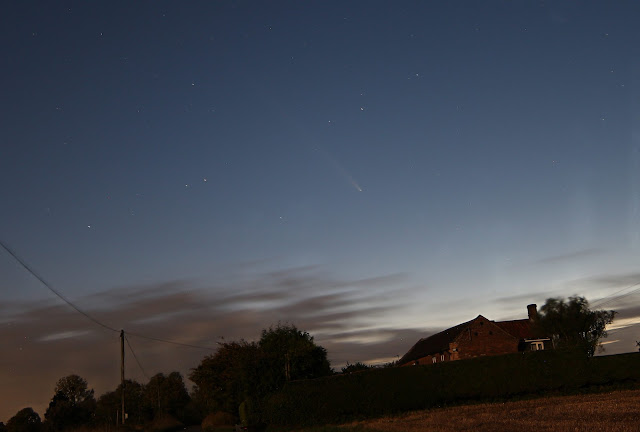
Comet Tsuchinshan-ATLAS, C/2023 A3 , Comet A3,

  A cosmic wanderer, Comet Tsuchinshan-Atlas or more commonly known as Comet A3 has traced its elliptical path through the solar system, a j...