AVI capture at just 4 frames per second, hardy a high frame rate but best 90% of 300 frames for each


A rework of a previous capture. Using the new to me Arcsinh Photoshop curves processing. A piece of software designed for PIXinsight. Can be found here. Photoshop Colour Preserving Stretch (markshelley.co.uk) Along with a fantastic explanation and several You tube videos showing it's use. A great one from Astro Ed (1) Astrophotography: The ABSOLUTE BEST way to STRETCH your Astro Image data in Photoshop [PS]! - YouTube demonstrates some new techniques for the teasing of data from images, especially keeping those stars small too. I used two itterations and combined it with a Starnet++ frame. Not the cleanest of data but great fun to play with. 
A last look at the Great Orion Nebula for a few months. Unfortunately for me it disappears behind the front of the house about an hour past the meridian so a very limited window of capture now in March.
Anyway a short capture of 20 x 180 and 20 x 30 seconds images taken with the ASI294mc pro on the ED100 via the ASI AIR Pro. Calibrated and stacked in Deep sky stacker and processed in Photoshop. I am always amazed how smooth the result is and even with a huge crop on the Trapezium the resulting image is incredibly clean. One confession to make though for the pixel peepers, the 4 stars of the Trapezium have been made round removing slight halos from processing.


 Some recent captures under less than average seeing. Using my ZWO ASI120MC camera and the clubs Celestron C9.25 with a 2x Barlow lens. Captured at 11 frames per second approx 90 seconds of recoding to avoid image rotation. The best 50% of frames captured was the result. My best capture of the Great red spot I like the small white disturbance into the south equatorial belt, that defines the red spot nicely. I can also see some lovely striation detail to the North Belt. I am pleased with it despite the seeing, but not as happy as I would like when seeing some of the other jupiter images posted on Facebook groups. I will of course endeavour to get a little more each capture and produce an image worthy of publicaion.
 I am very happy with this image capture of Jupiter and Ganymede. A steadier atmosphere gave a small improvement to the overall image quality. Captured to the right is Ganymede. It looked like a horrible blur at first. An RGB realign later has given a pleasing result to it's disk. I also gave a small increase in colour vibrance and some contrast adjustment. Some distinct patterns in the north & south temperate belts can also be seen. I have a few more Avi's to process and I will add to this post if anything new comes from them..
 Sunday was a day of work for me. Finished early enough to roll back the roof for what was about an hours break before the clouds rolled across at around hrs. This is the first time I have used my William Optics GT 81 triplet refractor for lunar imaging. The focusser on the scope is wonderfully smooth and allowed a quick set up. Imaging at f11.8 I am pleased with detail. Registax calibrated using 70% of the best of 1500 frames. Processed in Photoshop with a layers mask overlay to increase contrast. A high pass filter also used to selectively sharpen. Width across the image approx 1000 km. Centred is my favourite crater on the surface "Plato" Age is anything from 3.2 to 3.8 billion years old. A perfct circular shape has obliterated what was a mountainous area. Appearance in the centre is of a smooth surface formed by lava. There are craters in the central area, not visible at this focal lenth. High walls and steep slopes of 2000 metres are almost perfect aprt fromon the left edge is a partial collapse. I have also neglected to change the image to B & W I like the contrast from the imbrium basin.


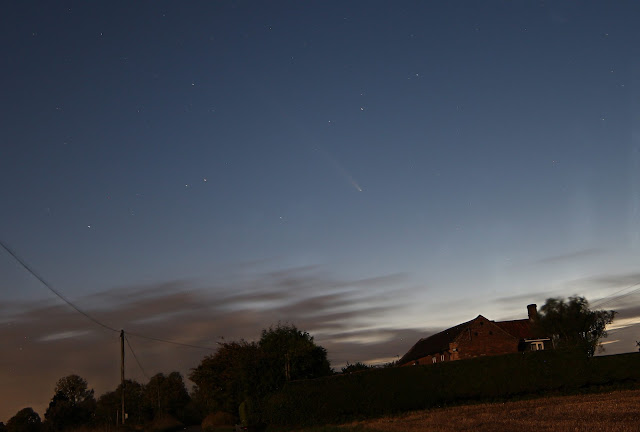
A cosmic wanderer, Comet Tsuchinshan-Atlas or more commonly known as Comet A3 has traced its elliptical path through the solar system, a j...