Wednesday, 27 October 2010

The Moon

Well this is the first clear night in the first 12 days of my holiday, so I thought I would have a go at the moon. I thought I might take 100 shots crop them in Images plus and Registax them together.
Just a small reduction in brightness and an increase in contrast.

Result 76 frames. Images taken ISO 100. 1/160 sec each. At a mean distance of 236.305 Miles

Saturday, 23 October 2010

M33 The Pinwheel galaxy

I took this pic on the same night as M45 (below). With a great deal of humidity in the air. This was taken before M45 and is just a small stack of 35 x 1 minute exposures at Iso 800 Unguided. It was really just a test of focus and balance really so I wasn't serious about this set. As the night previous I had run a sequence on M37 and M38, having taken a couple of hours worth of photons on processing to find focus was out by probably one tenth of a mm "gutted" Me thinks an electronic focuser is on my christmas list?


With a diameter of about 50,000 light years, the Triangulum galaxy is the third largest member of the Local Group, a group of galaxies which also contains the Milky Way Galaxy and the Andromeda Galaxy, and it may be a gravitationally bound companion of the Andromeda Galaxy. Triangulum may be home to 40 billion stars, compared to 400 billion for the Milky Way, and 1000 billion stars for Andromeda.

Monday, 11 October 2010

M 45 Revisited

     As I mentioned previously I am returning to those treasures that I had previously captured using my Canon 300D. After a wonderful clear sky day at the zoo with my family. I wanted to get what could be the last trip outside before my training starts, and that will mean well into Jan before another opportunity comes along.

So here is the result.

There was a 86% humidity last night so the dew heaters were working overtime but did their job well.

    This image is a stack of 61 x 1 minute Iso 800 unguided exposuress in RAW. No darks or other calibration files used.
I may even have another go with the Lumicon deep sky filter on too?

    I can see a gradient across the image but do not posess the gradient remover tool. Contains a good DDP stretch . This is the first run of this set so I may return and update it if I get chance to look at what else I can do in Images plus. I have the untouched master Tiff file is anyone wants to have a go with it too just drop me an email.

I am quite pleased with the result the wispy tendrills are much more pronounced around Merope and Maia. Everything about the image is a good deal more natural I also like the horizontal shock waves under Electra.

PS poor jpeg compression . I will look at it when I can.

Thursday, 7 October 2010

NGC 891


NGC 891 is an edge-on unbarred spiral galaxy about 30 million light-years away in the constellation Andromeda. It was discovered by William Herschel on October 6 1784. The galaxy is a member of the NGC 1023 group of galaxies in the Local Supercluster. It has an H II nucleus.

I am not sure if things are working correctly you know?

Since I done a custom white balance using the Deep Sky Filter. When I return to auto white balance and remove the filter the results are very blue and a significantly reduced number of stars are recorded almost as if the filter was still in place. I had to almost remove blue from the processing to get a reasonable pic. I also get blue halos around stars!! Is there some step I am missing. It has been a while since I have been doing any telescope time but I just cannot get my head around this. Next step is to reset the camera back to factory status. ( daylight pics seem fine though aghhhhhhh !!!!!

I have to disappear on the 15th Nov for 8 weeks training so I fear this winter is not going to be as productive as I had hoped.

Tuesday, 5 October 2010

Heavens door


Mrs Rae Diane Dent

31st Oct 1930 - Sept 1st 2010.


 Mum, I will see you face in the stars forever.

Be safe and happy with your son Andrew and husband Raymond.

Until we all meet again Goodnight and Godbless.

The sun came up this morning;
It wasn't vey bright.
My dark mood cast a shadow;
It's hard to see the light.

We all have just one mother
And, now that her life on earth is done,
The emptiness and loss I feel
Make it hard to see the sun.

Tomorrow is a brand new day;
May the pain and sadness lighten.
I will remember all her love,
And the sky will brighten.

Gone is not forgotten;
Her love remains behind;
She's traveled in a new direction,
Love know no space and time.

Mum you know I love you.
She will care for me from above.
She will send me starlight and rainbows
To remind me of your love.


Saturday, 14 August 2010

Persied Meteor 2010

     We have spent the last few days down in Yeovil, Somerset visiting family far away from the clear skies of Norfolk.
     We all had a wonderful day at Longleat safari park too as I watched the skies clear above us on the drive back. The plan was to just sit the camera on the tripod and shoot from the back garden. A few test shots revealed a lovely orange sky. I decided there and then to get away. About 6 miles from Yeovil is a beautiful and reasonable dark site on top of Ham hill in Stoke Sub Hamden. I arrived at 11.30 pm to a car park full of meteor watchers. I found a quiet corner and started to shoot. We had an amazing view to the south Sagittarius was easily visible as the teapot sank below the hill and the milky way arched across the entire sky. Most of the cars disappeared about midnight and left me and another chap clicking away and chatting. We saw some amazing meteors that left a trails of smoke for sometimes 15 seconds after but annoyingly never in the direction of where our cameras we pointed. However I did capture this one flashing through Camelopardalis at 01:16:56 again leaving a trail of smoke behind it. I did capture about 30 others but none as bright as this one.

Cant decide if its worth sending to one of our publications.

Friday, 6 August 2010

In a galaxy far far away

I was saying the other night to a fellow member at our societies observatory that I shall spend the rest of the summer taking obscure faint fuzzies as most of the big and bright objects have been covered. Then Barry says well there is always room for improvement. True I said especially as I now have the field flattener so I think it may be the time to improve on a few of the objects previously imaged and cropped considerably because of coma. I was going to image the Cocoon nebula last night then realised that imaging at the near verticle will cause the camera to hit the mount. I could see the Andromeda galaxy naked eye well above the neighbours rooftop so I thought yeah lets have ago. Seven seconds later I was focused and set up a run of 90 pics. I didnt bother firing up the guider as I have no problems with 60 second exposures when facing east.

Comparing it to the previous image a bit further down the blog I am very pleased that there has been no cropping and a greater depth of focus has returned a very pleasing result.


Object: M31 The Andromeda Galaxy


Type: Galaxy

Constellation: Pegasus

Instrument: William Optics Megrez 90mm, William Optics MkIII field flattener.

F/stop: 5.52

Exposure: 1 hour 23 minutes

IS0: 1600

Date: 05/06/Aug/2010

Location: Saham Toney Norfolk.
Enhancement: Images Plus 3.82 DDP stretch and 3 Sharpening iterations.

Sunday, 1 August 2010

NGC 7000 With UHC Filter

Hi everyone,

I am enjoying my 3 weeks off 1 down 2 to go Daddy day care is fun!!(most of the time) although last night was the first night outside since last Saturday. First off I have solved the little mystery of the failure of guide camera and dew heaters. The power supply / charger for the power tank had broken. So each time I thought I was charging nothing happened and of course the voltage dropped below usable and caused equipment failure. All working fine now.

Went out at about 9.00 pm to test the bahtinov mask kindly supplied by fellow member and manufacturer of these fine items. Made to a professional standard with precise laser cutting of the material providing extremely sharp focus spikes to allow quick and easy focus. Less than 10 seconds I think. Please see Keiths page on my list of fellow bloggers and get ordering they are worth every reasonably priced penny.

This time I thought I would complete my little task of taking NGC7000 again this time with the UHC filter in place. I was very pleased with the result showing the true colour of the Hydrogen Alpha line emissions.

This stack is of 38 X 1 minute unguided subs with no dark calibration / flats or bias frames used.
Stacked in deep sky stacker and a DDP stretch in Images Plus. No additional colour enhacement but I will have a play and if its worthy of posting I will let you see in due course. Let me know what you think comments are always welcome.

Sunday, 18 July 2010

Ngc 7000 North American Nebula

I have a couple of weeks holiday at the moment and Saturday was the first night with a decent clear stable sky. Powered up everything to find the red dot finder battery flat. (oops that was me) the Atik guide camera stopped working. Unable to download an image??? and the dew heaters stopped working just a yellow light .Great night this is going to be. Done a quick 2 star alignment and had a quick look at a few deep sky delights via the Canon. Started with some favourites to ease my pain like M27 and M71. Took a slow slew over to M11 and M26 found a couple of lovely ngc open clusters. Then headed towards M16 damn just obscured by the roof of the observatory. Not a good time of night to see it for me. So I headed back to Cygnus and had a good look at Everybody's favourite Alberio. finally moved across to The North American Nebula. I took about 10 minutes worth of data a month or so ago done a quick process to it and nothing highly dissapointed with the lack of colour. So I set up a quick run of 20 x 5 minute exposures, as I have no guiding capability tonight, and done a little deep sky stack on them. No lats or darks and I even took them in JPEG I know stop swearing at me. I didnt really have any intention of doing anything with them after last time so wasnt really expecting a great deal. Any way enough rambling from me here are a couple of pics. i think I like the negative better very pleased with the accuracy of the mount giving round stars. and a good flat field. Enjoy


Saturday, 5 June 2010

M81 & M82 Again


I never get bored of these beautiful galaxies nestling themselves about 12 million light years away M81's (ngc 3031 Bodes Galaxy) A near perfect arm structure circles all the way to it's core. I can also see a 3 dimensional structure like water going down the plug hole to be swallowed up by a raging black hole of about 70 million solar masses. However only one super nova found in recent years found in 1993.

M82 (cigar galaxy ngc3034) also positions itself at the same distance. Recently well about 200 million years ago the pair were interacting resulting in a large amount of gas being funneled into its core. Also known as the starburst galaxy as it produces stars at a rate 10 times faster that our own Milky Way.

The 3rd member of the group the much smaller and fainter NGC 3077 @ mag 10.6 has a very fine wispy structure this is a result of again tidal interaction between its parents many millions of years ago.

I can also confirm a few more faint fuzzies as you can see from my labelled picture.
down to an amazing mag 15.6 Unheard of from an amateur just 10 years ago.

Comet 2009 R1 McNaught

Congratulations go to Rob McNaught this is his 51st comet discovery during the course of the Siding Springs Survey. Expected to get another couple of magnitudes brighter by the end of the month just about when us Brits lose it.

I had a quick go the other morning around 2.45 when the moon was up and it had just risen over a neighbours rooftop. Knowing my luck the next week set of nights off I get will all be cloudy so get it while yuo can!!

Here is a stack of 6 x 30 second exposures at ISO400

Not an amazing pic but just glad to have seen it. Enjoy while you can.

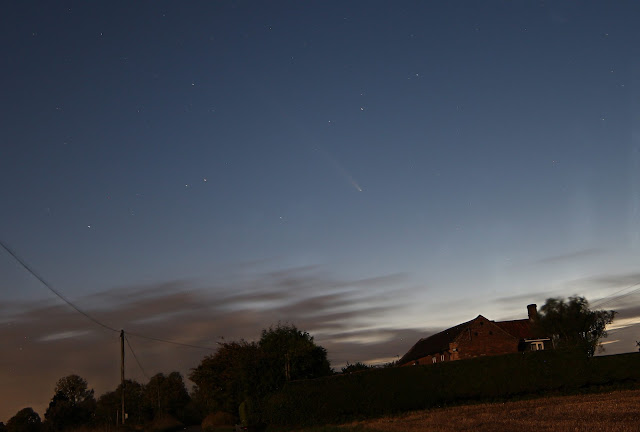
Comet Tsuchinshan-ATLAS, C/2023 A3 , Comet A3,

  A cosmic wanderer, Comet Tsuchinshan-Atlas or more commonly known as Comet A3 has traced its elliptical path through the solar system, a j...